
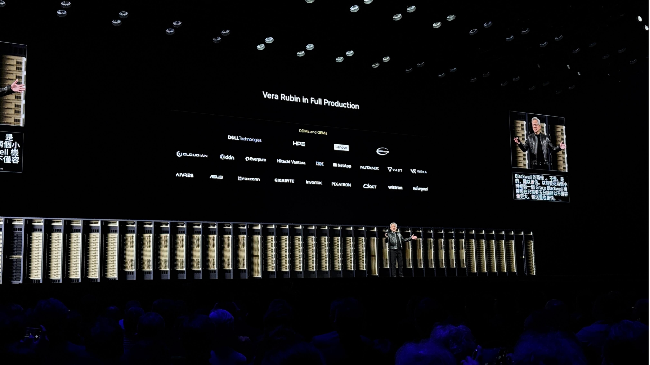
Nvidia CEO Jensen Huang announced Monday that the company’s highly anticipated next-generation AI accelerator, Vera Rubin, has entered full production. During his GTC Taipei keynote, Huang confirmed that high-bandwidth memory (HBM) modules from industry leaders Samsung Electronics, SK Hynix, and Micron will power this advanced platform.
While the selection of these three key memory suppliers was largely anticipated, the Computex trade show keynote in Taipei solidified a critical milestone: the Vera Rubin chip has officially transitioned from its development roadmap to high-volume production. This move definitively establishes the specific orders secured by each memory manufacturer.
Analysis of these confirmed orders positions SK Hynix as the leading supplier. Industry estimates suggest SK Hynix will account for approximately 60 to 70 percent of Nvidia’s HBM4 volume for the initial Rubin launch, a dominance built upon its strong performance in supplying the current generation of AI accelerators. Samsung’s share is projected to be around 25 to 30 percent, with Micron securing a smaller, supplementary allocation.
For Samsung, this represents a significant resurgence in the competitive HBM market. After facing challenges in keeping pace with SK Hynix in HBM development, Samsung successfully passed Nvidia’s stringent qualification tests for the 10 and 11 gigabit-per-second data rates required by the Rubin design. The company began shipping its advanced 12-layer HBM4 early this year. Securing a substantial quarter or more of the orders for Nvidia’s pivotal AI platform signals a strong recovery and a regained foothold in this crucial segment.
High-bandwidth memory (HBM), a sophisticated stacked memory technology vital for feeding data to powerful AI processors, is a focal point of intense competition between Korea’s two leading chipmakers. The financial stakes in this market continue to escalate rapidly. Morgan Stanley estimates reveal that the memory component now constitutes a staggering 435 percent higher share of the total parts cost for a Rubin rack compared to the previous generation of AI systems.
The innovation race within the HBM sector shows no signs of slowing. Samsung has already commenced shipping early samples of HBM4E, its seventh-generation memory, designed specifically for the upcoming Vera Rubin Ultra platform, which is anticipated for release in late 2027.
Further underscoring the strategic importance of this technology, Jensen Huang is scheduled to travel to Seoul this week. He is expected to meet with the chairmen of Korea’s largest conglomerates, including SK Group Chairman Chey Tae-won, with discussions on advanced memory technologies anticipated to be a key agenda item.
mjh


