Samsung Asset Management made a landmark announcement on Tuesday, revealing the launch of Korea’s inaugural single-stock leveraged products. These innovative financial instruments are specifically tied to industry giants Samsung Electronics and SK hynix, set to debut on Wednesday.
The firm is set to list the highly anticipated Kodex Samsung Electronics Single Stock Leverage and Kodex SK hynix Single Stock Leverage products. These offerings are meticulously designed to provide investors with amplified exposure, aiming to deliver twice the daily returns of their respective underlying shares.
Demonstrating immense market demand, these two pioneering products collectively attracted an impressive 2.4 trillion won (approximately $1.6 billion) in assets under management even before their official launch. This staggering figure establishes a new record for the largest-ever ETF product debut in Korea’s financial history. Specifically, 1.07 trillion won was allocated to the Samsung Electronics products, while 1.37 trillion won was committed to the SK hynix offerings.
A key distinguishing feature, Samsung Asset Management highlighted, is that these products diverge significantly from traditional leveraged structures. They primarily achieve their objectives through direct spot holdings rather than complex futures contracts, a strategic approach that effectively mitigates rollover costs typically associated with extending futures positions monthly.
Lim Tae-hyuk, Managing Director of Samsung Asset Management’s ETF Management Division, emphasized that this innovative structure also grants the firm enhanced flexibility to navigate evolving spot and futures market conditions. Furthermore, it enables the generation of valuable dividend income directly from their strategic stock holdings, adding another layer of investor benefit.
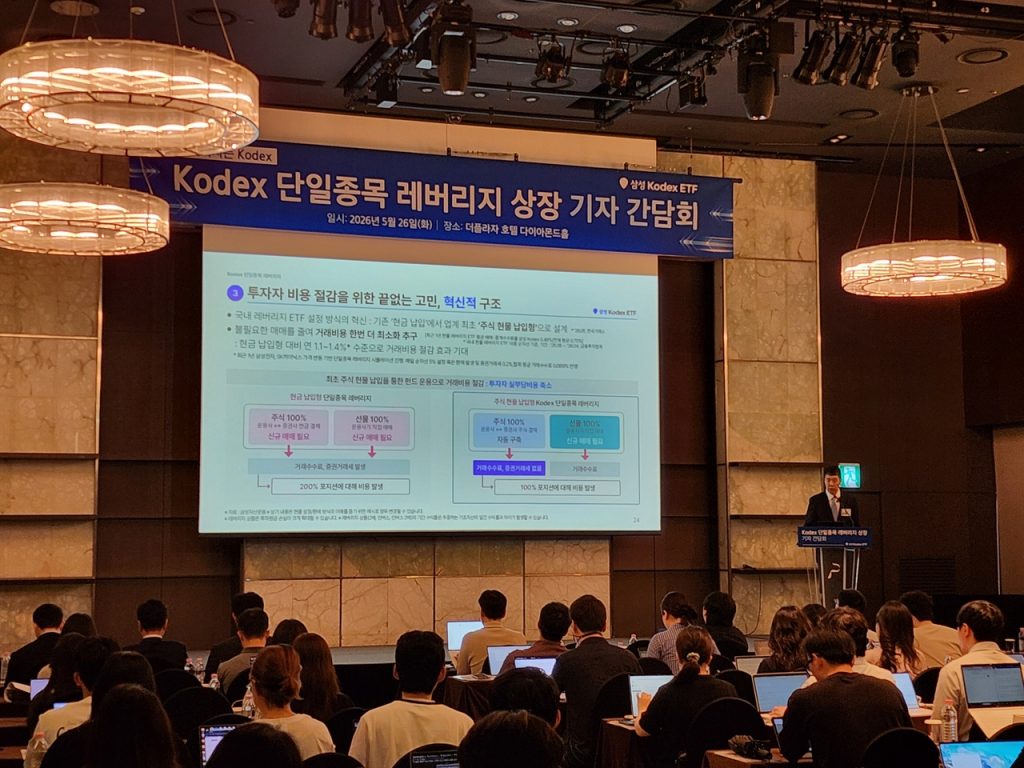
Further underscoring its leadership, Samsung Asset Management is also the first in Korea to implement an in-kind creation and redemption structure for these leveraged single-stock products, moving away from conventional cash-based models. This pioneering approach is expected to streamline operations and offer distinct advantages.
This advanced structure is projected to significantly reduce annual trading costs for investors, potentially by 1.1 percent to 1.4 percent. These savings are realized through the reduction of brokerage commissions and securities transaction taxes, making these products more cost-effective.
To ensure robust market performance and optimal trading conditions from day one, Samsung Asset Management has successfully secured an unparalleled network of 25 authorized participants and 15 liquidity providers. This formidable alliance, the largest in the industry, is poised to bolster trading liquidity and maintain tighter bid-ask spreads, benefiting all market participants.
The introduction of these cutting-edge products aligns perfectly with recent developments, as Korean financial regulators have progressively opened the market to single-stock leveraged and inverse products. This regulatory evolution specifically targets highly liquid blue-chip shares, signaling a new era for sophisticated investment options.
Mr. Lim also noted that while foreign omnibus accounts are presently restricted from investing in certain ETFs due to existing regulations, anticipated future regulatory changes could significantly contribute to channeling greater international capital into Korea’s dynamic domestic market.
It is crucial for investors to acknowledge, however, that financial authorities issued a clear warning on Tuesday: these products inherently carry significant risks. Due to their leveraged nature, potential losses can be sharply amplified during periods of heightened market volatility, necessitating careful consideration.
To ensure clarity and proper differentiation from conventional exchange-traded funds, regulators have explicitly prohibited the use of the term “ETF” within the names of these new products. Instead, they mandate the distinct label “single stock,” underscoring their specific investment focus.
ch0221