Samsung Faces Historic Full-Scale Strike Amidst Intense Debate on Government Intervention
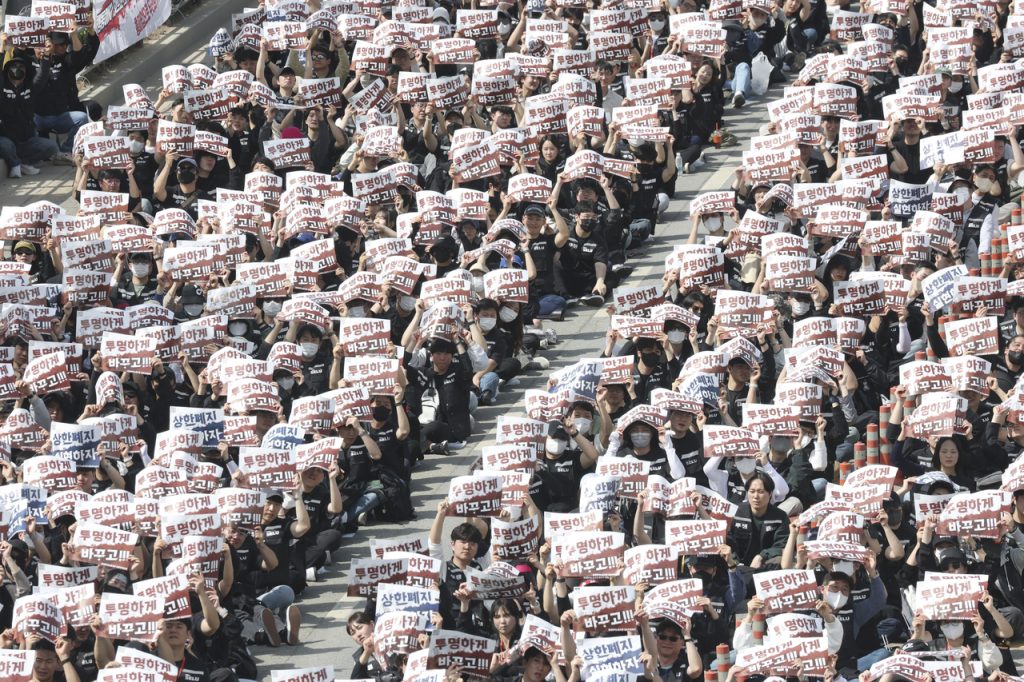
Samsung Electronics, the global tech giant, is on the brink of its first-ever full-scale strike, as its largest labor union moves forward with an 18-day walkout plan. This significant industrial action threatens to disrupt critical production within the heart of Korea’s influential chip industry, sending ripples through the global supply chain.
The possibility of a widespread strike became more imminent following the breakdown of last-ditch negotiations. Talks mediated by the National Labor Relations Commission concluded without a breakthrough early Wednesday, solidifying the union’s commitment to its fixed strike timing and duration. This leaves minimal room for a swift resolution unless a major concession is made by either party in this high-stakes labor dispute.
Central to the ongoing conflict is the union’s demand for the institutionalization of a performance bonus equivalent to 15 percent of Samsung’s operating profit, alongside the removal of the current bonus cap. This compensation dispute has escalated into a pivotal moment for the company.
The Samsung labor dispute has garnered significant international attention due to the company’s immense global standing. As the world’s largest memory chipmaker, Samsung sits at the epicenter of Korea’s robust export economy and plays a crucial role in the global AI chip supply chain. Any prolonged industrial action could have severe consequences, impacting production schedules, export volumes, investor confidence, and the intricate network of Samsung’s suppliers. JPMorgan recently highlighted these concerns, warning that an extended strike could notably weigh on Samsung’s annual operating profit projections.
Given that semiconductor fabrication plants (fabs) operate continuously, even limited disruptions can significantly derail production schedules. Furthermore, uncertainty surrounding the output of high-bandwidth memory (HBM) and other AI-related chips, crucial components for advanced technologies, could directly affect delivery timelines and undermine customer confidence in Samsung’s reliability.
Estimates from experts underscore the immense potential financial damage. Song Heon-jae, an economics professor at the University of Seoul, indicated that a shutdown of Samsung’s production lines could incur costs of “tens of billions of won, or tens of millions of dollars, per minute,” potentially reaching as much as 1 trillion won ($670 million) per day. Industry analysts have projected that the direct economic damage from a full-scale strike could range from 20 trillion won to 30 trillion won.
This severe economic threat has brought into sharp focus the potential invocation of emergency arbitration, one of the Korean government’s most potent tools for resolving labor disputes. Under Korea’s labor law, the labor minister holds the authority to invoke emergency arbitration if a strike is deemed likely to endanger public life or cause serious harm to the national economy. Once this measure is enacted, the striking union is legally compelled to cease all industrial action and is barred from striking for up to 30 days while labor authorities proceed with mandatory mediation or arbitration.
Historically, emergency arbitration has been an exceptionally rare measure in Korea, utilized only four times. Past instances include a 1969 strike at The Korea Shipbuilding Corp. (now HJ Shipbuilding and Construction), a 1993 strike at Hyundai Motor, and strikes by the pilots’ unions of Asiana Airlines and Korean Air in 2005.
For the Korean government, the decision to intervene with emergency arbitration is both politically sensitive and legally complex. While a prolonged Samsung strike undeniably poses significant national economic risks, emergency arbitration is an exceptional legal tool that inherently limits workers’ fundamental right to collective action.
Government officials have expressed grave concerns. Deputy Prime Minister and Finance Minister Koo Yun-cheol emphasized on X (formerly Twitter) that “a strike must not happen under any circumstances.” Labor Minister Kim Young-hoon echoed this sentiment, stating that the government would exert its utmost efforts to facilitate further talks and prevent the dispute from escalating into a full-blown strike.
Legal and labor experts remain sharply divided on the appropriateness and necessity of government-invoked emergency arbitration in this specific Samsung labor dispute.
Park Ji-soon, a professor at Korea University School of Law, highlighted the unusual nature of the union’s demand for a fixed bonus tied to operating profit. He asserted, “A general strike at Samsung Electronics would have an enormous, indeed catastrophic, impact on the national economy. The government needs to consider invoking emergency arbitration as a last line of defense to protect the national interest.”
Conversely, Jung Heung-jun, a professor at Seoul National University of Science and Technology, disagreed, advocating that emergency arbitration should be reserved only for truly exceptional circumstances. Jung commented, “It is difficult to regard the Samsung union’s strike as illegal at this point, so applying emergency arbitration would not be appropriate or justifiable.”
Adding another layer of complexity to the situation, a pending court ruling, expected before the scheduled walkout, could significantly influence the union’s scope for action. The Suwon District Court is currently reviewing Samsung’s request for an injunction against what the company deems unlawful industrial action by the union.
Should the court grant part of Samsung’s request, the union could face legal limitations on how it conducts the strike or organizes rallies at worksites. Conversely, if the request is rejected, the union could gain further momentum and leverage heading into the planned May 21 walkout.
The court’s decision is anticipated as early as Thursday, with a final ruling expected no later than May 20, just one day prior to the scheduled start of the historic strike.
Despite these legal challenges and the potential for government intervention, Samsung union chief Choi Seung-ho remains resolute. He stated, “Even if part of the injunction is accepted, there will be no problem with the strike itself.” Choi further indicated that emergency arbitration would “only delay the strike a little” and ultimately grant the union “more time to prepare,” suggesting their resolve remains firm.
yeeun