
Policy surrender payouts rise as savings-bank deposits hit 4-year low
South Korean investors are increasingly withdrawing funds from insurance policies and traditional savings accounts, channeling their capital into the burgeoning local stock market rally in pursuit of higher returns.
Data released Monday by industry sources reveals that policy surrender payouts at South Korea’s three largest life insurers—Samsung Life Insurance, Hanwha Life Insurance, and Kyobo Life Insurance—soared to 4.9 trillion won ($3.3 billion) in the first quarter. This represents a significant 16.3 percent increase compared to the same period last year.
This upward trend signifies a growing willingness among policyholders to terminate their insurance contracts prematurely, often incurring a loss, as they actively seek more lucrative opportunities in the equity market. Policy surrender value refers to the amount an insurer returns to a policyholder upon early cancellation, which is typically less than the total premiums paid over time.
The surge was particularly pronounced in savings-type insurance policies, where surrender payouts escalated by 23.2 percent year-on-year to 2.29 trillion won. Designed to return premiums and interest as a lump sum or annuity at maturity, the accelerated cancellation of these stable savings products indicates a clear shift in household investment strategies towards riskier, higher-yield assets.
“There is a discernible movement of capital as consumers surrender policies, even at a loss, to pursue greater returns in the securities market,” commented an industry official. “While similar patterns have emerged during previous stock market rallies, the current increase is still considered temporary and not expected to significantly impact insurers’ overall profitability.”
This dynamic shift in investor behavior is also reflected in the latest financial group earnings. Shinhan Life Insurance reported a nearly 40 percent drop in its first-quarter profit compared to the previous year, while KB Life Insurance experienced an 8 percent decline. In stark contrast, Shinhan Securities’ earnings more than doubled, and KB Securities’ profit surged by an impressive 93 percent.
Meanwhile, deposit outflows are intensifying across the banking sector, with savings banks actively raising rates in an effort to stabilize their funding bases.
According to the latest Bank of Korea data, savings-bank deposits have fallen to 97.93 trillion won, marking the lowest level in four years and four months. This balance has been in continuous decline since October, following a peak of approximately 105 trillion won in September.
This drop has occurred despite the average rate on one-year time deposits at the nation’s 79 savings banks climbing to 3.24 percent as of last week, the highest rate observed since January of the previous year, according to the Korea Federation of Savings Banks.
Historically, savings banks attract depositors by offering higher interest rates than their commercial counterparts. However, the recent decline underscores that even elevated yields are struggling to compete with the compelling momentum of the equity market.
The capital outflow phenomenon is now extending to major commercial banks as well. The combined outstanding balance of time deposits at leading institutions like KB Kookmin, Shinhan, Hana, Woori, and NH NongHyup reportedly decreased from 947 trillion won at the end of February to 935 trillion won in early May—a substantial reduction of approximately 12 trillion won in just over two months.
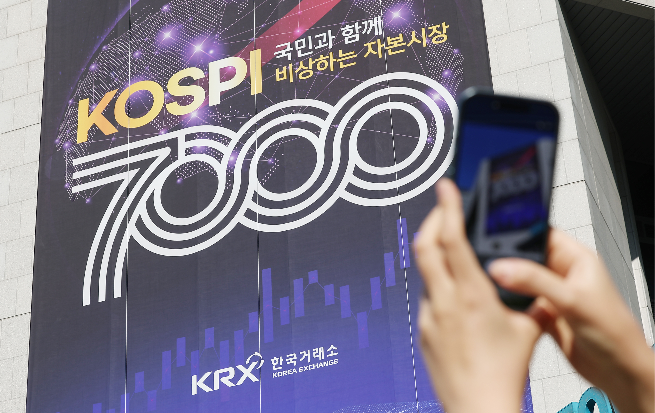
This significant decline in deposits coincides directly with the Kospi’s remarkable rebound from its March pullback and its subsequent surge to unprecedented records. After delivering a world-beating 76 percent gain in 2025, South Korea’s benchmark stock index soared as high as 6,300 in the first two months of this year, adding another 50 percent. It then temporarily dipped towards 5,000 in March amid rising Middle East tensions and oil prices, before rapidly recovering to cross the 7,000 mark in early May.
On Monday, the Kospi achieved another milestone, topping 7,800 for the first time intraday. This extends its impressive advance to roughly 190 percent from its 2,700 level at the close of 2024 and an 85 percent gain so far this year.
jwc


