Firm files court appeal to prevent strike; industry insiders warn of potential market share loss amid intensifying CDMO competition
The growth trajectory for **Samsung Biologics**, a global leader in **contract development and manufacturing organization (CDMO)** services, faces significant uncertainty as its first-ever **labor strike** threatens production schedules, client relationships, and its competitive edge in the **biopharmaceutical industry**.
The **Samsung Biologics labor union** has put forth demands including a 14 percent average wage increase, a 300 million won cash payout per worker, and a bonus equivalent to 20 percent of operating profit. In response, the company has reportedly offered a 6.2 percent wage increase.
While negotiations to find common ground continue, the Incheon District Court delivered a ruling on Thursday allowing the **strike** to proceed in part, despite **Samsung Biologics**’ request for a complete halt to the walkout.
The court explicitly restricted the **labor union** from suspending three critical processes essential for maintaining the quality of **drug products**: ultrafiltration and diafiltration, drug substance filling, and buffer preparation and supply. However, it affirmed that workers involved in cultivation and purification processes could participate in the **strike action**.
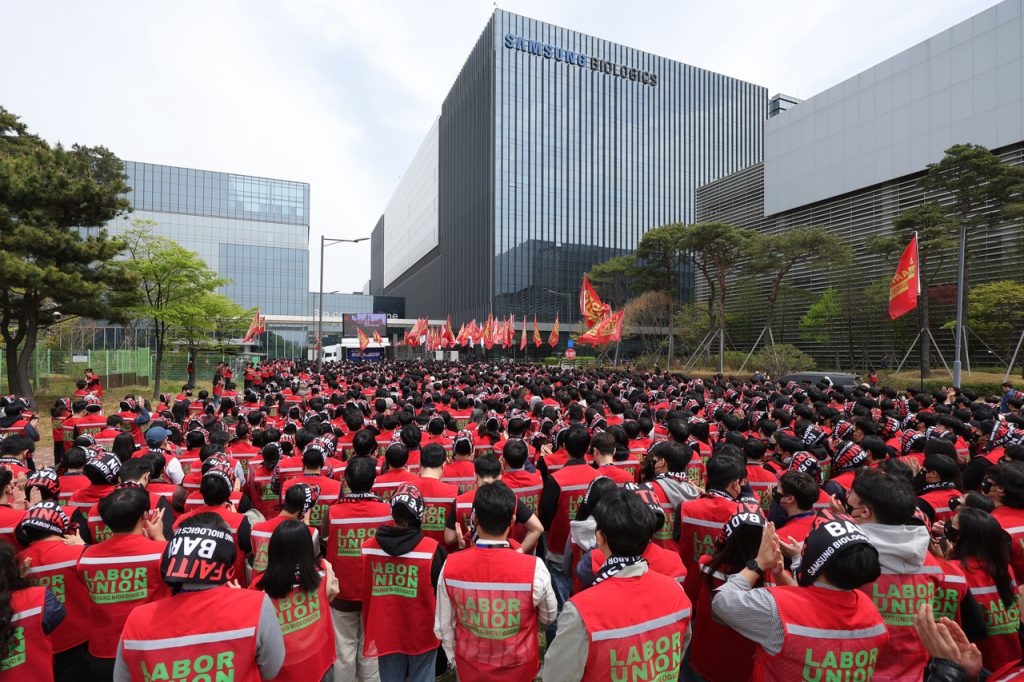
According to the union, approximately 400 of its roughly 4,000 members work in the three processes that are barred from the **strike**. The union staged its initial rally in front of the **Samsung Biologics**’ Bio Campus I in Songdo, Incheon, the day prior to the court’s decision, drawing an estimated 2,200 participants. The union asserts that about 75 percent of all company employees are members.
“Even now, we have not abandoned the chance for dialogue,” stated Park Jae-sung, head of **Samsung Biologics’ labor union**. “But if management continues to refuse meaningful talks, we will show our determination through the planned **strike action**.”
**Samsung Biologics** immediately announced it had filed an appeal to prevent the parts of the **strike** permitted by the court. The company emphasized the unique nature and inherent quality risks associated with **biopharmaceutical production**, arguing that operational halts could lead to more than just delayed production. It warned of potential batch discard, process infection, and severe issues with quality certification, all of which could severely impact **client trust** and product integrity.
This critical **labor dispute** at the prominent **CDMO** coincides with the company’s ambitious goals to sustain its robust growth momentum in the **biopharmaceutical** sector.
For the first quarter of this year, **Samsung Biologics** reported impressive financials, with 1.26 trillion won in sales and 580.8 billion won in operating profit, marking increases of 26 percent and 35 percent respectively, compared to the same period last year. The company projects its annual growth guidance to be between 15 percent and 20 percent.
“Although **Samsung Biologics**’ first-quarter earnings look excellent, it is primarily the result of orders secured in the past,” an official from the **biopharmaceutical industry** commented.
“If the union proceeds with the **strike** and disrupts the company’s **production schedule** in May, it will not only trigger penalties for violating contracts but also deal a critical blow to **Samsung Biologics**’ credibility among global clients.”
Highlighting **Samsung Biologics**’ recent acquisition of a **biopharmaceutical manufacturing** plant in Rockville, Maryland, from GSK, the official cautioned that a loss in credibility could undermine the company’s strategic efforts to diversify global supply chains and production. This scenario, the official added, presents a significant opportunity for competitors such as Lonza and Fujifilm to attract **Samsung Biologics’ clients**.
“The **strike risk** poses a great opportunity for **Samsung Biologics**’ competitors amidst geopolitical uncertainties, particularly with the United States’ stronger protectionism,” the official concluded. “If **Samsung Biologics**, a leader in Korea’s bio industry, experiences instability, it could derail the global level of trust in the country’s entire bio ecosystem.”
hwkan