
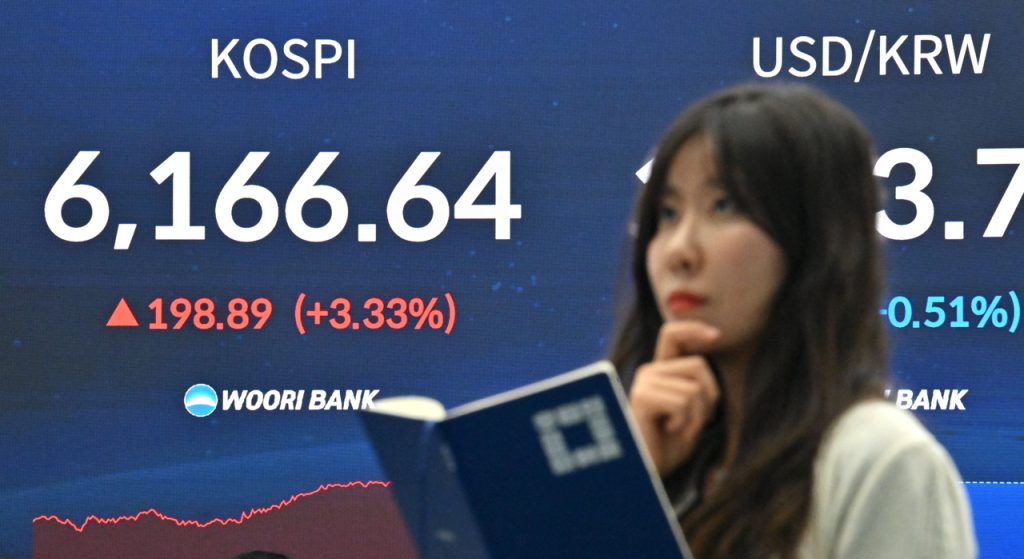
South Korea’s benchmark stock index, the Kospi, successfully reclaimed the crucial 6,100 point mark during early trading on Wednesday. This positive movement in the Korean stock market was largely driven by increasing optimism regarding the potential resumption of ceasefire negotiations between the US and Iran.
Opening strongly at 6,145.75, the Kospi demonstrated a significant 2.98 percent increase from the previous session’s close. By 10:30 a.m., the index sustained its momentum, trading slightly higher at 6,146.06. This notable surge marked the first instance the South Korean index had climbed above the 6,100 threshold since heightened Middle East tensions began to exert downward pressure on global markets.
Among the top performers on the Seoul bourse, market heavyweight Samsung Electronics saw its shares climb 3.75 percent to reach 214,250 won (approximately $145). Concurrently, semiconductor giant SK Hynix experienced an impressive surge of 5.44 percent, closing at 1.16 million won. Earlier in the trading session, SK Hynix even set a new record high, touching 1.17 million won, thereby extending its remarkable rally from the preceding day.
The upward trajectory of the Kospi index was primarily fueled by robust net purchases from foreign and institutional investors, injecting approximately 363 billion won and 222 billion won into the market, respectively. Conversely, retail investors exhibited net selling, offloading a substantial 698 billion won on the exchange during the same period.
This market rally also propelled the total market capitalization of all Kospi-listed firms back above the significant 5,000 trillion won mark. Data from the Korea Exchange indicated that the combined market cap stood at 5,035.5 trillion won, representing a gain of over 1,300 trillion won compared to the previous day’s closing figure of 4,894.52 trillion won.
It’s worth noting that the main bourse’s market capitalization had initially surpassed the 5,000 trillion won milestone on February 25. However, it subsequently experienced a sharp decline following military actions by the US and Israel against Iran on February 28, highlighting the sensitivity of the South Korean market to geopolitical developments.


