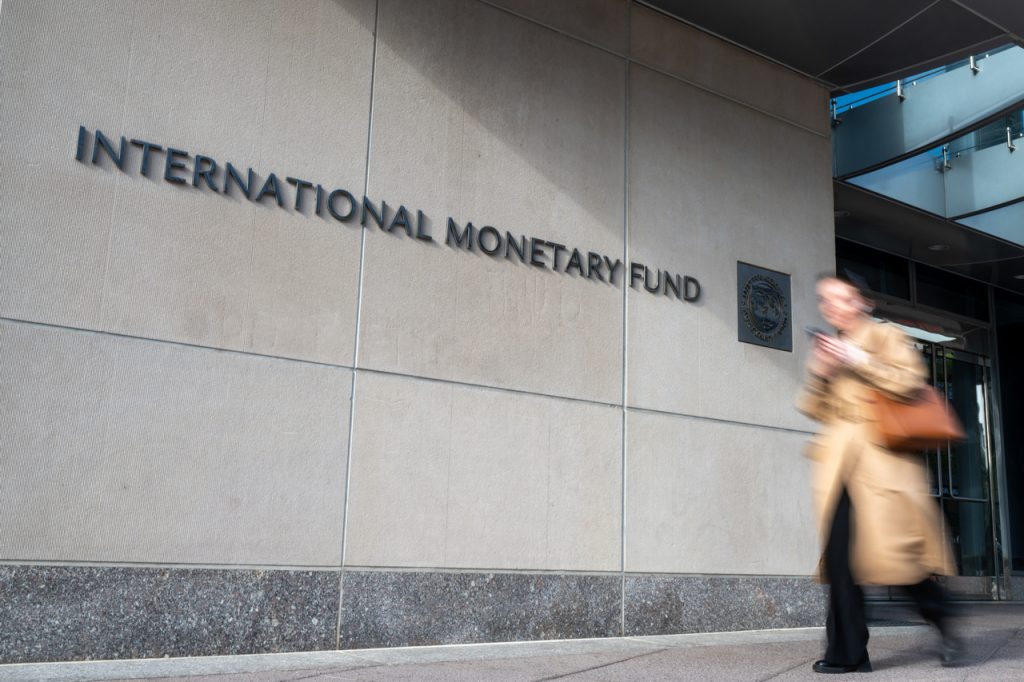
The International Monetary Fund (IMF) has maintained its 2026 economic growth forecast for South Korea at a steady 1.9 percent. This consistent projection comes as the South Korean government credits a timely supplementary budget and strategic policy support for effectively mitigating significant external economic shocks.
This stability in the IMF’s April world economic outlook stands out, as it retains the same projection issued in January, contrasting sharply with downward revisions from other major institutions. For instance, the OECD adjusted its forecast for Korea’s economic growth down to 1.7 percent in March from 2.1 percent in December. Similarly, French bank Natixis dramatically cut its estimate by a full percentage point to 0.8 percent, marking the first sub-1 percent prediction for South Korea this year.
Despite these varied projections, South Korea’s economic forecast remains slightly above the average 1.8 percent expected for 41 advanced economies.
South Korea’s Finance Ministry attributes the IMF’s stable outlook to the nation’s swift and decisive policy actions, aimed at counteracting the economic ramifications stemming from the ongoing Middle East conflict.
A ministry official stated that while robust exports bolstered economic performance, the Middle East war’s negative spillovers also impacted the economy. They further assessed that the substantial supplementary budget effectively mitigated a significant portion of this impact. This additional budget, valued at approximately 26 trillion won ($17.6 billion) and recently approved by the National Assembly, was a key factor already incorporated into the IMF’s latest economic forecast.
In contrast, the IMF revised its global growth forecast downward by 0.2 percentage points, settling at 3.1 percent. The organization highlighted that the Middle East conflict continues to exert pressure on the world economy, primarily through escalating energy prices, rising global inflation expectations, and a general risk-averse sentiment prevalent in financial markets.
Global inflation is now projected at 4.4 percent, marking a 0.6 percentage point increase from January, driven largely by soaring energy and food prices. For South Korea, the inflation rate for the current year is anticipated to be 2.5 percent, which is notably below the 2.8 percent average observed across advanced economies. The IMF did not provide a January inflation forecast specifically for Korea.
The IMF’s baseline forecasts are predicated on the assumption that the Middle East conflict will gradually de-escalate, enabling energy production and exports to return to normal levels by mid-2026.
The IMF also presented several downside scenarios for the global economy. In an adverse case, global growth could decelerate to 2.5 percent, assuming oil prices average approximately $100 per barrel in 2026 and $75 in 2027. A more severe scenario projects growth around 2 percent, with oil prices potentially reaching $110 in 2026 and $125 in 2027.
According to the Finance Ministry’s summary of the IMF’s April outlook, the fund emphasized that “downside risks continue to dominate the global economy.” These key threats include the potential for sustained supply chain disruptions if the Middle East war persists, possible financial market corrections as optimistic expectations for AI profitability are re-evaluated, and the increasing global trend of protectionism.
jwc