
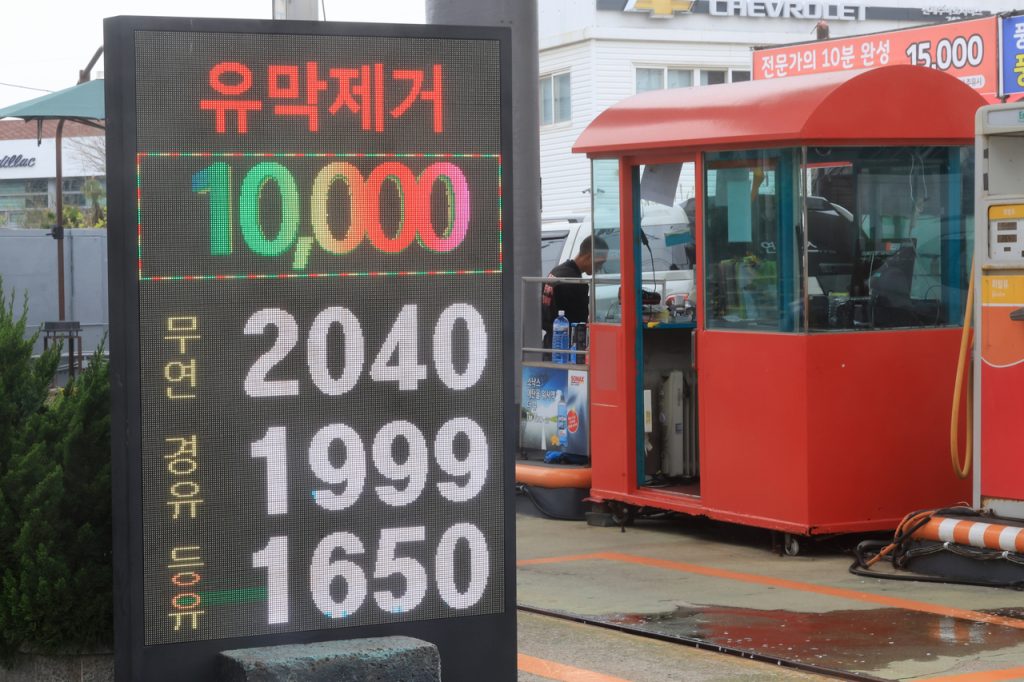
Seoul’s gasoline prices have surged past 2,000 won ($1.32) per liter, hitting a significant peak not seen since mid-2022. This sharp increase in fuel costs, observed on Tuesday, is directly linked to escalating global supply disruptions.
Data from Opinet, the official fuel price monitoring system managed by the state-run Korea National Oil Corp., confirmed Seoul’s average gasoline price at 2,000.27 won per liter as of Tuesday morning (9:30 a.m.). This represents a daily increase of 9.88 won.
Alongside gasoline, diesel prices also experienced a notable rise, climbing 11.6 won to average 1,979.6 won per liter.
This recent spike signifies the first instance of Seoul’s average gasoline price breaching the 2,000-won mark per liter since July 25, 2022. That previous surge was primarily attributed to the economic repercussions of the Russia-Ukraine war.
Highly dependent on crude oil imports, with approximately 70 percent sourced from the Middle East via the critical Strait of Hormuz, South Korea initiated oil price caps on March 13. This measure was a direct response to the disruptions plaguing this vital shipping route due to the ongoing Iran war.
These implemented caps regulate maximum wholesale prices for petroleum products, distinct from retail pump prices. They undergo bi-weekly adjustments to adapt to evolving global oil prices and supply dynamics. The announcement for the third round of these adjustments is anticipated this Friday.
A concerning development is that all 28 South Korean vessels transporting fuel have been stranded within the Strait of Hormuz since the commencement of the conflict, exacerbating supply concerns.
milaya


