
Renault Group Eyes Major EV Production in Korea, Solidifying Busan Plant’s Global Hub Status
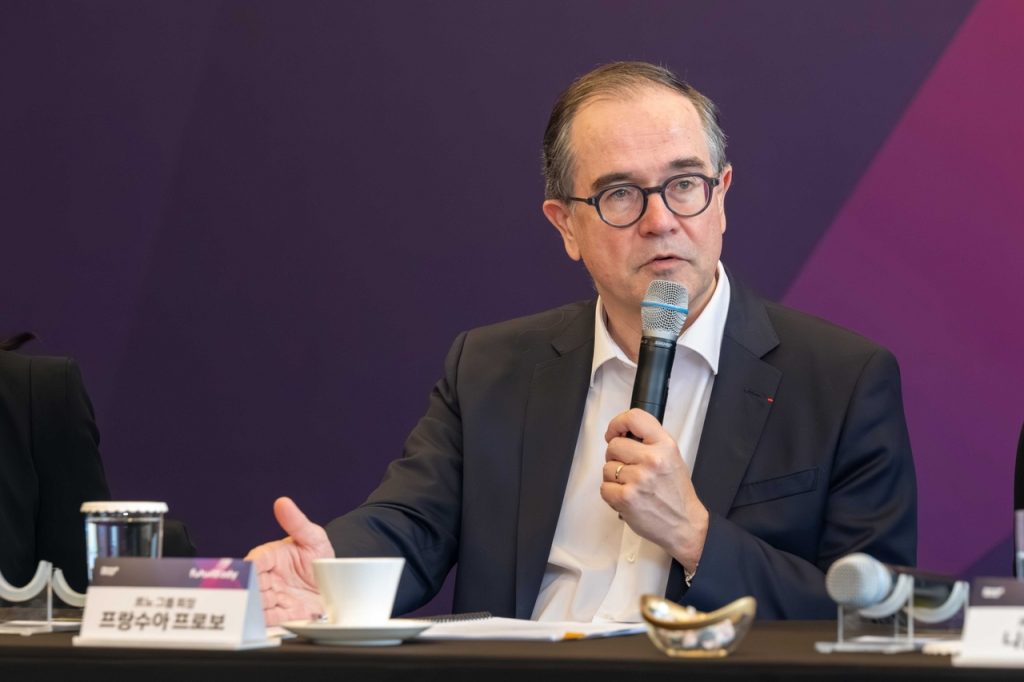
Renault Group CEO Francois Provost announced the company is exploring the significant potential of producing fully electric vehicles (EVs) in Korea. This strategic move signals a profound commitment to expanding local manufacturing capabilities, extending well beyond current gasoline and hybrid model production.
During a pivotal press conference held in Seoul on Friday, hosted by the esteemed Korea Automobile Journalists Association, Provost affirmed that Renault would “seriously consider” full-scale EV production in Korea.
He elaborated, “In the coming years, our focus will be on significantly enhancing our presence and credibility within the dynamic Korean automotive market through the introduction of advanced full-electric cars.”
Provost underscored Renault’s unwavering commitment to electrification, even amidst a global deceleration in overall EV demand. He asserted, “Consumers who have experienced the benefits of electric vehicles rarely revert to internal combustion engine models,” reaffirming that EVs are poised to become a foundational pillar of Renault’s future global business strategy.
Notably, Renault’s strategic approach for Korea will diverge from its predominantly Europe-centric focus on compact EVs. Provost outlined that upcoming models specifically tailored for the Korean market will concentrate on mid- to large-sized vehicles, encompassing sophisticated electrified D- and E-segment offerings.
The Renault Korea Busan plant is already demonstrably capable of producing electric vehicles, as evidenced by its successful contract manufacturing of the Polestar 4 SUV, confirmed by Renault Korea Motors CEO Nicolas Paris. The company’s immediate strategy involves fulfilling near-term demand with advanced hybrid models, concurrently executing a progressive transition towards full-scale EV production.
To effectively facilitate this significant transition, Renault intends to forge robust collaborations with key local partners, notably including leading Korean battery manufacturers like LG Energy Solution.
Provost emphatically highlighted Korea’s crucial strategic importance within the broader Renault Group, emphasizing his choice of Korea as his inaugural overseas destination subsequent to the global launch of Renault’s comprehensive medium- to long-term strategy, ‘FutureReady.’
Within the ambitious ‘FutureReady’ framework, Renault has officially designated Korea as one of its five pivotal global production hubs, standing alongside India, Morocco, Turkey, and Latin America. A central tenet of this strategy involves significantly expanding the product lineup available in Korea, with the company strategically prioritizing substantial market share gains above aggressive volume growth.
Provost affirmed that the successful launches of the Grand Koleos SUV and Filante crossover were specifically engineered to reinvigorate Renault’s market presence in Korea. Both models, he noted, have remarkably surpassed initial sales and performance expectations.
Furthermore, he reaffirmed strategic plans to firmly establish the Busan plant as a critical export hub, with the company actively exploring avenues to secure substantial additional export volumes. However, it was clarified that direct shipments of the aforementioned SUV models to the United States market are currently not under consideration.
Following an insightful visit to Renault’s advanced domestic R&D center, Provost indicated that the Korean unit holds significant potential to emerge as a prominent hub for autonomous driving technology development across the entire group.
Provost brings extensive experience, having previously served as CEO of Renault Samsung Motors from 2011 to 2016. His distinguished career within the group includes holding various senior leadership roles, such as group purchasing chief, prior to his appointment as CEO in July of last year.
hyejin2


