Uncertain Ceasefire Outlook Drives Risk Aversion, Boosts Dollar
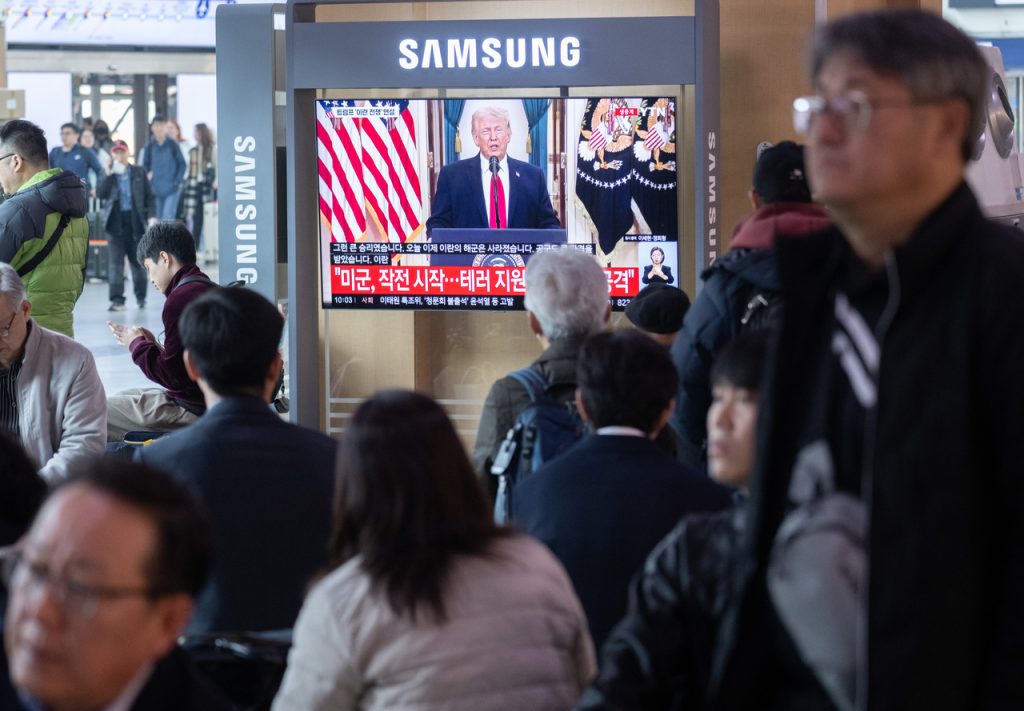
South Korean stocks experienced a significant downturn on Thursday following renewed threats against Iran by US President Donald Trump in a highly anticipated address. This prompted the Korea Exchange to activate sell-side sidecars on both the benchmark Kospi and the secondary Kosdaq markets. Simultaneously, the Korean won weakened against the US dollar amid growing risk aversion in the financial markets.
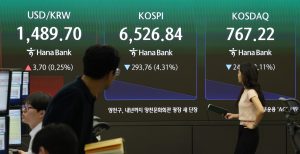
As of 3 p.m., the Kospi index stood at 5,176.56, marking a decrease of 302.14 points, or 5.51 percent, compared to the previous trading session. The sharp decline triggered a sell-side sidecar on the main bourse at 2:46 p.m., temporarily halting programmed sell orders for five minutes. A sidecar is activated when the Kospi 200 Futures index fluctuates by 5 percent or more for at least one minute.
Initially, the index opened 1.33 percent higher at 5,551.69, fueled by increased optimism regarding a potential resolution to the conflict ahead of Trump’s public statement. It briefly exceeded 5,570 points during intraday trading. However, it reversed course and declined sharply as Trump delivered his address.
Foreign and institutional investors engaged in substantial selling, offloading 498.1 billion won ($328 million) and 1.09 trillion won, respectively. Retail investors were the sole net buyers, acquiring shares totaling 1.23 trillion won.
Major semiconductor stocks and other large-cap shares experienced widespread declines.
Shares of Samsung Electronics traded at 175,400 won, a decrease of 7.49 percent. The stock initially opened with gains of approximately 1 percent and continued its upward trajectory in early trading before reversing course and expanding its losses as Trump’s speech unfolded.
SK hynix also fell 8.17 percent to 820,000 won, while Hyundai Motor and LG Energy Solution experienced declines of 6.35 percent and 1.23 percent, respectively.
The tech-heavy Kosdaq index closed at 1,042.08, down 74.1 points, or 6.64 percent. A sell-side sidecar was triggered on this bourse at 2:34 p.m.
The Korean won depreciated against the US dollar, failing to sustain its gains from the previous day.
The won opened at 1,512.2 per dollar in onshore trading, reflecting a decrease of 10.9 won from the previous close.
Although it briefly appreciated to 1,506.7 per dollar during trading, it quickly retreated to the 1,520 per dollar level as the dollar strengthened due to safe-haven demand, driven by the lack of a clear ceasefire timeline from Trump. The exchange rate stood at 1,520.28 won per dollar as of 3 p.m.
Despite the won’s continued decline, government officials emphasized the importance of South Korea’s inclusion in the FTSE World Government Bond Index, which officially took effect on Wednesday.
Financial authorities reported that over 4.4 trillion won in foreign capital flowed into Korea’s bond market between Monday and Wednesday as the country began its phased inclusion in the key bond index.
“Capital inflows, primarily driven by Japanese investors, have been progressing smoothly and are expected to contribute to stability in both the bond and foreign exchange markets,” stated Finance Minister Koo Yun-cheol at a macroeconomic policy meeting on Thursday. The meeting was attended by Bank of Korea Gov. Rhee Chang-yong and the heads of the Financial Services Commission and Financial Supervisory Service.
Kim Yong-beom, chief secretary for national policy, highlighted the medium- to long-term significance of the WGBI inclusion.
“The phased inclusion in the WGBI represents a structural factor that has the potential to attract sustained foreign investment into the bond market and contribute to the stability of supply and demand in the foreign exchange market,” Kim wrote on social media.
“While it might not alleviate immediate pressure on the won, it is anticipated to reduce volatility and enhance confidence in won-denominated assets.”
silverstar