
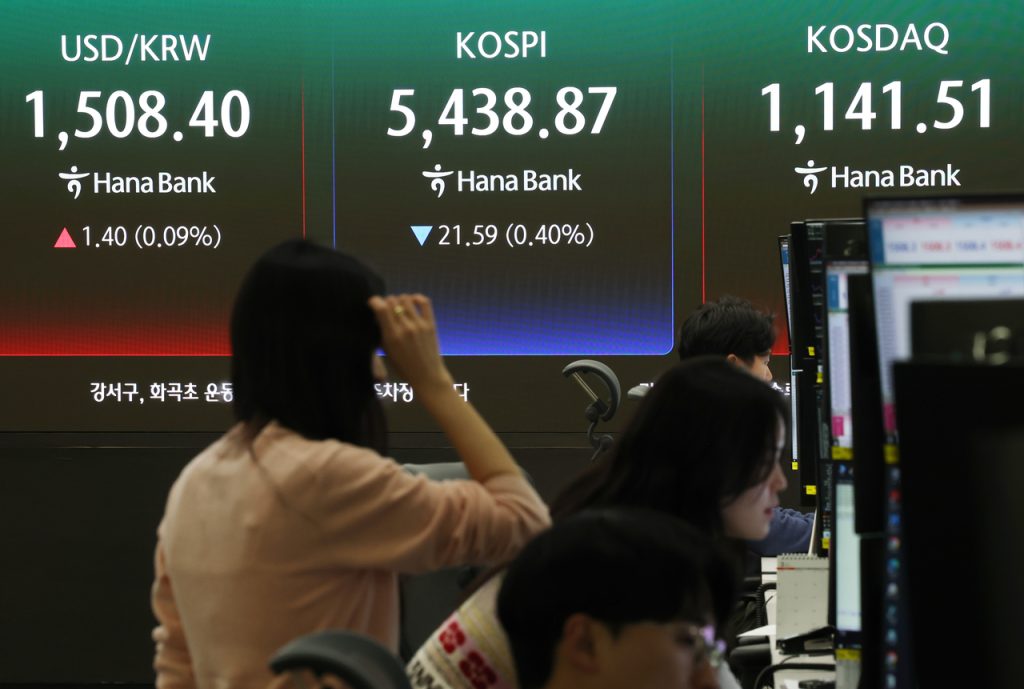
South Korean stocks experienced a slight dip at the close of trading Friday, managing to recover most of their earlier losses. This came amidst mixed signals from the United States regarding its stance on Iran and a lessening of anxieties surrounding the semiconductor industry. Simultaneously, the Korean currency weakened against the US dollar.
The benchmark Korea Composite Stock Price Index (KOSPI) concluded trading down by 21.59 points, a 0.4 percent decrease, settling at 5,438.87. This followed an initial drop of 2.93 percent, reaching a low of 5,220.10 during the session.
Trading volume remained moderate, with 889.8 million shares changing hands, amounting to a total value of 23 trillion won (US$15.3 billion). The balance between losing and gaining stocks was nearly even, with 441 decliners versus 436 advancers.
Foreign investors engaged in net selling of 3.88 trillion won, continuing their selling trend. However, retail investors and institutions stepped in to purchase local shares, amounting to 2.7 trillion won and 778.7 billion won, respectively.
The KOSPI’s initial decline was largely attributed to an overnight slump on Wall Street. This was fueled by US President Donald Trump’s ambiguous statements concerning negotiations with Iran, coupled with ongoing concerns about the potential impact of Google’s new AI compression algorithm, TurboQuant. TurboQuant is projected to reduce the demand for memory chips necessary for running AI models.
On Thursday, Trump issued a warning to Iranian negotiators, urging them to “better get serious soon, before it is too late.” However, he later stated that the US and Iran were engaged in “substantial talks.”
Furthermore, the White House announced an extension of the pause on strikes targeting Iranian power plants and energy infrastructure until April 6.
The index managed to recover earlier losses during the afternoon session as investors sought to capitalize on bargain opportunities in blue-chip stocks. This was driven by the belief that major semiconductor shares had been excessively impacted by the TurboQuant news the previous day, according to Lee Sung-hoon, an analyst at Kiwoom Securities.
Semiconductor giant Samsung Electronics closed slightly lower, down 0.22 percent at 179,700 won, rebounding from an initial drop of nearly 4 percent. Its competitor, SK hynix, also saw a decrease of 1.18 percent, closing at 922,000 won, after recovering from a nearly 5 percent decline earlier in the day.
AI investment firm SK Square experienced a decline of 2.51 percent, closing at 544,000 won.
Defense industry leader Hanwha Aerospace dipped by 2.48 percent to 1.34 million won, while power plant manufacturer Doosan Enerbility contracted by 2.78 percent to 98,100 won.
Major shipbuilding companies also faced losses, with HD Hyundai Heavy decreasing by 2.45 percent to 498,500 won and Hanwha Ocean retreating by 1.99 percent to 123,200 won.
HD Hyundai Electric experienced a significant drop of 5.18 percent, closing at 915,000 won.
Conversely, leading automaker Hyundai Motor showed gains, adding 1.02 percent to reach 495,000 won, while prominent battery manufacturer LG Energy Solution jumped by 2.6 percent to 394,500 won.
Major bio firm Samsung Biologics climbed by 1.32 percent to 1.6 million won, and Celltrion advanced by 1.48 percent to 206,000 won.


