
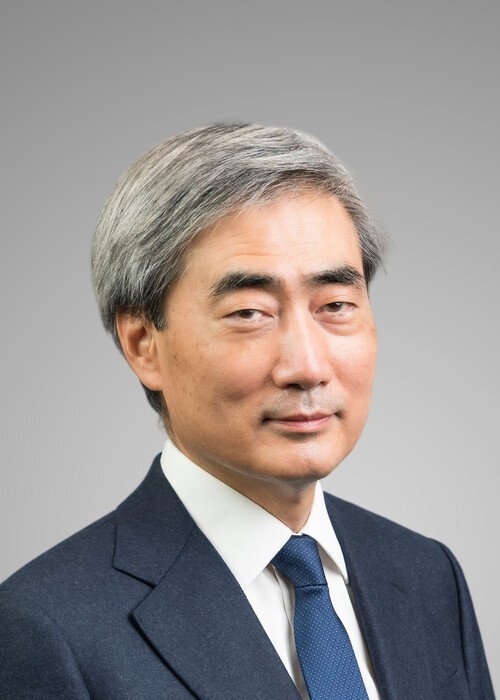
Veteran policymaker seen favoring early tightening as Korea grapples with inflation, market volatility
Shin Hyun-song has been nominated to lead the Bank of Korea (BOK). As one of the country’s most internationally respected monetary policymakers, he is largely viewed as an economist with a hawkish approach.
Born in Daegu in 1959, Shin Hyun-song’s education primarily took place in Britain. After graduating from Emanuel School in London, he obtained bachelor’s, master’s, and doctoral degrees in economics from Oxford University. He subsequently taught at Oxford until 2000.
His career progressed with teaching positions at the London School of Economics and Princeton University. He further served as an advisor to the Bank of England and as a senior resident scholar at the International Monetary Fund (IMF), solidifying his global reputation in international finance. In 2010, he briefly returned to Korea to serve as a senior presidential advisor on international economic matters.
Shin is frequently recognized for his early warnings regarding vulnerabilities that preceded the global financial crisis. He focused on leverage, liquidity, and systemic fragility at the 2005 Jackson Hole symposium.
In 2010, he played a vital role in developing Korea’s post-crisis macroprudential toolkit. This toolkit was designed to protect against volatile capital flows and abrupt reversals. Shin emphasized that these measures were safeguards rather than capital controls. The IMF later cited Korea’s experience as a key case study, generally deeming the steps effective.
From 2014, Shin held positions at the Bank for International Settlements (BIS), initially as head of research, chief economist, and economic advisor. Most recently, he served as head of its Monetary and Economic Department. His appointment as BIS economic advisor marked the first time a non-US or European scholar had held the role in the institution’s 83-year history, and he was also the first Korean to hold a senior position at the bank.
Following Shin’s nomination, BIS General Manager Pablo Hernandez de Cos released a congratulatory statement, noting that Shin is “widely respected within the economics profession and central banking community” and calling him “an excellent candidate for Governor.”
Shin’s long-standing record of caution regarding excessive debt, increasing household borrowing, and asset-price bubbles has earned him a reputation as a hawk, especially concerning financial stability risks. He has advocated for proactive interest rate hikes to control inflation. Furthermore, he has suggested that central banks should consider broader macroeconomic and financial stability risks in addition to price stability.
As Korea confronts uneven economic growth, oil-driven inflation concerns, and increased market volatility stemming from the Middle East conflict, Shin’s extensive experience at the BIS, deep expertise in macroeconomics and finance, and broad global network position him well to address the resulting policy challenges.
In announcing Shin’s nomination on Sunday, the presidential office described him as “a globally renowned authority on international finance and macroeconomics with both academic depth and practical insight.” They stated that he was “the right person to deliver the twin goals of monetary policy — price stability and growth in the national economy” amidst increasing uncertainty due to the Middle East crisis.
Shin is scheduled to officially commence his term next month, following a parliamentary hearing and formal appointment. The Bank of Korea governor serves a four-year term, which is renewable once. The governor also chairs the Monetary Policy Board.
jwc


