
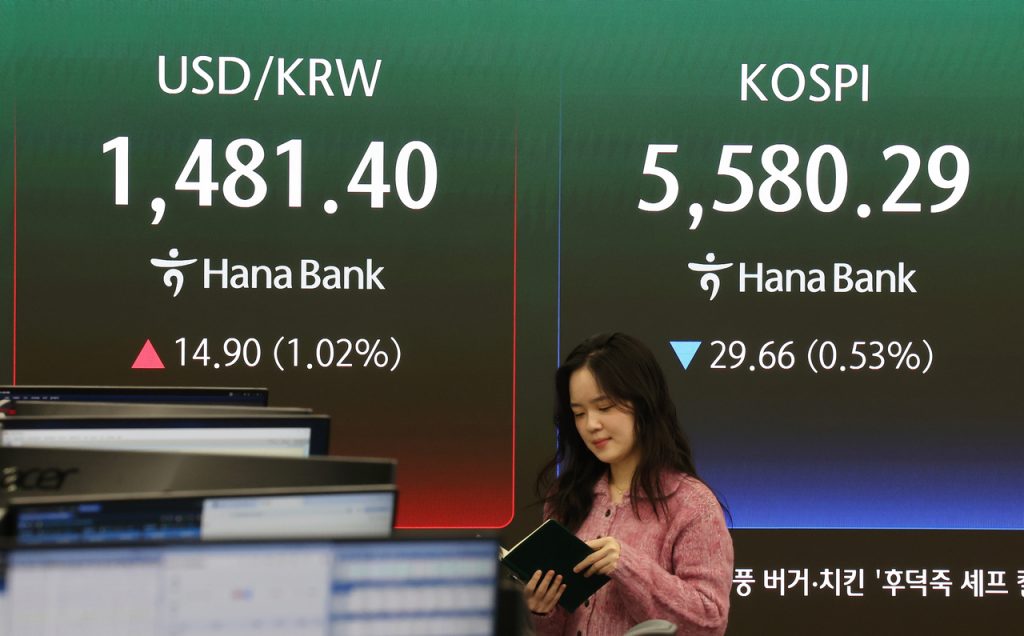
Foreign investors significantly reduced their holdings in South Korean stocks last month, withdrawing a record amount as they cashed in on recent gains, according to data released by the Bank of Korea on Thursday.
The central bank’s report on international finance and foreign exchange markets revealed that foreign investors’ sales of Korean securities exceeded their purchases by $7.76 billion in February.
This outflow represents the second-largest net outflow ever recorded and interrupts a five-month period of net inflows that began in September of the previous year.
Breaking down the asset classes, equities saw the most substantial departures, with $13.5 billion exiting the Korean stock market – the highest monthly outflow on record.
Conversely, bond investments attracted net inflows of $5.74 billion, partially offsetting the sell-off in equities.
The Bank of Korea attributed the large equity outflow primarily to investors taking profits after the surge in Korean stock prices, coupled with growing caution regarding investments linked to artificial intelligence (AI).
“Stock funds experienced a significant net outflow due to profit-taking following gains in the domestic stock market and concerns surrounding AI-related investments,” the central bank stated.
Meanwhile, demand for bonds remained robust, driven by bargain-hunting amidst rising market interest rates and increased investment from private-sector entities, the bank added.
Market volatility also saw an increase during February. The credit default swap (CDS) premium on South Korea’s sovereign bonds, a measure of perceived credit risk, rose to an average of 22 basis points, a slight increase from 21 basis points in January.
The won-dollar exchange rate also experienced greater volatility. The average daily fluctuation widened to 8.4 won, with a daily volatility rate of 0.58 percent, compared to 6.6 won and 0.45 percent in January.
jylee


