Hybrid pivot, flexible production lift Korean auto giant to global No. 2
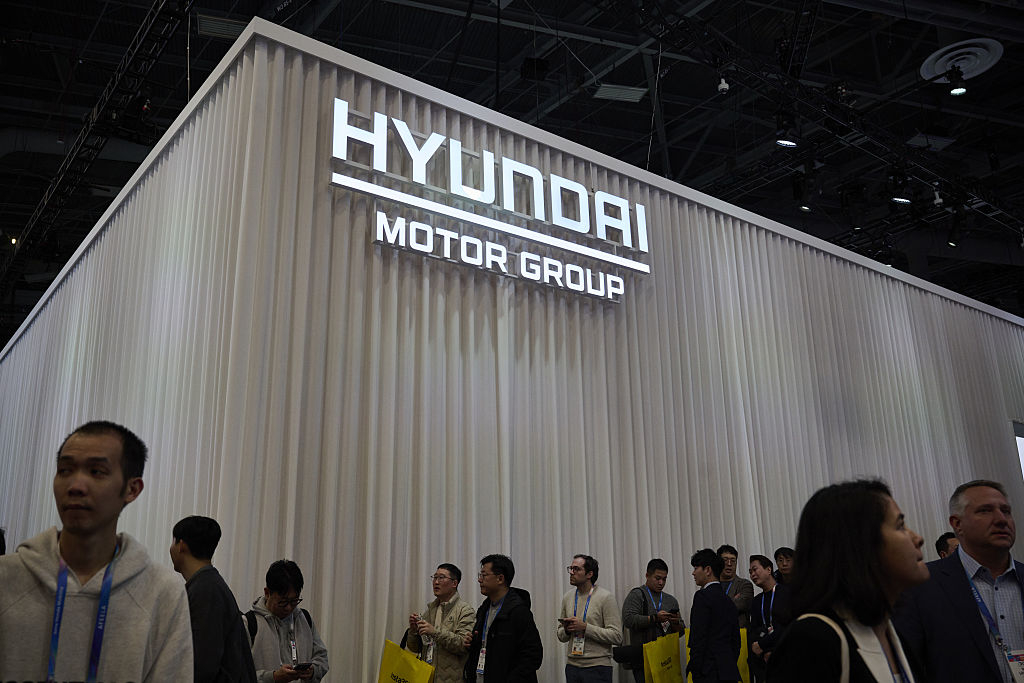
Hyundai Motor Group of South Korea has risen to become the world’s second-most profitable automaker, surpassing Volkswagen Group for the first time, according to recent industry data. This achievement highlights the company’s successful adaptation to market challenges.
The group, encompassing Hyundai Motor, Kia, and Genesis, reported an impressive 20.5 trillion won ($13.95 billion) in operating profit for 2025. This figure places them second only to Toyota Motor Corporation, which leads the industry with 4.3 trillion yen ($27.15 billion) in operating profit.
Industry analysts attribute this success to the two Asian automakers’ swift responses to shifting market dynamics, including tariff adjustments and a slowdown in electric vehicle (EV) demand. Their ability to adapt production and inventory strategies proved crucial.
This marks a significant milestone for Hyundai Motor Group, achieving the second-highest global operating profit despite having lower sales volumes than Volkswagen Group, which maintains its position as the second-largest automaker globally by sales, with brands such as Volkswagen, Audi, and Porsche.
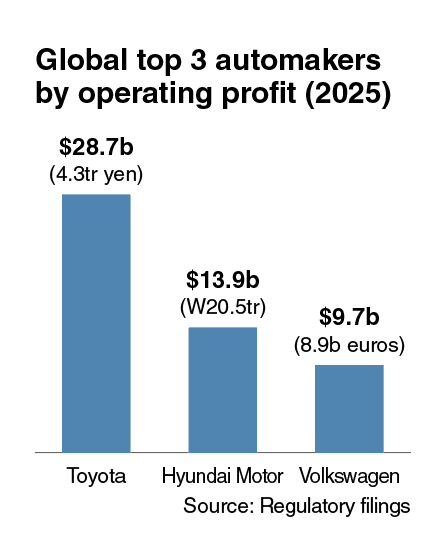
General Motors secured the third spot with $12.7 billion in operating profit, while Volkswagen Group followed in fourth place with 8.9 billion euros ($10.34 billion).
Stellantis, however, reported an operating loss of 840 million euros.
Hyundai Motor Group also excelled in operating profit margin, achieving 6.8 percent, second only to Toyota’s 8.6 percent and more than double Volkswagen’s 2.8 percent.
Hybrids cushion EV slowdown
In 2025, Hyundai Motor Group sold 7.27 million vehicles worldwide, maintaining its position as the world’s third-largest automaker by sales volume.
Toyota Motor Corporation remained the top seller with 11.32 million vehicles, followed by Volkswagen Group with 8.98 million. General Motors ranked fourth with 6.18 million, while Stellantis sold 5.48 million vehicles.
Experts suggest that automakers’ reactions to the EV market’s deceleration and US tariffs significantly influenced profitability across the industry.
Hyundai Motor Group strategically shifted its production towards hybrid models to compensate for the decreased demand for EVs.
The group sold over 1 million hybrid vehicles globally last year, with Hyundai Motor experiencing a substantial 32 percent year-on-year increase in hybrid sales.
“Hyundai’s strong performance amidst challenging global conditions is largely attributed to its competitive full-hybrid vehicles, which offer excellent fuel efficiency and widespread appeal,” stated Kim Pil-su, an automotive engineering professor at Daelim University. “The company’s strength lies in implementing the appropriate models and branding strategies tailored to each specific region.”
Tariffs reshape global competition
Tariffs have also emerged as a significant challenge in the United States, Hyundai Motor Group’s largest overseas market, representing approximately 24 percent of its global sales.
Despite both Hyundai Motor and Kia achieving record revenue last year, tariffs impacted profitability, with Hyundai’s profit decreasing by 19.5 percent and Kia’s by 28.3 percent compared to the previous year.
Analysts emphasize that the tariff burden is not unique to Hyundai but affects automakers broadly, thereby reshaping competition within the global automotive industry. While many competitors responded by increasing prices or modifying supply chains, Hyundai Motor Group focused on minimizing price increases, operational adjustments, and expanding local production.
This strategy allowed the group to achieve record US sales of 1.83 million vehicles last year, the highest in its history.
Meanwhile, Volkswagen’s profits were negatively affected by US tariffs and declining sales in China due to heightened local competition. Europe’s largest automaker characterized 2025 as a “challenging environment” after reporting a more than 50 percent decrease in operating profit from the previous year on Tuesday.
Hyundai Motor Group also incurred lower tariff expenses than Toyota.
The Korean automaker paid approximately 7.2 trillion won in tariffs last year – including 4.1 trillion won for Hyundai Motor and 3.1 trillion won for Kia – compared with Toyota’s 1.2 trillion yen.
South Korean-made vehicles exported to the US currently face a 15 percent tariff, reduced from the previous 25 percent.
Experts caution that challenges remain this year, stemming from geopolitical tensions in the Middle East and ongoing tariff uncertainties.
“Significant uncertainties persist, including potential policy changes, ongoing conflicts, and evolving tariff regulations,” Kim stated. “To effectively address tariff pressures and geopolitical disruptions, Hyundai should continue producing vehicles in the US for the American market while maintaining robust manufacturing bases in Korea for other regions, alongside implementing region-specific models.”
sahn