Foreign Investors Return, Fueling Sharp Market Recovery Led by Chip Stocks
South Korea’s KOSPI index experienced a significant surge on Tuesday, bouncing back strongly from the previous day’s sharp decline. This rebound was fueled by renewed optimism regarding a potential de-escalation of tensions in the Middle East, which positively impacted global markets.
Following statements from US President Donald Trump on Monday suggesting a contained situation regarding Iran, crude oil prices dipped below $90 a barrel. This decline in oil prices contributed to a widespread recovery in equity markets worldwide, including the Korean stock market.
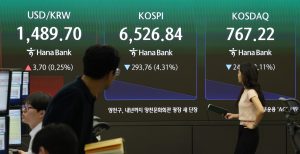
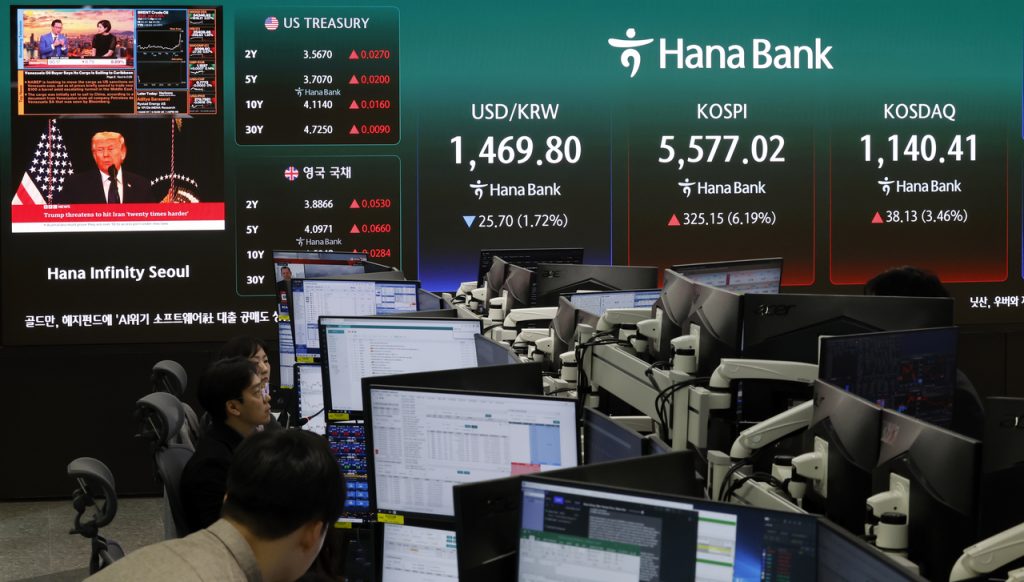
The KOSPI index swiftly reclaimed the 5,500 level at the start of trading, opening at 5,523.21, a notable 5.17 percent increase from the previous trading session. The index continued its upward trajectory, reaching a peak of 5,595.88 before slightly retracting. As of 2 p.m., the KOSPI stood at 5,491.64, marking a 4.57 percent rise for the day.
This positive movement follows Monday’s substantial 5.96 percent drop, a decline that triggered both a sell-side sidecar and a circuit breaker.
The surge in KOSPI 200 futures also activated a buy-side sidecar at 9:06 a.m. on Tuesday, resulting in a temporary halt of program buy orders. This marked the fifth instance of a buy-side sidecar being triggered on the main market this year.
Foreign investors returned to the market with significant buying activity after the previous day’s heavy selling. They purchased a net total of 1.09 trillion won ($740 million) worth of shares. Institutional investors also participated in the buying spree, acquiring a net 306.3 billion won, while retail investors engaged in net selling, offloading 1.29 trillion won.
Key market players Samsung Electronics and SK hynix saw substantial gains, climbing 7.84 percent and 10.65 percent, respectively. This recovery offset the sharp declines experienced on the previous day, where they fell by 7.81 percent and 9.52 percent, respectively.
The semiconductor sector has experienced increased volatility since the onset of geopolitical tensions, with daily price fluctuations approaching 10 percent.
Conversely, defense-related stocks experienced a decline as expectations of a swift resolution to the conflict grew. Hanwha Systems and Hyundai Rotem fell by 5.22 percent and 2.79 percent, respectively.
The technology-heavy KOSDAQ index mirrored the KOSPI’s positive performance, opening up by 4.15 percent at 1,147.99 and reaching 1,135.93 as of 2 p.m., a 3.05 percent increase from the previous session, driven primarily by retail and institutional buying.
With risk aversion subsiding, the Korean won strengthened against the US dollar. The currency opened at 1,470.8 won per dollar, a 24.7 won difference from the previous close, and was trading at 1,475.34 won as of 2 p.m.
Woori Bank economist Min Kyung-won suggested that the decline in oil prices and limited foreign selling could provide support for the Korean currency.
“However, uncertainty surrounding the war remains, and market sentiment continues to shift with headlines, so it is too early to be certain,” Min cautioned.
silverstar