
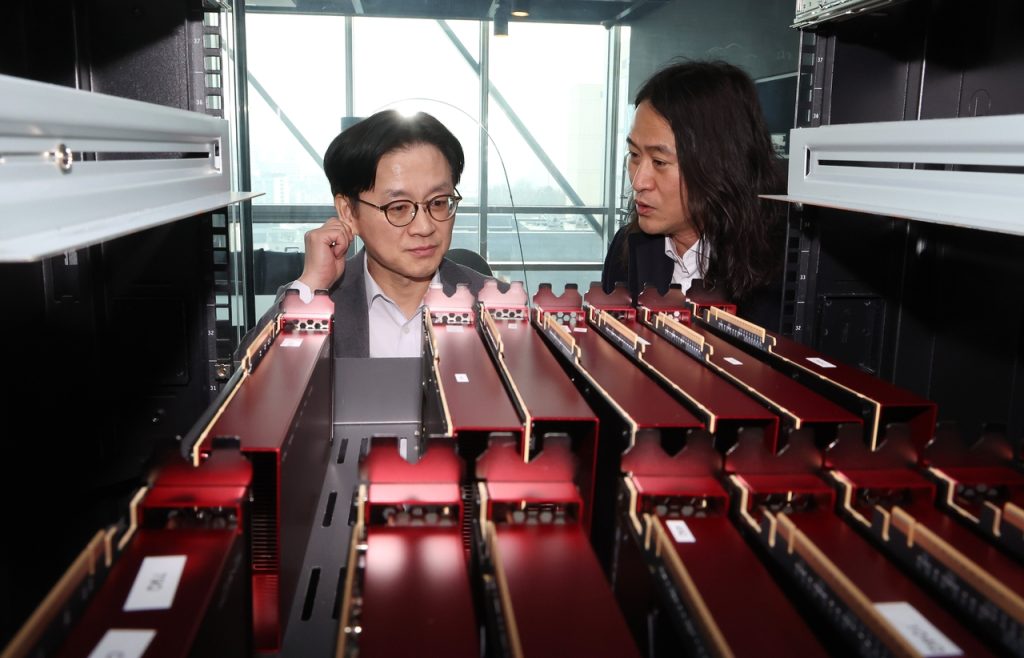
South Korea’s AI chip startups are aggressively expanding their teams as they enter a crucial phase: commercializing advanced processors designed for AI service applications.
According to industry sources and data from TheVC, a Korean startup investment database, four leading Korean AI fabless companies — Rebellions, DeepX, Mobilint, and FuriosaAI — have significantly increased their workforce in the past year. This growth is driven by the progress of their latest chips towards mass production and customer validation.
Fabless companies specialize in semiconductor design, outsourcing the actual manufacturing to external foundries.
This hiring boom is fueled by the companies’ development of new neural processing units (NPUs) optimized for AI inference. Inference, the process of deploying trained AI models for real-time services, demands chips with lower power consumption and operating costs compared to processors used for AI model training.
DeepX, an edge AI chip developer, has approximately doubled its workforce from 70 employees at the start of last year to over 140 by early 2026, based on industry data. Similarly, Mobilint, focusing on AI processors for industrial and on-device applications, has almost doubled its staff to about 105 employees.
Rebellions, a data center-focused startup, has grown from roughly 200 to nearly 300 employees. FuriosaAI, another AI inference chip developer targeting enterprise servers, has increased its team from about 100 to around 130 and plans to reach 200 employees this year.
Next-Generation AI Chips Enter Production and Testing Phases
These staffing increases coincide with significant product milestones across these companies.
Rebellions has commenced mass production of its second-generation AI processor, REBEL-Quad, and is conducting proof-of-concept (PoC) testing with global partners. PoC involves pilot testing with potential clients before broader commercial deployment.
In January, FuriosaAI announced receiving an initial production batch of approximately 4,000 units of its second-generation Renegade AI inference chip from manufacturing partner TSMC. These chips are currently being assembled into accelerator cards designed for enterprise systems.
Mobilint plans to begin mass production of its Regulus chip later this year after completing PoC work with potential customers. DeepX is already manufacturing its first-generation DX-M1 chip while concurrently developing its next-generation DX-M2 processor.
These four companies are targeting distinct segments of the AI inference market. Rebellions and FuriosaAI primarily focus on data center and enterprise workloads. Meanwhile, DeepX and Mobilint are targeting edge and on-device AI applications such as robots, cameras, vehicles, and industrial systems where low power consumption and compact deployment are crucial factors.
Their progress is closely monitored because South Korea, despite its global leadership in memory semiconductors through companies like Samsung Electronics and SK hynix, still seeks to establish globally competitive companies in AI logic and accelerator chips.
Government policy is increasingly focused on supporting this sector. In February, the Ministry of Trade, Industry and Energy announced a 1 trillion won ($678 million) investment over five years in a joint development program for on-device AI semiconductors. The goal is to accelerate commercialization and expand domestic adoption.
mjh


