A new study from the Korea Medical Institute (KMI) reveals a concerning link between e-cigarette use, dual use (combining traditional and electronic cigarettes), and increased risks of metabolic syndrome and declining lung function.
The study, a part of KMI’s “Health Big Data Series,” analyzed health check-up data from approximately 3.05 million individuals who underwent screenings at eight KMI health centers nationwide.
Researchers compared the prevalence of metabolic syndrome and impaired ventilatory function across different smoking types and cumulative smoking exposure, measured in pack-years. Pack-years, a standard metric defined by the US National Cancer Institute, quantify the amount a person has smoked over time by multiplying the number of cigarette packs smoked daily by the number of years smoked.
The study also tracked changes in smoking behavior by comparing participants’ health check-up results from previous and recent examinations.
Among men who underwent medical check-ups, 61.6% had a history of smoking, and 34.8% were current smokers. Among these current smokers, 17.0% used traditional cigarettes, 9.1% used e-cigarettes, and 8.7% were dual users.
For women, 89.8% were lifetime non-smokers, and the current smoking rate was 6.1%. Of the female smokers, 2.6% used traditional cigarettes, 2.1% used e-cigarettes, and 1.4% were dual users.
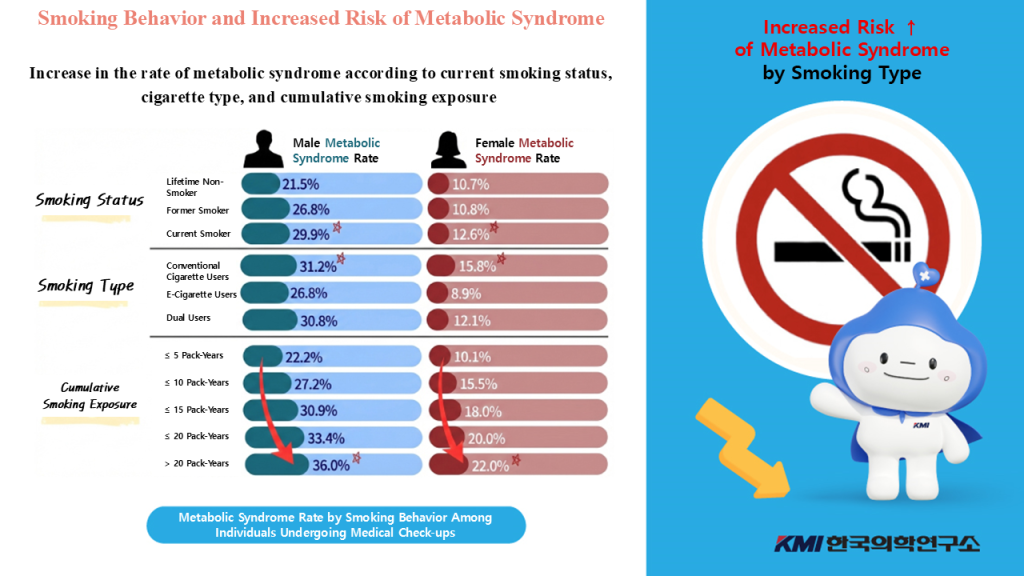
The study found that among men, the prevalence of metabolic syndrome increased from 21.5% in non-smokers to 26.8% in former smokers and 29.9% in current smokers. Examining specific smoking types, the prevalence was 31.2% among traditional cigarette users and 30.8% among dual users.
Metabolic risks also showed a correlation with cumulative smoking exposure. The prevalence of metabolic syndrome was 22.2% among those with five or fewer pack-years, but rose to 36.0% among those with more than 20 pack-years.
In women, the overall prevalence was lower, with 10.7% among non-smokers and 12.6% among current smokers. By smoking type, the rate was 15.8% among conventional cigarette users and 12.1% among dual users, increasing to 22.0% among those with more than 20 pack-years.
The prevalence of ventilatory function impairment, indicated by reduced respiratory function due to decreased lung capacity or airway obstruction, was 23.4% among men and 21.5% among women. Among those with more than 20 pack-years of smoking exposure, lung function decline sharply increased to 38.0% in men and 28.8% in women.
Former smokers also exhibited signs of lung function decline, suggesting that cumulative smoking exposure significantly impacts respiratory health even after quitting.
The study also revealed evolving smoking patterns. The proportion of lifetime non-smokers among men increased from 36.7% in 2022 to 39.7% in 2025, while e-cigarette-only use rose from 7.8% to 10.0% during the same period. Repeated health check-up data indicated a decline in the proportion of individuals continuing to smoke traditional cigarettes, but an increase in transitions to non-smoking, e-cigarette use, and dual use.
“Smoking is associated not only with respiratory diseases but also with systemic metabolic function,” stated Ahn Ji-hyun, director of the KMI R&D Center and an internal medicine specialist. He also cautioned that smoking data among women might be underreported, and therefore findings should be interpreted by considering overall trends rather than absolute figures.
The analysis is based on anonymized health screening data collected from individuals visiting KMI centers and may not be fully representative of the broader population.
stlee0329