
Retail demand strong in subscriptions, but first-day trading turns choppy
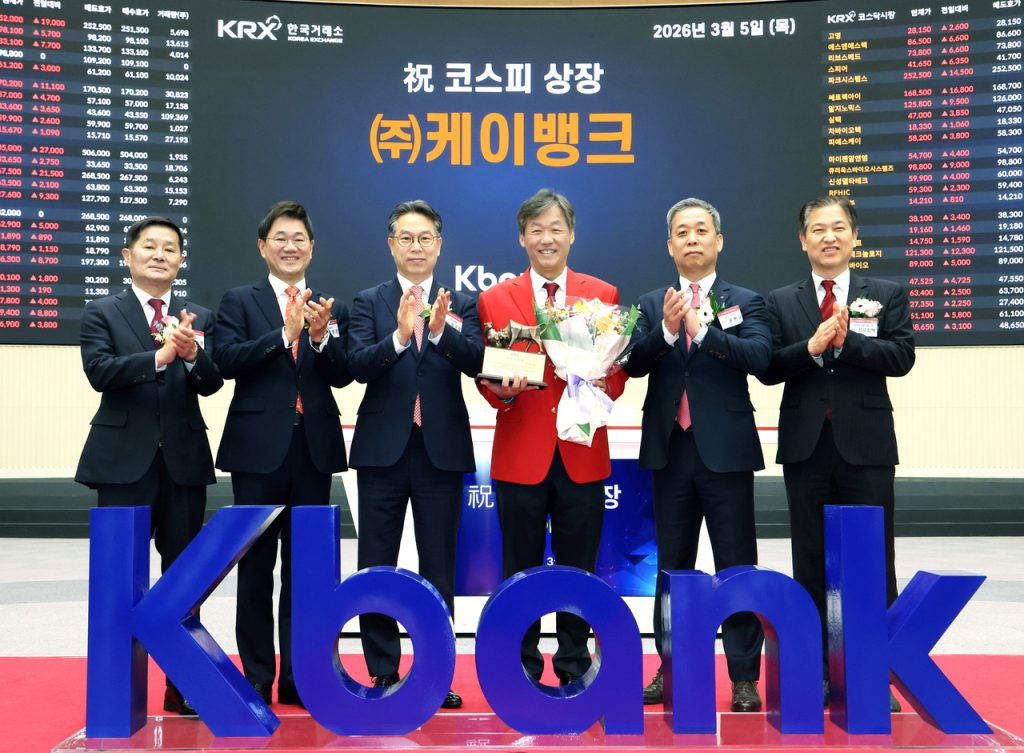
Korea’s first online-only bank, K bank, faced a challenging market debut on the Kospi Thursday, marking the end of a protracted and difficult IPO journey after two previous unsuccessful attempts.
The initial public offering (IPO) was met with considerable interest, with the stock price climbing as high as 16 percent to 9,880 won ($6.70) within the first hour of trading, exceeding its IPO price of 8,300 won. K bank offered 60 million shares in the IPO, generating approximately 498 billion won and valuing the digital bank at around 3.37 trillion won based on the initial offering price.
However, this positive start was not a given, especially following a turbulent week for global markets. The Kospi experienced a significant drop of 12 percent on Wednesday and 7 percent on Tuesday, triggered by rising geopolitical tensions in the Middle East. Seoul’s market was particularly vulnerable after an extended two-month rally, creating uncertainty among investors about the sustainability of the upward trend.
The market briefly rebounded on Thursday morning, with the Kospi opening 3 percent higher and subsequently increasing nearly 12 percent to over 5,700, marking a positive shift after four consecutive sessions of decline.
Unfortunately for K bank, this positive momentum was short-lived. The stock quickly lost much of its early gains, falling as low as 8,120 won in the afternoon, approximately 2 percent below the IPO price, before settling to close almost unchanged at 8,330 won.
This subdued first-day performance cast a shadow over K bank’s highly anticipated listing, which had been delayed twice in 2022 and 2024 due to unfavorable market conditions and a lack of investor enthusiasm.
The disappointment was especially acute given the strong indications of investor interest leading up to the listing, particularly during the public subscription period. The retail offering, held on February 20 and 23, attracted a competition rate of around 135 to 1, signifying strong demand from individual investors. This enthusiasm was fueled, in part, by K bank’s IPO launch coinciding with a broader market rally that had pushed the benchmark index above 6,000, a roughly 40 percent increase since the beginning of the year.
Nevertheless, the successful listing removes a significant obstacle for K bank. The company had previously secured approximately 700 billion won from financial investors with the condition that it complete its IPO by July 2026. The agreement included drag-along rights, allowing investors to compel the sale of their stakes, as well as shares held by BC Card, K bank’s largest shareholder, if the IPO failed.
K bank plans to allocate the IPO proceeds to diversify its financial portfolio through expanding loans to small and midsized enterprises (SMEs), enhancing its technological infrastructure, scaling its platform business, and aggressively pursuing opportunities in digital assets and stablecoins.
jwc


