
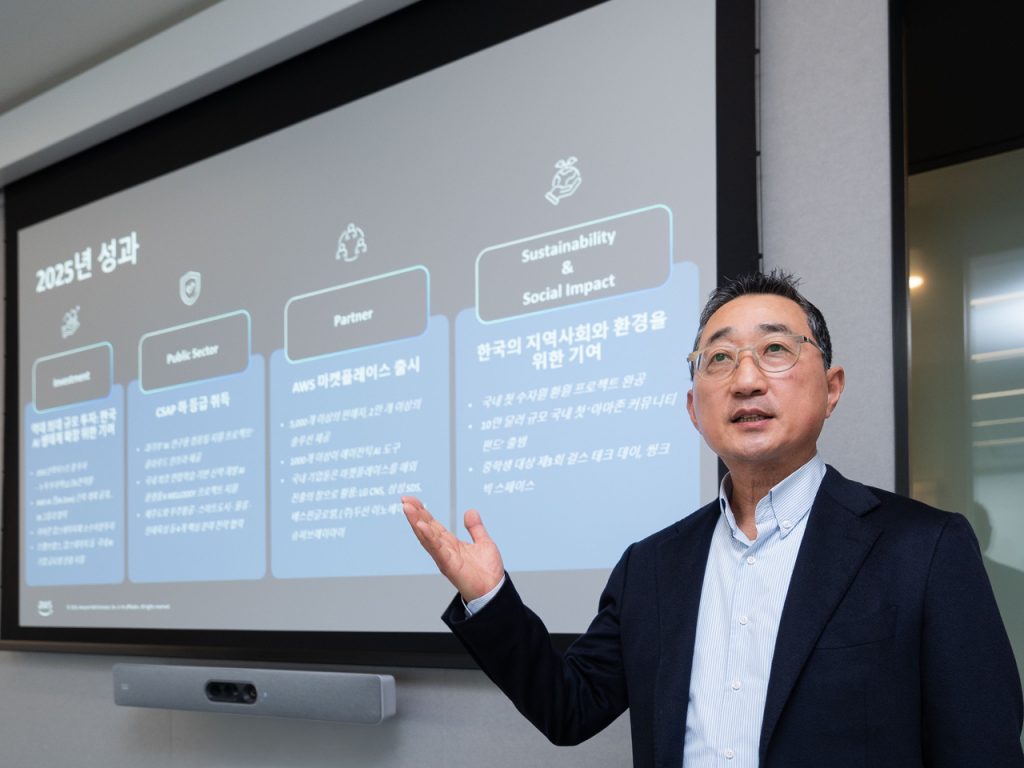
Amazon Web Services Korea is boosting its infrastructure investments this year, focusing on expansion in the public sector and the advancement of agentic AI. This strategic move aligns with the South Korean government’s goal to become a global AI leader.
“We are dedicated to providing enhanced services for our Korean customers and contributing to South Korea’s ambition to rank among the world’s top three AI nations, a vision championed by President Lee Jae Myung,” stated AWS Korea country managing director Ham Kee-ho at a press conference held in Seoul on Tuesday.
The South Korean government aims to achieve its AI leadership goal by 2027 through substantial investments in graphics processing units (GPUs), enhanced data infrastructure, and the development of domestic foundation models.
In October, AWS CEO Matt Garman met with the President in Gyeongju, North Gyeongsang Province, announcing a plan to invest over $5 billion in Korea by 2031. This investment includes new AI data centers in Incheon and Gyeonggi Province. This commitment, combined with previous investments, brings AWS’s total planned investment in South Korea to over $9 billion by 2031, marking the largest investment by a foreign company in the country.
“We will continue to expand our investment and upgrade AI infrastructure across both the public and private sectors to bolster South Korea’s competitiveness,” Ham affirmed.
Beyond financial investments, Ham emphasized the transformative impact of AI adoption, predicting that AI-driven operating models could enable at least five Korean companies to generate $100 billion in annual revenue with lean teams of fewer than 12 employees by 2029.
“Currently, over 60 percent of Korean companies are already integrating multiple AI models into their daily operations,” he noted. “If this trend continues, we anticipate the emergence of highly efficient, high-revenue firms.”
AWS estimates that 60% of Korean companies have already implemented AI agents. However, challenges remain. According to data from International Data Corp. Korea, a lack of clear guidelines is the biggest hurdle to AI deployment for half of Korean companies – 5.9 percentage points higher than the global average.
“We have entered the AI-native era,” Ham stated, highlighting a shift from AI as a mere support tool to a system capable of independently executing tasks.
He further added that AWS’s recent $50 billion strategic partnership with OpenAI will serve as “a powerful engine” to accelerate the adoption of AI agents by Korean companies.
yeeun


