Major banks roll out emergency support programs as government reviews 100 trillion won market stability plan
South Korea’s financial sector is bracing for potential economic repercussions from the escalating Middle East conflict. Major banking groups are launching emergency support programs aimed at assisting companies vulnerable to the increasing geopolitical instability, while financial authorities are enhancing their surveillance of financial markets.
Hana Financial Group announced Monday a 12 trillion won ($8.2 billion) financial assistance package, delivered through Hana Bank. This initiative targets companies susceptible to disruptions caused by the conflict, offering emergency liquidity support of up to 500 million won for businesses operating in or trading with the Middle East. The program also provides for loan maturity extensions, repayment grace periods, and interest rate reductions of up to 1 percentage point.
In addition, the group stated it would collaborate with government bodies to supply essential goods and support packages to Korean citizens residing in the Middle East.
“Hana will deploy all available resources to help Korean residents and businesses affected by the unexpected geopolitical turmoil recover stability as swiftly as possible,” stated Chairman Ham Young-joo.
Other leading banking groups are implementing similar monitoring and support actions as the effects of the rising tensions reverberate across global markets.
Shinhan Financial Group has activated an internal monitoring system, engaging key executives to closely observe financial market trends and their potential effects on the group. The company reports no direct damage thus far and will maintain its crisis management level at “caution,” conducting weekly meetings to assess market conditions.
KB Financial Group’s chairman and subsidiary heads are jointly monitoring exchange rates, interest rates, and oil prices in real-time to evaluate potential disruptions.
Woori Financial Group acted proactively, announcing on Sunday the activation of an emergency response system headed by Chairman Yim Jong-yong. Along with enhanced market monitoring and financial support for businesses, Yim mandated stricter cybersecurity protocols across its affiliates to protect against potential cyberattacks exploiting the instability.
This coordinated response from financial groups occurs as authorities move to limit potential consequences for the broader economy.
Financial regulators convened an emergency meeting on Sunday following US and Israeli strikes on Iran, which significantly intensified Middle East tensions. The regulators activated a financial market emergency response team, indicating preparedness to implement market stabilization measures exceeding 100 trillion won if necessary.
“The situation in the Middle East remains highly uncertain, and if tensions persist, the impact could spread to domestic financial markets and the real economy,” stated Financial Services Commission Chairman Lee Eog-weon, who presided over the meeting, emphasizing the need for increased vigilance.
The response team, comprised of officials from the FSC, the Ministry of Economy and Finance, the Bank of Korea, and the Financial Supervisory Service, will maintain continuous market monitoring and information sharing across agencies.
Global markets have already reacted to the geopolitical shock. Brent crude closed at $72.48 a barrel on Friday, a 2.5 percent increase. Futures traded higher around $78 on Monday, Seoul time, as investors factored in potential risks to energy supplies through the Persian Gulf. US benchmark West Texas Intermediate futures briefly surged by over 8 percent to $72 in early trading before settling around $70.7, still up approximately 5.5 percent.
The surge in oil prices prompted investors to seek safe-haven assets, strengthening the US dollar. Gold futures briefly exceeded $5,400 and were trading near $5,374 on Monday afternoon, reflecting a 2.4 percent increase.
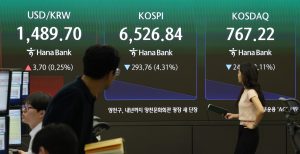
The Korean won also experienced downward pressure. In offshore trading on Monday afternoon, the currency weakened to around 1,456 per dollar from Friday’s onshore close of 1,424.5, surpassing the 1,450 level for the first time in over a week as heightened energy prices and global risk aversion drove up demand for the US dollar.
Investors are now closely watching how the geopolitical shock may affect Korea’s stock market when trading resumes on Tuesday after a public holiday. The Kospi declined by 1 percent on Friday to 6,244.13, halting the benchmark’s recent gains as foreign investors increased net selling. During Korea’s market closure, major Asian equities also faced pressure due to Middle East tensions, with Japan’s Nikkei 225 falling by as much as 2.7 percent in earlier trading, and Chinese markets also weakening.
jwc