
Auto giant to build AI data center, robotics cluster, hydrogen city from 2026
Hyundai Motor Group is set to invest 9 trillion won ($6.27 billion) in Saemangeum, North Jeolla Province, to establish a large-scale advanced industry hub. This strategic move underscores Hyundai’s commitment to becoming a leader in future technology, with a focus on robotics, artificial intelligence (AI), and hydrogen energy.
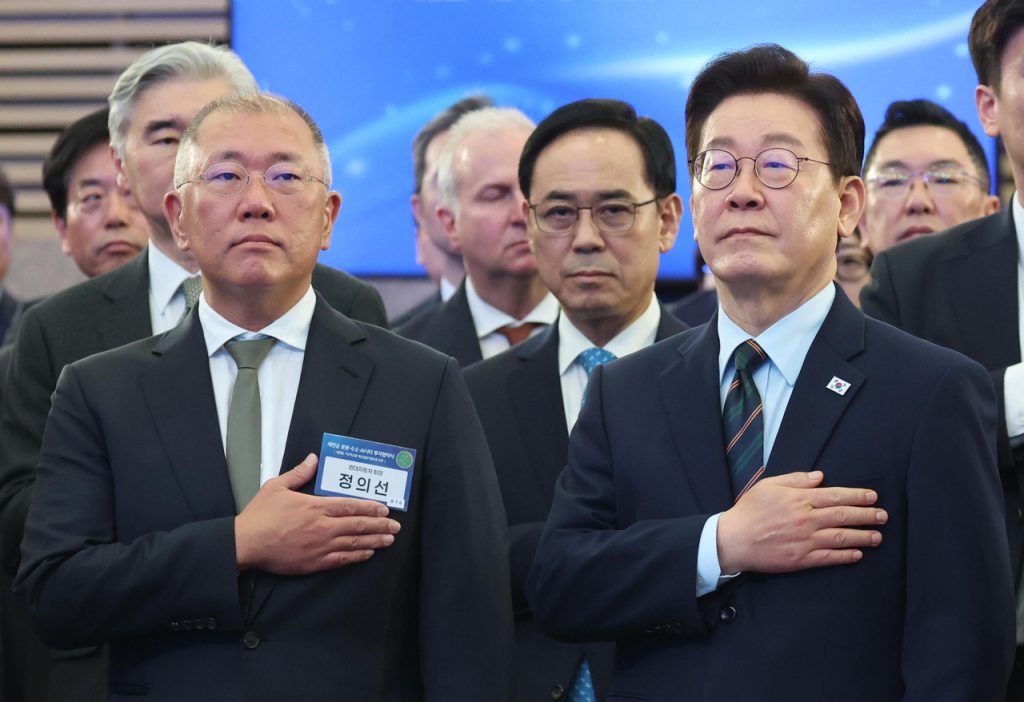
President Lee Jae Myung has expressed his support for this significant investment, emphasizing its potential to transform the region.
“This will completely reshape the economic map of the (southwestern) Honam region,” Lee stated during the investment agreement ceremony held at the Saemangeum Convention Center in Gunsan. “I sincerely welcome Hyundai Motor Group’s large-scale investment in Saemangeum.”
Lee further noted that the new facilities will produce logistics and industrial robots integrated with an AI data center for continuous learning, establishing Saemangeum as a future-oriented city where robotics are seamlessly integrated into daily life.
Hyundai Motor Group has formalized its commitment by signing a memorandum of understanding with the government and the North Jeolla provincial administration. The agreement aims to cultivate the robotics and hydrogen industries and create an “AI hydrogen city” within the reclaimed coastal zone.
Starting in 2026, Hyundai plans to transform a 1.12 million-square-meter site into an integrated value chain, encompassing an AI data center, a robotics manufacturing and parts cluster, a 200-megawatt water electrolysis plant, gigawatt-scale solar power facilities, and a smart hydrogen-powered city.
This investment is a critical component of Hyundai’s previously announced 125.2 trillion won domestic investment plan, and is projected to generate approximately 16 trillion won in economic impact, while creating around 71,000 direct and indirect jobs.
At the heart of this ambitious project is a 5.8 trillion won AI data center, designed to gradually scale up to accommodate 50,000 graphics processing units. The facility will be responsible for processing and storing the vast amounts of data required for autonomous driving, robotics, and the development of software-defined vehicles, supporting Hyundai’s broader “physical AI” vision.
Hyundai’s goal is to establish a closed-loop system where data collected from manufacturing, logistics, and sales operations is used to train AI models. This data is then reapplied to products and services, accelerating development cycles and enhancing reliability.
The group will also invest 400 billion won to establish a robotics manufacturing and components cluster, with an annual capacity of up to 30,000 units. This facility will integrate smart logistics systems based on automated guided vehicles and autonomous mobile robots. It will also function as a contract manufacturing base for small and medium-sized firms, supporting local suppliers in expanding into robotics and reducing reliance on imported core components such as motors and sensors.
To solidify its hydrogen strategy, Hyundai will construct a 200-megawatt water electrolysis plant, valued at 1 trillion won. This plant will utilize renewable electricity generated in Saemangeum to produce clean hydrogen, which will then supply nearby refueling stations and power mobility solutions including trams, buses, and demand-responsive transport services.
The group aims to expand its domestic electrolysis capacity to 1 gigawatt in the future. Additionally, a hydrogen fuel cell plant is under construction in Ulsan, scheduled for completion in 2027, to further strengthen the supply chain for hydrogen components.
An additional 1.3 trillion won will be invested in gigawatt-scale solar power facilities to ensure a stable electricity supply for the AI data center and the electrolysis plant. Hyundai has been operating a 99-megawatt solar facility in Saemangeum since 2021 and intends to expand its renewable portfolio through 2035 to support carbon neutrality and RE100 goals.
The project also involves the development of an AI hydrogen city within Saemangeum’s 6.6-square-kilometer smart waterfront district. This city will integrate AI-driven robotics into transportation, logistics, and safety systems, while adopting a localized hydrogen production-and-consumption model.
Prior to the signing ceremony, officials were given a demonstration of Hyundai’s robotics and hydrogen technologies, including the humanoid robot Atlas, the MobED mobile platform, the wearable robot X-ble, and uncrewed firefighting robots, as well as hydrogen mobility models such as the Nexo fuel cell SUV and hydrogen buses and trucks.
Vice Chairman Jang Jae-hoon stated that the Saemangeum initiative will serve as a cornerstone for Korea’s next industrial transformation.
“The next-generation industrial paradigm beginning in Saemangeum will go beyond regional development and become a central axis for designing Korea’s future,” Jang said. “Hyundai Motor Group is fully prepared to build an advanced industrial ecosystem spanning manufacturing, robotics, AI and hydrogen energy.”
Construction of the AI data center and solar facilities is scheduled to begin in 2027, with completion targeted for 2029. The electrolysis plant will be built in phases, starting the same year, while the robotics cluster is slated for completion in 2029.
Hyundai stated that the Saemangeum hub will strengthen regional balanced development and position Korea as a global leader in robotics, AI, and hydrogen-based industries.
sahn


