
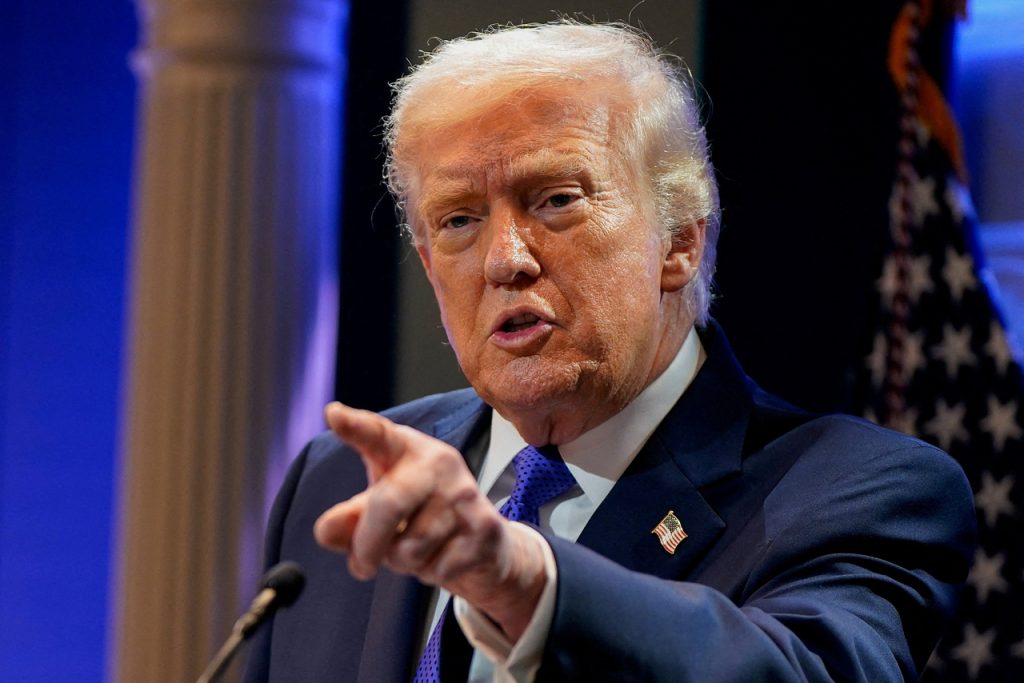
WASHINGTON — Former US President Donald Trump has announced a new 10% global tariff, responding to a Supreme Court decision that struck down his previous emergency duties. Trump vowed to implement these new measures to address trade imbalances.
This proclamation follows the Supreme Court’s ruling against his use of the 1977 International Emergency Economic Powers Act (IEEPA) to justify “reciprocal” tariffs. Trump expressed his disappointment with the court’s decision.
The new 10% tariff, set to take effect at 12:01 a.m. on Tuesday, is based on Section 122 of the 1974 Trade Act. This provision grants the president the authority to impose import restrictions, including tariffs and quotas.
According to a White House fact sheet, certain goods will be exempt from the tariff, including critical minerals, metals used in currency and bullion, energy products, specific agricultural products, passenger vehicles, and certain light, medium, and heavy-duty trucks.
During a press conference, Trump stated that his administration has “even stronger measures” than the IEEPA.
“Today, I will sign an order to impose a 10 percent global tariff under Section 122 over and above our normal tariffs already being charged,” Trump stated.
“We’re also initiating several Section 301, and other investigations to protect our country from unfair trading practices of other countries and companies,” he added, referencing the 1974 Trade Act.
Section 122 allows the president to impose import surcharges of up to 15% and other measures, such as import quotas, to address significant trade and financial imbalances. These measures can initially last for up to five months.
“During that period of five months, we are doing the various investigations necessary to put fair tariffs or tariffs … on other countries,” Trump said. “So we are doing that period, but we’re immediately instituting the 10 percent provision, which we are allowed to do.”
Trump suggested that the court’s decision might “not substantially constrain a president’s ability to order tariffs going forward,” emphasizing that his administration has other tools available to impose duties.
“The good news is that there are methods, practices, statutes and authorities, as recognized by the entire court and also is recognized by Congress, that are even stronger than the IEEPA tariffs available to me as the president of the United States,” he said.
Trump outlined a series of provisions, including Sections 122, 201, and 301 of the 1974 Trade Act and Section 338 of the 1930 Tariff Act, as other legal tools his administration can use.
Criticizing the court ruling, Trump claimed that foreign countries that have been “ripping us off” are “ecstatic.”
“They are so happy, and they are dancing in the streets, but they won’t be dancing for long,” he said. “I can assure you.”
He also stated that the court has been “swayed by foreign interests and a political movement that is far smaller than people would ever think.”
In April, Trump announced his IEEPA-based reciprocal tariff plan, stating that a lack of “reciprocity” in trade with trading partners and their trade barriers led to “large” and “persistent” trade deficits, which he claimed posed an “unusual” and “extraordinary” threat to US national security and the economy.
However, the Supreme Court stated that the framers of the US Constitution granted “Congress alone” the power to impose tariffs during peacetime, and that the foreign affairs implications of tariffs do not suggest that Congress would relinquish its tariff power “through vague language, or without careful limits.”


