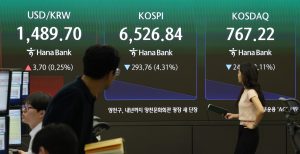
South Korean investors significantly increased their overseas stock investments in 2025, reaching a record high nearly triple the previous year. Data released by the central bank on Wednesday indicates this surge brings overseas equity investments to a level comparable to the nation’s annual current account surplus.
According to the Bank of Korea (BOK), residents’ total overseas equity investments soared to $114.35 billion in the past year, a substantial jump from $42.16 billion in 2024.
This figure more than doubles the previous record of $68.53 billion, established in 2021.
Analyzing investor types, asset managers, securities firms, and insurers accounted for $42.1 billion of the total overseas equity investment. The National Pension Service (NPS) and other public institutions followed with $40.7 billion, while individual investors contributed $31.4 billion.
“When considering retail investors’ investments in overseas exchange-traded funds (ETFs) through asset managers, the total direct and indirect overseas equity investment by individuals in 2025 is estimated to surpass that of the NPS and other public institutions,” stated a BOK official.
The significant increase in overseas stock investment has been identified as a contributing factor to the weakening of the South Korean currency (Won). This demand for US dollars, fueled by overseas investments, has counteracted the increased dollar supply resulting from the country’s current account surplus, the official explained.
South Korea recorded its largest annual current account surplus ever in 2025, reaching $123.05 billion. This was driven by strong export performance, particularly in the semiconductor industry.
The primary income account, which includes wages of foreign workers, dividend payments from overseas, and interest income, also reached a record surplus of $27.92 billion in 2025.
In 2025, the country’s dividend income surplus increased by 11 percent year-on-year, reaching a record $20.19 billion. Conversely, the interest income surplus decreased by 4.95 percent to $9.98 billion, resulting in an overall investment income surplus of $30.17 billion for the year.
“The increased overseas securities investment by South Korean investors appears to have mitigated a considerable portion of the positive impact of the current account surplus on the country’s economic fundamentals,” the BOK official commented.
Throughout the past months, the Korean Won has fluctuated around the key psychological threshold of 1,450 Won per dollar. Towards the end of last year, it fell to a multi-year low of 1,480 Won, pressured by a generally strong US dollar, geopolitical uncertainties, and substantial overseas securities investments by domestic investors.