19-Year Google Map Data Impasse in South Korea: Infrastructure Costs, Not Government Resistance, at the Heart of the Issue
For nearly two decades, Google has sought permission from South Korea to export its detailed 1:5000 map data, a request consistently denied by Seoul. While national security concerns, given Korea’s technically still-at-war status, have been the standard explanation, a revised proposal from Google has shifted the focus.
Google’s latest proposal addresses nearly all security conditions previously set by the South Korean government.
However, a critical element remains absent: a commitment to establish a data center within South Korea.
Yoo Ki-yoon, former director of Korea’s National Geographic Information Institute, the agency responsible for producing the country’s base maps, argues that framing the debate as a regulatory hurdle or server location dispute is a simplification.
“If the financial benefits are there, Google will invest, pay taxes, and compete, as demonstrated in Japan recently,” stated Yoo, now a professor of geospatial engineering at Seoul National University, in an interview with The Korea Herald. “Google’s absence in Korea isn’t due to restrictions but rather a strategic decision that the current returns don’t justify the required investment.”

The cost assessment extends beyond mere map server operation, encompassing the potential implications of a physical presence. Google Korea reported revenues of 386.9 billion won (approximately $268 million) in 2024, incurring 17.2 billion won in corporate tax. However, Professor Jeon Seong-min of Gachon University estimates Google’s actual Korean earnings from platforms like YouTube, the Play Store, and advertising to range between 4.8 trillion and 11.3 trillion won, based on US Securities and Exchange Commission filings and domestic corporate disclosures.
This discrepancy arises from a corporate structure that channels revenue through low-tax jurisdictions. Establishing a Korean data center could subject this structure to increased scrutiny, according to Yoo, “not only for maps but potentially for all Google services used by Korean consumers.”
Naver Maps dominates the domestic market with approximately 68% share, integrated into a comprehensive search and commerce ecosystem that Google has struggled to penetrate. “A standalone map service doesn’t generate sufficient revenue to offset the tax implications a local data center would trigger for Google,” he explained.
Every commercial map in South Korea relies on the government’s base map, a publicly funded infrastructure developed over decades. Similar export restrictions exist in around 40 countries, including the United States. The principle, as Yoo articulated, is clear: “If you intend to profit from public infrastructure, you should establish a local presence and contribute your fair share.”
Skepticism Surrounds Economic Impact Studies
Yoo also expressed skepticism regarding the economic research surrounding the debate. A preliminary study by urban policy professor Jung Jin-do of Korea National University of Education projected potential losses of up to 197 trillion won over a decade if map data export were permitted. Conversely, a 2024 study by The Korea Academic Society of Tourism and Leisure forecasted an increase of 3.4 million annual tourists due to improved Google Maps.
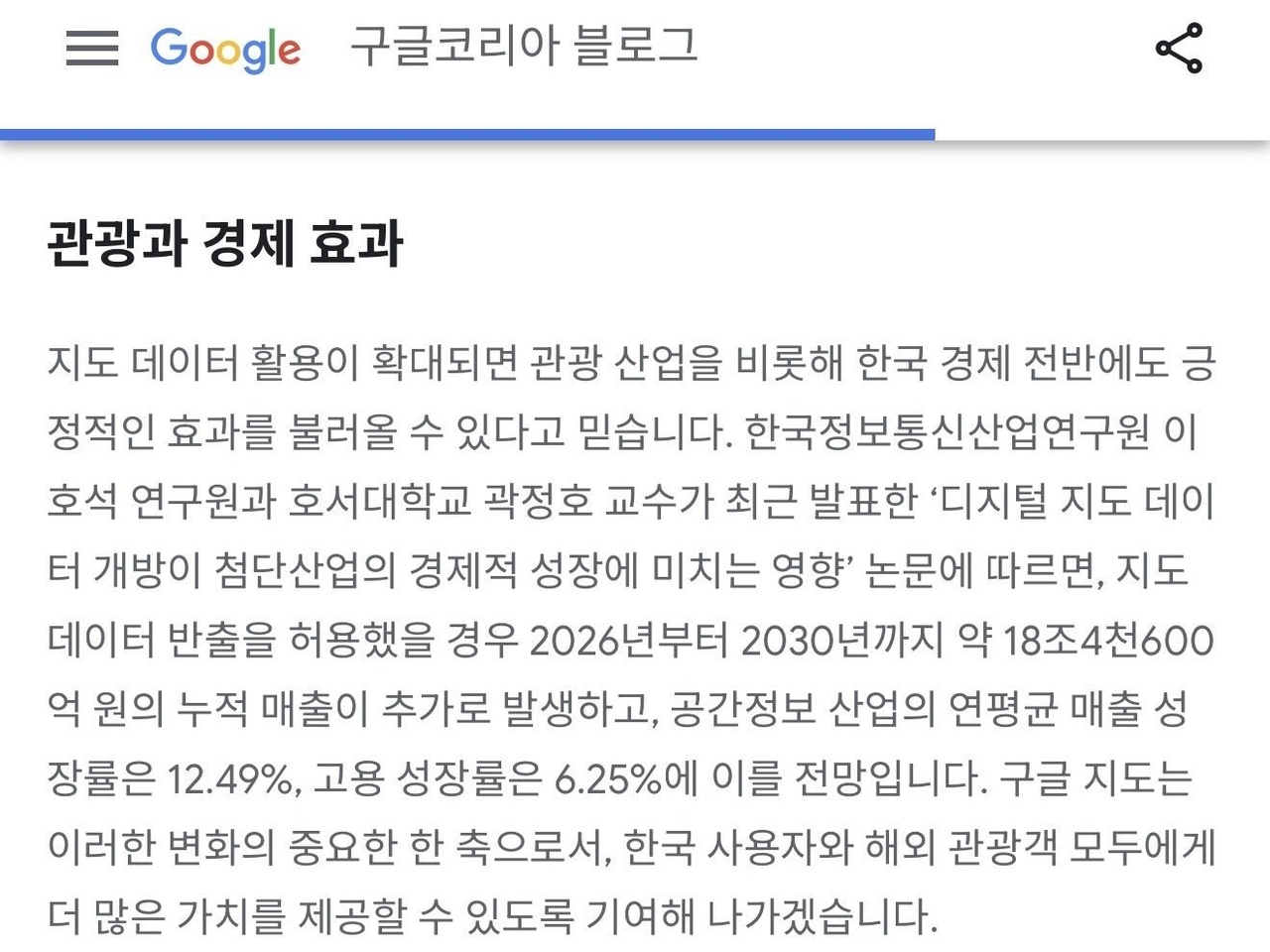
Another study, cited in a Google Korea blog post in August 2025, claimed cumulative industry gains of 18.46 trillion won over five years if South Korea allowed map data export.
“None of this research is particularly credible,” Yoo asserted. He pointed out that the 2025 paper cited by Google was not peer-reviewed, dismissing it as “a leaflet masquerading as scholarship.”
He argued that such research is inherently problematic: “Maps are interwoven with advertising, navigation, commerce, and mobility platforms. It’s virtually impossible to isolate the economic impact of map data alone.”
If the economic arguments are inconclusive, what will resolve the 19-year stalemate? Yoo believes the answer lies not in Seoul’s policies, but in Google’s long-term strategy.
The next generation of Google services, such as Waymo’s autonomous vehicles and augmented reality smart glasses, will rely heavily on local infrastructure. Autonomous vehicles require precise 2D navigation maps for route calculation, while AR glasses need street-level data to overlay information onto the real world. Given South Korea’s high smartphone penetration and strong automotive industry, it becomes “a market you cannot ignore,” according to Yoo.
This fundamentally alters the economic calculation. While Google Maps alone might not justify a Korean data center, the combined potential of Waymo, smart glasses, and other location-based services “could potentially shift the equation.” Yoo referenced Google’s 2023 investment in local server infrastructure in Japan once the returns were deemed sufficient.
“When the numbers make sense, Google will willingly establish a local presence, pay taxes, and compete fairly.”
Until that point, South Korea’s position remains unchanged. “We aren’t asking anything of Google,” Yoo stated. “Google is making a request of us, and we have no reason to grant it for free.”
mjh