
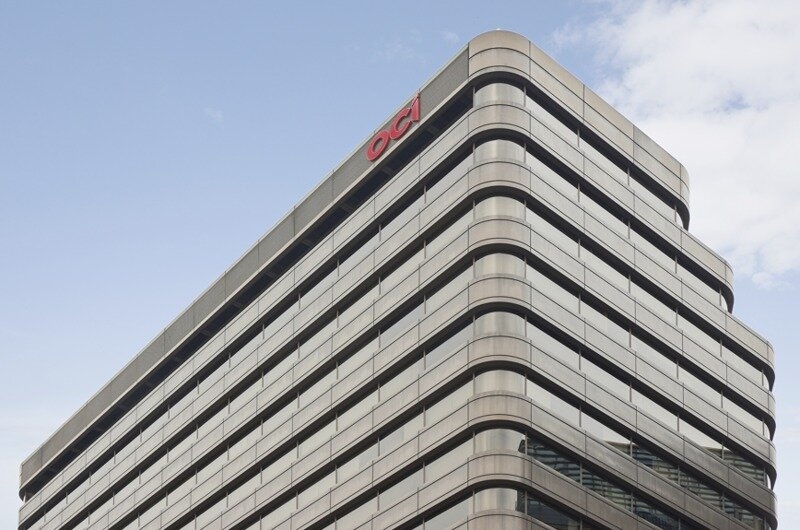
OCI Holdings announced a return to profitability in the fourth quarter of last year, driven by a recovery in its Malaysian solar material business and strong performance in housing sales at its real estate division.
The South Korean chemical manufacturer reported an operating profit of 27.3 billion won ($18.79 million) for the period spanning October to December, a significant turnaround from the 107.8 billion won loss recorded in the same period the previous year. This marks the company’s first quarterly profit in three quarters.
Fourth-quarter revenue reached 810.6 billion won, a 5.1 percent decrease year-on-year, while net profit soared to 26.6 billion won, a dramatic improvement from the 81.99 billion won deficit reported a year earlier.
The company credited the positive results to the resumed operations of its Malaysian subsidiary, OCI TerraSus, which boosted sales of solar-grade polysilicon, and the successful pre-sales of apartments in Korea through its urban development arm, DCRE.
However, for the entire year, OCI Holdings experienced a net loss due to policy uncertainties and production disruptions that impacted its core solar materials operations.
In 2025, the company reported an operating loss of 57.6 billion won, compared to the 101.5 billion won profit earned the previous year. Revenue declined by 5.5 percent to 3.38 trillion won, and net profit shifted to a loss of 144.2 billion won from a profit of 113.7 billion won in 2024.
OCI Holdings attributed these challenges to uncertainties surrounding US trade policies, including potential reciprocal tariffs and the “One Big Beautiful Bill” legislation, which impacted overall earnings.
To mitigate these ongoing policy risks, OCI Holdings plans to diversify its supply chain away from Chinese solar suppliers and increase the production of “Non-Prohibited Foreign Entity” (Non-PFE) products – materials not linked to restricted foreign entities – to meet the requirements of its US customers.
Meanwhile, OCI’s real estate division, DCRE, reported fourth-quarter revenue of 110 billion won and an operating profit of 12 billion won, fueled by ongoing construction and sales at its City OCL residential complex in Incheon. The company plans to launch additional apartment units this year, totaling over 2,600 units.
OCI Holdings Chairman Lee Woo-hyun stated that the company continued to invest despite the business uncertainties experienced last year.
“From Malaysian polysilicon to Vietnamese wafers, we have made strategic investments to establish a ‘Non-PFE’ solar value chain,” Lee said in a statement. “OCI Holdings plans to continue efforts to enhance shareholder value by focusing on high-growth, high-value-added sectors aligned with the AI era, such as power infrastructure and semiconductor materials.”
sahn


