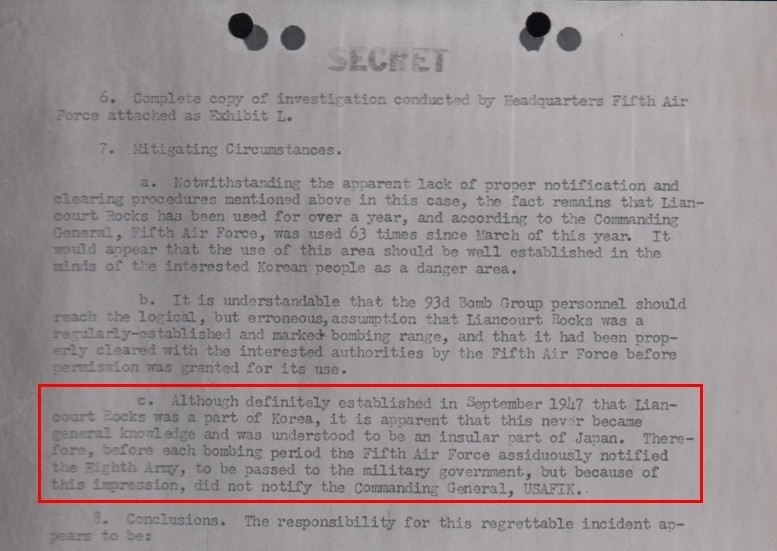
A recently declassified report from the U.S. Far East Air Forces (FEAF), dated June 24, 1948, definitively establishes the historical understanding of **Dokdo’s sovereignty**. The document explicitly states that it had been “definitely established in September 1947 that the Liancourt Rocks was a part of Korea,” referring to South Korea’s easternmost islets of **Dokdo**, using their Western designation.
Titled “Report of Bombing of Liancourt Rocks,” the document details a tragic incident earlier that month. U.S. Air Force aircraft, conducting a training exercise, bombed the islets, resulting in the deaths of 14 Korean fishermen and injuries to several others. This **1948 Dokdo bombing** is a somber part of the islets’ history.
**Dokdo** has long been a focal point of **territorial tension** between South Korea and Japan. Tokyo consistently asserts its claims over the islets in official papers, public statements, and educational materials. However, South Korea maintains a permanent police detachment on the islets, effectively asserting its **control over Dokdo**.
The language within this **U.S. Far East Air Forces report** is considered a clear acknowledgment of **Dokdo as Korean territory**, according to the Northeast Asian History Foundation, which spearheaded the discovery and public announcement of these vital documents.
This extensive 222-page file, containing the pivotal report, was located at the U.S. National Archives and Records Administration. Its identification was the work of Jeon Gap-saeng, a research professor at the East Asian Research Institute of Sungkonghoe University in Seoul.
Further emphasizing **Dokdo’s status as Korean territory**, the report includes a provision from “FEAF Radio MX 6399.” This required a fifteen-day prior notification to the commanding general of the U.S. Army Forces in Korea (USAFIK) before using the bombing range. USAFIK was the U.S. Army command overseeing the military government in South Korea at the time. The foundation interprets this as an obligation to inform relevant Korean authorities, reinforcing that **Dokdo was recognized as Korean territory**.

The newly uncovered archives also feature other significant documents supporting **Korea’s Dokdo sovereignty**. These include official correspondence from the then governor of Ulleung Island concerning Dokdo, alongside valuable testimonies from local residents. A document signed by local officials at the time of the bombing explicitly states they received no advance warning of the military exercise.
Moreover, the archive contains a 1946 official document from an Ulleung Island governor, confirming **Dokdo as part of Ulleung’s jurisdiction**. This includes a handwritten copy of a report by Shim Heung-taek, a local official renowned for protesting Japan’s illegal incorporation of the islets in 1905.
While the contents of Shim’s report were previously known, this discovery marks the first time the document has been found in its original, standalone single-sheet form, as highlighted by the foundation.
These newly found historical materials are anticipated to serve as crucial **primary evidence of Korea’s sovereignty over Dokdo** during the immediate post-liberation era, a period for which such definitive documentation has been limited.
“These records are important historical materials showing that U.S. military authorities clearly recognized **Dokdo as Korean territory** at the time,” stated the foundation. They also announced plans to display these significant documents publicly during future exhibitions at the Dokdo Museum Seoul.