By Lee Minji
The MBC romantic comedy series, starring Byeon Woo-seok as Grand Prince I-An and IU as conglomerate heiress Seong Hui-ju, captivated audiences with its intriguing premise. Set in a fictional 21st-century constitutional monarchy, the drama follows their journey from a strategic marriage contract to an unexpected discovery of true love and courage.
This 12-episode K-drama concluded triumphantly, achieving a record 13.8 percent viewership for its finale. It quickly became the most-watched Korean series on Disney+ across major international markets, including North America, Europe, and Latin America, solidifying its global appeal.
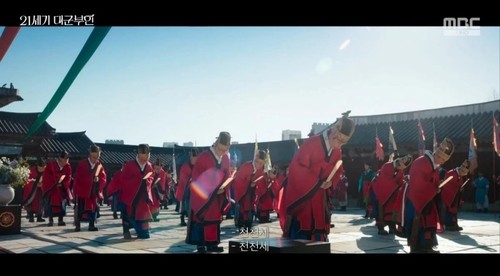
Despite its initial success, the series soon faced significant controversy regarding its historical accuracy, particularly following the 11th episode depicting Grand Prince I-An’s coronation. Viewers and critics noted the use of ‘cheonse’ – a term associated with vassal states – instead of ‘manse,’ appropriate for an independent nation. Furthermore, the Grand Prince’s crown was criticized for resembling those used in subordinate states during the Joseon Dynasty.
In response, the production team promptly issued an official apology, acknowledging their failure to accurately portray the court etiquette and historical context of the Joseon Dynasty (1392-1910).
The team stated, “We deeply apologize for causing concerns over the concept and historical research. These issues occurred as we did not thoroughly check how Joseon-era etiquette changed through history.” They accepted with a “heavy heart” criticisms that these inaccurate depictions could potentially damage South Korea’s international image as an independent nation.
Measures are now underway to swiftly correct the audio and subtitles in all videos for online streaming platforms and future re-runs.
As the controversy persisted, lead actors Byeon Woo-seok and IU also released separate apologies addressing the issue.
In a handwritten note shared on his social media, Byeon Woo-seok expressed, “There was not enough consideration of the historical context and meaning embedded in the work and of how it might be received by viewers,” pledging to adopt a more cautious approach in his acting career.
IU echoed similar sentiments in her apology.
She stated, “As it was important to capture both imagination rooted in our own history and the traditional beauty of Korea, I feel ashamed that I, as an actor, should have read and studied the script more carefully,” emphasizing the importance of diligent research.
Critics have underscored the urgent need for heightened caution in historical research for Korean TV series and films, especially given their expanding global influence and viewership.
Renowned history lecturer Choi Tae-seong commented on his social media, “It’s not only us watching. The whole world is watching… we need a system fit for that status.” He advocated for systemic changes within the industry rather than placing sole accountability on actors.
He further lamented, “Controversies over history distortion always happen but things do not change… please respect academic history,” highlighting a recurring pattern of unaddressed issues.
The Voluntary Agency Network of Korea (VANK) confirmed it has dispatched an official letter to Disney+, requesting corrections to the audio and subtitles for the disputed episode. VANK also plans to initiate a campaign, collaborating with Hallyu fans, to identify and rectify historical inaccuracies in Korean films and dramas.