By Lee Minji
Veteran actress Jeong-su makes a captivating comeback to the silver screen after a twelve-year hiatus, marking her return with a pivotal role in a new independent film. Her return follows a significant period of personal change, including marriage, motherhood, and divorce, all before stepping back into her acting career.
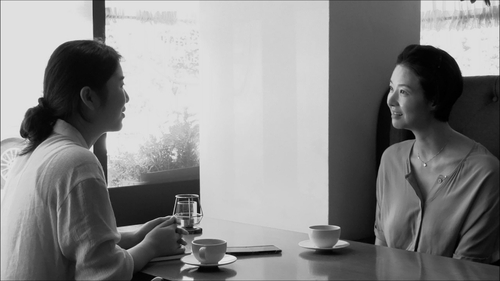
Acclaimed director Hong Sang-soo presents his 34th feature, “The Day She Returns,” a poignant black-and-white film that chronicles a single day in the life of actress Jeong-su. The narrative largely unfolds through a series of press interviews she conducts with three young female journalists at a unique restaurant managed by a German Korean family.
Shot predominantly in stark black-and-white, the film crafts a minimalist atmosphere, primarily set around a windowside table. The subtle background sounds of clanging pots and dishes serve to enhance, rather than distract from, the intimate tableside dialogues, inviting audiences to deeply engage with the conversations.
The cinematography maintains an intense focus on Jeong-su, subtly capturing the three reporters’ voices and partial appearances from behind or the side. This technique immerses viewers in Jeong-su’s candid interactions during the interviews, punctuated by numerous cups of coffee and several pints of German beer—offerings some journalists courteously decline.
Despite Jeong-su’s initial eagerness to discuss the film itself, the interviews swiftly pivot towards her personal journey. The journalists display a keen interest in her private life, delving into topics like her divorce and daily routines, shifting the focus away from her cinematic return.
Remarkably, the dynamic soon reverses, with the interviewers gradually revealing their own frustrations. Their candid confessions touch upon professional challenges and complexities in their romantic relationships.
This evolving series of conversations culminates as the three young reporters collectively seek wisdom from the experienced middle-aged actress, prompting her for “any word of advice for young people.”
Responding with a compassionate, older sisterly demeanor, Jeong-su imparts a message of self-love, even extending a comforting hug to one of the reporters post-interview, showcasing her genuine empathy.
Jeong-su, whose dialogue frequently features emphatic repetitions of “truly” and “really,” also shares profound insights on achieving inner peace by embracing reality and accepting circumstances as they are.
 “/>
“/>
Later that afternoon, in an acting class, Jeong-su attempts to reenact the very conversations she had earlier. However, she finds herself struggling to accurately recall the precise details of her statements during the interviews.
Amidst uneasy silences, Jeong-su fidgets with her script, her recited lines diverging notably from the actual interviews conducted earlier. This subtle shift highlights the fluidity of memory and perception.
This seemingly simple narrative—an actress giving interviews and then struggling to recall their exact content—provokes profound contemplation for audiences. It raises fundamental questions about memory, perception, and the elusive nature of truth: how do we truly remember events, and is our recollection truly reliable?
Yet, as Jeong-su herself suggests, perhaps such deep analytical dissection is ultimately unnecessary. The film encourages viewers to simply observe and accept its narrative as it unfolds, embracing its inherent honesty without overthinking.
“The Day She Returns” garnered international recognition with its premiere at the prestigious Berlin International Film Festival in February. It was featured in the Panorama section, known for highlighting cutting-edge independent and art house films that explore contemporary social issues and emerging cinematic trends.
Korean audiences can anticipate its local release next Wednesday, offering a chance to experience this thought-provoking cinematic work.