By Lee Minji
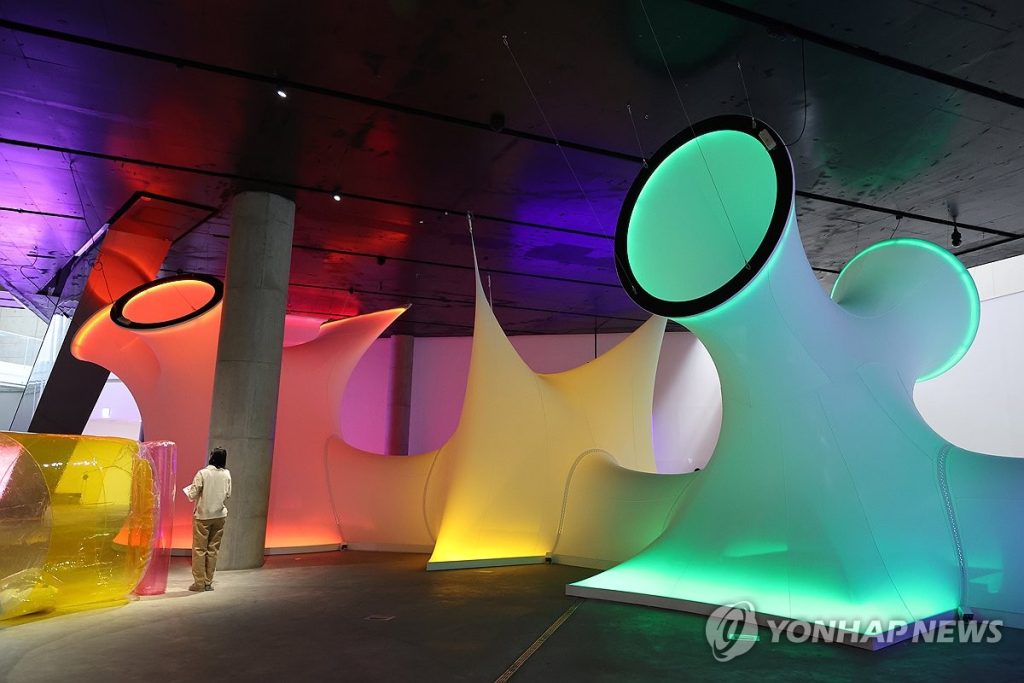
Step into a unique artistic journey at the Leeum Museum of Art in Seoul, where “Inside other spaces: Environments by women artists 1956-1976” invites visitors to truly become part of the art. A compelling voice welcomes you, “You are now inside my work,” ushering you into the meticulously restored world of South Korean visual artist Jung Kang-ja’s “Incorporeal Exhibition.” This groundbreaking showcase brings to life the historically overlooked contributions of pioneering women artists.
The “Inside other spaces” exhibition presents a rare collection of “environments,” or expansive immersive art installations, by eleven visionary women artists from Asia, Europe, and South America. Featured luminaries include iconic names like Judy Chicago, Tsuruko Yamazaki, and Aleksandra Kasuba, whose innovative works challenged conventional art forms.
In a postwar era predominantly focused on traditional paintings and sculptures, where the significant works of women artists were often sidelined, immersive art provided an unexpected sanctuary. Unlike art confined to pedestals or walls, this experiential medium offered women artists unparalleled freedom to explore and express themselves without typical constraints, as highlighted by the museum.
However, the ephemeral nature of immersive art, frequently dismantled post-exhibition, led to the loss of many significant works due to insufficient documentation. This exhibition, therefore, represents an extraordinary feat of art restoration, demanding extensive research to faithfully reconstruct these artworks to their original designs.
Curators Andrea Lissoni and Marina Pugliese, who initiated this ambitious project at the Haus Der Kunst museum in Munich, collaborated with researchers globally. Their meticulous process involved delving into historical records, artist correspondence, and architectural blueprints to revive these lost environments.
A particularly poignant restoration is Jung Kang-ja’s 1970 work, making its debut in this project at the Leeum exhibition. Curators painstakingly revisited archival materials, including vintage news articles and photographs, and consulted with the artist’s family. This dedication successfully brought Kang’s work back to life for the first time in 56 years, after its abrupt dismantling in 1970 under an authoritarian regime that deemed it political propaganda.
Beyond the physical restoration, these immersive artworks truly come alive through viewer engagement. The core appeal of immersive art lies in its invitation for visitors to interact with the pieces, transforming them into active participants within the artistic experience.

Tsuruko Yamazaki’s “Red” exemplifies this interaction. Modeled after traditional Japanese mosquito nets, this red-lit box floats 70 centimeters above ground, originally installed in a Japanese park. Visitors were encouraged to enter and be enveloped by the crimson light, their shadows becoming an integral, visible part of the artwork for external observers.
Similarly, Judy Chicago’s “Feather room,” a circular white chamber filled with 136 kilograms of soft goose feathers, offers an ethereal, cloud-like walking experience, inviting contemplation and wonder.
“This exhibition … allows environments to be revived as a newly written and living form that transcends the past and the present, without being sealed off as a historic genre,” affirmed Kim Sung-won, deputy director of Leeum, during a press conference. This perspective underscores the exhibition’s role in vitalizing art history and fostering new interpretations.
Don’t miss this groundbreaking celebration of women artists and immersive art at the Leeum Museum of Art. The exhibition opens next Tuesday and will be on view until November 29.