US policy shift reshapes competition while highlighting reliance on rare earths
The United States is actively working to temper China’s growing influence in the **humanoid robotics** sector, with new legislation poised to block **China-made robots** from **federal procurement** due to **national security concerns**.
This strategic policy shift could present a significant opportunity for **Hyundai Motor**. While **Chinese robotics competitors** face **US market restrictions**, the key question remains whether these limitations will expand beyond complete **robotic systems** to encompass critical **components and raw materials**, potentially **reshaping the global robotics supply chain**.
How the US plans to block Chinese robots
On March 26, a bipartisan effort by two US senators led to the introduction of the **American Security Robotics Act**. This landmark bill aims to prohibit the **federal government** from utilizing federal funds to acquire “unmanned ground vehicles” and “robotic systems” manufactured in nations deemed hostile to the U.S., including **China**.
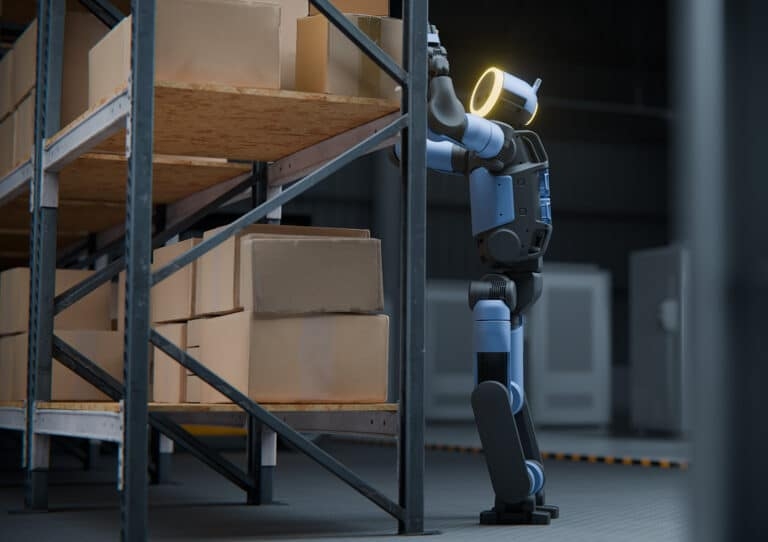
Designed to thwart potential infiltration of vital **national security systems** and **public infrastructure**, the proposed legislation broadly targets a range of **autonomous robotic systems**. This includes **autonomous patrol robots**, **mobile inspection platforms**, **logistics robots**, and **humanoid robots**, with specific focus based on their data-collection capabilities and autonomy levels.
While the **American Security Robotics Act** doesn’t explicitly ban individual **robotic parts**, industry sources indicate that critical **data collection and control components** – such as cameras, sensors, and controllers – will effectively fall under these restrictions when integrated into designated **robotic systems**.
Currently, **hardware components** manufactured in China, specifically **actuators** (the “muscles” enabling movement), **grippers** (human-like robot hands), and **motors**, remain unrestricted. Furthermore, these regulations do not yet encompass **upstream materials** like **rare earth metals**, an area where **China holds significant global dominance** in processing and production.
**Samsung Securities analyst Im Eun-young** projected in a recent report that the **American Security Robotics Act** is expected to be implemented by early 2027. Restrictions concerning the operation of existing equipment would then commence by the end of 2027.
While the bill’s current scope is limited to **robot procurement by US public institutions**, **industry experts** anticipate its expansion to private supply chains, especially those utilizing **federal funding**.
This anticipated expansion could alleviate competitive pressure from **Chinese players** within the **US humanoid robotics market**, directly benefiting **Hyundai Motor** and its Massachusetts-based subsidiary, **Boston Dynamics**.
According to an **industry insider**, “Hyundai is rapidly progressing to establish its independent **humanoid robotics supply chain**, strategically utilizing its robust network of domestic parts vendors. The company recently extended invitations to a select group of suppliers for proposals, with multiple vendors actively vying for each **robotics component category**.”
This initiative aligns with **Hyundai Motor’s** ambitious broader strategy to launch a **US-based humanoid robot production plant** capable of producing 30,000 units annually by 2028. Its automotive parts subsidiary, **Hyundai Mobis**, is bolstering this effort by constructing a local **robotics components facility**, initially concentrating on **actuators** with potential expansion to include **grippers**.
**Boston Dynamics** is also poised to significantly influence **US robotics policy**, contributing to the formulation of regulatory frameworks. This includes measures designed to structurally restrict the entry of **China’s humanoid robots**, alongside participating in broader **industry support initiatives**.
The **Special Competitive Studies Project**, a prominent US-based private think tank, recently inaugurated the “National Commission on Advanced Manufacturing Robotics.” **Boston Dynamics Vice President Brandon Schulman** will act as a commissioner, playing a crucial role in establishing strategic priorities. These include **strengthening supply chains**, **enhancing global competitiveness**, and reinforcing the broader ecosystem to solidify **US leadership in robotics**. The definitive **robotics policy roadmap** is slated for publication in March 2027.
Despite **Hyundai’s** clear **competitive advantage** over **Chinese robotics firms**, experts caution that **US restrictions on Chinese robots** may eventually encompass **key materials**. This mirrors strategies observed in the **military platforms** and **electric vehicle (EV) sectors**, where policies consistently aim to limit or disadvantage **Chinese-dominant supply chains**.
**Choi Hyouk-ryeol**, an esteemed **intelligent robotics professor at Sungkyunkwan University**, states that “a complete decoupling from China in **robotics components**, particularly **critical minerals**, is nearly impossible.” He highlights that **Korean-made humanoid robot motors** are highly dependent on **Chinese rare earth magnets**, a reliance similar to that seen in the automotive motor industry.
In contrast to the **EV sector**, where restrictions primarily target **Chinese-made batteries** rather than **upstream rare earth materials**, the **robotics supply chain** could encounter more extensive limitations. Washington is already preparing to prohibit **Chinese-origin rare-earth magnets and materials** across **defense platforms** from 2027. These prohibitions could foreseeably extend to **humanoid systems** within the **robotics sector**, given their shared reliance on **rare-earth-based components**.
Choi noted, “Given that **Tesla’s Optimus humanoid robot** exhibits significantly higher dependence on **Chinese parts and components** than **Boston Dynamics**, an immediate blanket ban on Chinese sourcing by the US is improbable.” He added, “Nevertheless, as the nation strives to establish a **non-China rare earth supply chain** for its **military hardware systems**, **US humanoid robotics companies** may find it increasingly difficult to sustain **price competitiveness**.”
**China’s dominance** in the **global rare earths market** continues unabated. According to a November report by **Visual Capitalist**, China possesses approximately 44 million metric tons of **rare earth reserves**, representing about 48 percent of worldwide output. A more critical vulnerability exists in the **processing sector**, where China accounts for roughly 85 percent of **ammonium chloride exports** – a vital chemical in rare earth refining.
hyejin2