
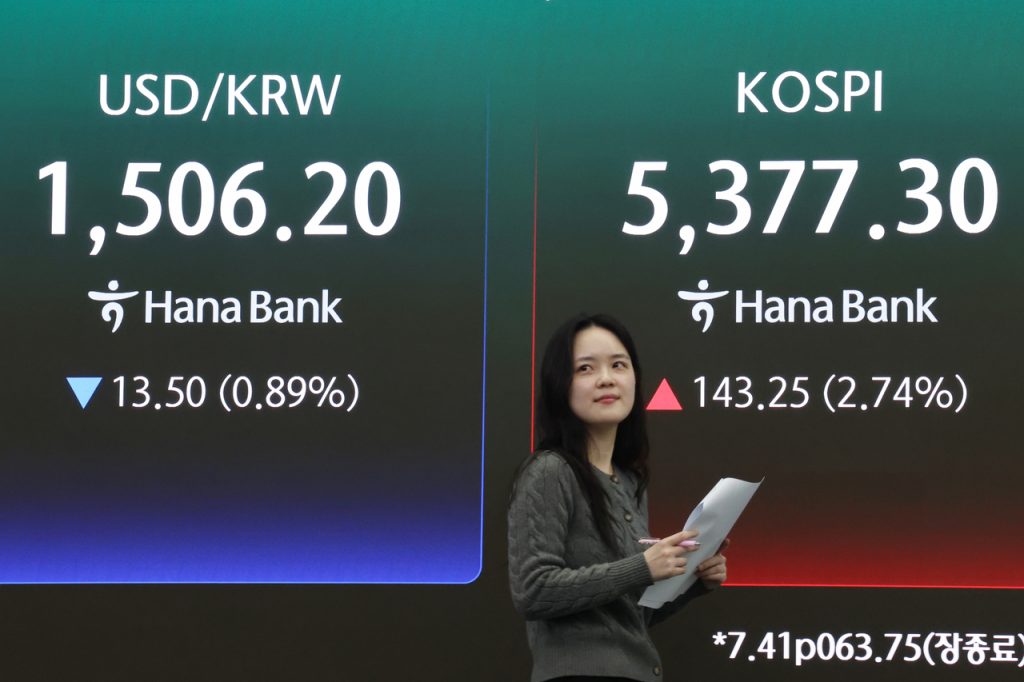
Kospi Volatility Reaches 22.6% in March, Exceeding Bitcoin’s and Activating Three Circuit Breakers
The South Korean stock market, particularly the Kospi, has recently displayed extreme volatility, raising significant concerns about its underlying structural weaknesses and increasingly mirroring the behavior of more speculative assets.
According to data released by the Korea Exchange, March saw an unusually high frequency of market stabilization measures. Circuit breakers were activated three times – twice for the benchmark Kospi index and once for the Kosdaq – marking the first such intense period since the initial phase of the COVID-19 pandemic. This market turbulence has continued into April, with a sell-side sidecar intervention triggered on the Kosdaq as early as April 2, signaling persistent instability in the Korean financial market.
The sheer magnitude of these market swings in South Korea has significantly surpassed that observed in major global markets. In March, the Kospi and Kosdaq indices recorded alarming monthly volatilities of 22.6 percent and 28.4 percent, respectively. This contrasts sharply with the S&P 500’s 8.1 percent and Japan’s Nikkei 225’s 7.4 percent. Even Bitcoin, frequently considered a highly speculative asset, exhibited relatively milder fluctuations at 16.8 percent during the identical period, underscoring the severity of the South Korean market’s instability.
Superficially, South Korea’s real economy demonstrates resilience. The Ministry of Trade, Industry and Energy reported that national exports surged past $80 billion in March, with the semiconductor sector alone contributing an impressive $36 billion, considerably exceeding initial forecasts and highlighting a key economic strength.
However, financial analysts caution that these robust headline export figures may conceal a more profound structural imbalance within the South Korean economy. Despite increasing export volumes, the nation’s economic landscape remains heavily concentrated in a single, dominant sector.
Kim Seok-hwan, a senior analyst at Mirae Asset Securities, emphasized the “extreme concentration” within the South Korean market. He highlighted that semiconductors alone comprise 38.1 percent of total national exports, and critically, just two industry giants – Samsung Electronics and SK Hynix – account for nearly 40 percent of the Kospi’s total market capitalization. This level of economic and market concentration, he noted, even surpasses that of the renowned “Magnificent 7” – the influential group of US tech stocks (Apple, Microsoft, Nvidia, Amazon, Alphabet, Meta, and Tesla) that have been significant drivers of the S&P 500’s performance.
This significant lack of economic diversification inherently amplifies the South Korean market’s vulnerability and sensitivity to various external shocks and global events.
The recent escalation of geopolitical tensions in the Middle East served as a direct catalyst for a sharp wave of profit-taking in the Kospi market. Following a substantial surge of nearly 50 percent in the Kospi since late last year, international foreign investors rapidly moved to secure their gains as global geopolitical risks intensified, contributing to selling pressure.
South Korea’s inherent low energy self-sufficiency further exacerbated the market impact. Consequently, rising global oil prices fueled broader market anxiety, directly triggering abrupt and significant swings across various South Korean equities.
A direct consequence of these factors has been a significant outflow of foreign capital from the South Korean financial market. Approximately 60 trillion won (equivalent to $40 billion USD) exited the market during the first quarter, with a staggering 40 trillion won of that amount withdrawn in March alone, indicating a major investor retreat.
Even with robust South Korean corporate earnings reported, foreign investors have adopted an increasingly cautious stance. Their primary concerns revolve around the market’s heightened vulnerability to external economic shocks and its perceived limited capacity to effectively absorb sustained high volatility.
Kim Seok-hwan described the frequent trading halts as an “exit trap” for global funds. He clarified that this term refers to situations where market liquidity dries up, making it extremely challenging for investors to sell their positions at optimal prices or within desired timeframes, further deterring international investment.
He further cautioned that “as long as the South Korean economy maintains its over-reliance on a single dominant sector, this level of extreme market volatility is highly likely to persist, posing ongoing challenges for investors.”
Analysts widely warn that without significant and broader economic diversification, the South Korean equity market risks being increasingly perceived by global investors as a high-beta, event-driven market. This perception positions it more akin to speculative assets rather than a stable, reliable investment destination, impacting long-term capital inflow.
ch0221


