China, US demand lifts exports despite Middle East risks; Kospi, won rebound
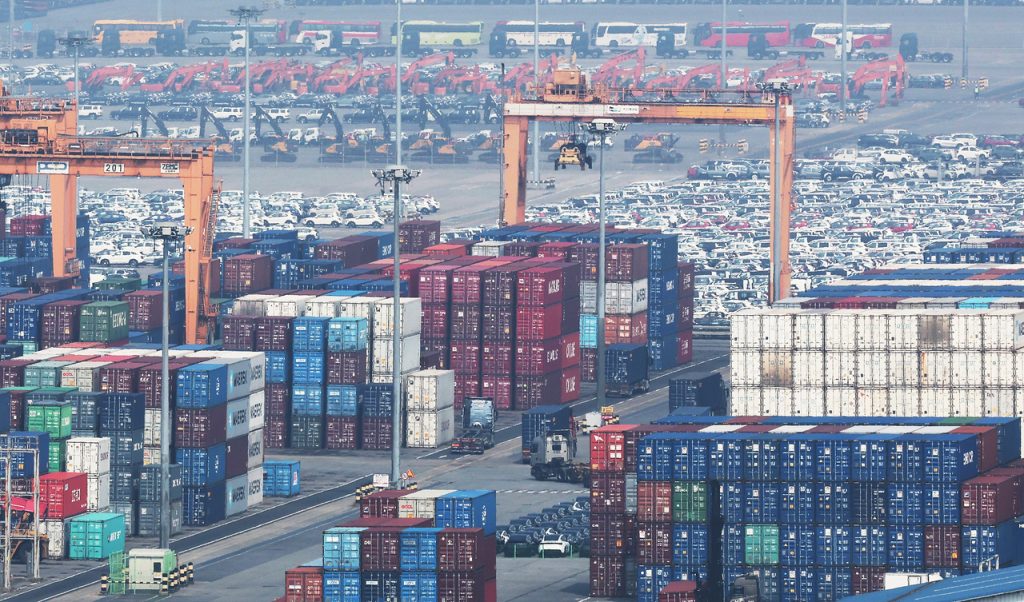
South Korea’s exports soared to a record high in March, surpassing $80 billion for the first time, despite ongoing concerns stemming from the Middle East conflict. According to government data released Wednesday, a booming semiconductor industry propelled a broad increase in outbound shipments.
Exports surged by 48 percent year-over-year, reaching $86.13 billion, according to the Trade Ministry. This figure marks the highest monthly total ever recorded, exceeding the previous peak of $69.5 billion set in December 2025.
This impressive result marks the tenth consecutive month of year-on-year export growth for South Korea. When adjusted for working days, average daily exports also rose significantly, climbing 42 percent to $3.74 billion.
Ten out of South Korea’s 15 major export categories experienced growth in March, with semiconductors leading the way.
Semiconductor exports more than doubled compared to the previous year, reaching $32.84 billion – a staggering 151.4 percent increase. This marks the first time semiconductor exports have exceeded the $30 billion mark. Strong demand for both AI-related and conventional servers, coupled with rising memory prices, drove shipments beyond the previous monthly high of $25.1 billion set just one month prior.
Automobile exports, South Korea’s second-largest export category, saw a 2.2 percent increase to $6.37 billion. Despite logistical challenges linked to the Middle East conflict, higher shipments of electric and hybrid vehicles helped maintain positive momentum.
Petroleum product exports jumped 55 percent in value terms to $5.1 billion as oil prices surged following the outbreak of war in the Middle East and supply disruptions linked to the blockade of the Strait of Hormuz.
However, in terms of volume, petroleum shipments decreased after emergency market-stabilization measures were implemented on March 13. Exports of gasoline, diesel, and kerosene fell by approximately 5 percent, 11 percent, and 12 percent, respectively, compared to the same period last year.
Other categories also showed strong growth, including ships, up 11 percent, and computers, up 189 percent. Outside the 15 major export items, electrical equipment, cosmetics, and agricultural and fisheries products all achieved record March export figures.
Exports to China increased by 65 percent year-over-year to $16.5 billion, driven by gains in semiconductors and petrochemicals, extending the growth streak to a fifth consecutive month. Exports to the US rose by approximately 47 percent to $16.34 billion, supported by robust demand for semiconductors and computers.
Overall, exports increased in seven of South Korea’s nine major overseas markets. Shipments to the Association of Southeast Asian Nations (ASEAN) rose by 34 percent, while those to the European Union (EU) gained 19 percent. In contrast, exports to the Middle East nearly halved to $900 million due to increasing geopolitical tensions.
Imports rose by 13 percent in March to $60.4 billion. Energy imports fell by 7 percent to $9.37 billion, while non-energy imports increased by 18 percent to $51.02 billion.
South Korea recorded a trade surplus of $25.74 billion in March, extending its surplus streak to 14 consecutive months.
Trade Minister Kim Jung-kwan emphasized the significance of South Korea’s first-ever $80 billion monthly export achievement despite challenging external conditions. He stated that authorities would “activate a pangovernment response system and move swiftly to implement stabilization measures” as the prolonged war in the Middle East adds to uncertainty surrounding export conditions.
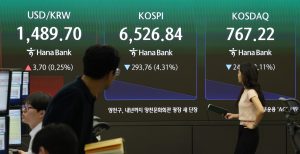
Financial markets also stabilized on Wednesday, with the Kospi rebounding after several days of sharp declines. The benchmark opened 5.5 percent higher than the previous day, triggering a buy-side sidecar shortly after the opening bell. Easing fears of geopolitical tension helped improve risk sentiment, while stronger-than-expected export data also provided support.
The Kospi climbed nearly 9 percent intraday to over 5,495 points in the afternoon, driven by institutional investors, who were the sole net buyers with purchases totaling 2.4 trillion won ($1.6 billion). Retail investors took profits, posting net sales of 2.5 trillion won, while foreign investors were modest net sellers at 200 billion won.
The tech-heavy Kosdaq also triggered a sidecar after rising 6 percent at around 2:10 p.m.
The won strengthened after opening 21.6 won firmer at 1,508.5 per dollar.
jwc