
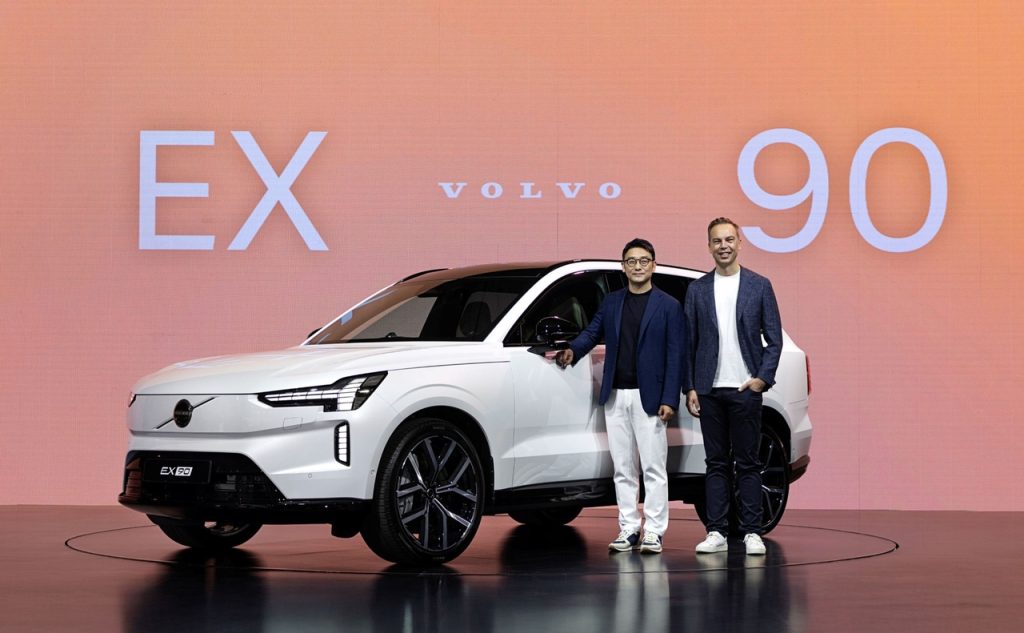
Volvo Cars announced on Wednesday its ambitious goal to sell 2,000 units annually of its flagship EX90 electric SUV in South Korea, marking a significant step in the company’s expansion within the premium EV sector.
During a press conference held in Incheon, Volvo Cars Korea CEO Lee Yoon-mo stated that deliveries are slated to commence in the latter half of the year, with an initial sales target of 500 units for 2024.
“We are confident that the EX90 will emerge as a top-selling model within the premium electric SUV market,” Lee affirmed.
Volvo emphasized the strategic importance of the Korean market amidst a global trend towards regionalization. Chief Commercial Officer Erik Severinson highlighted South Korea as a key growth market, particularly within the luxury segment, where Volvo already maintains a strong presence.
Pricing plays a crucial role in the company’s strategy. The EX90 will have a starting price of 106.2 million won ($70,200), which Lee pointed out is 10–20 percent lower than comparable premium electric SUVs. The model is also competitively priced in other global markets, including the United States.
The EX90 showcases Volvo’s transformation into a software-defined vehicle. It’s built upon the Hugin Core platform, which integrates computing, sensors, and software to facilitate advanced safety and driver assistance features. Over-the-air (OTA) updates will enable continuous improvements to the vehicle’s performance and functionality.
Featuring an 800-volt battery system, the EX90 offers a driving range of up to 625 kilometers (approximately 388 miles) and supports rapid charging, going from 10 to 80 percent in roughly 22 minutes. The standard model produces up to 456 horsepower, while the performance variant boasts an impressive 680 horsepower.
The SUV further demonstrates Volvo’s commitment to tech-driven mobility. It incorporates Nvidia’s Drive platform for high-performance computing and Qualcomm’s Snapdragon Cockpit Platform for infotainment, providing a more sophisticated in-car user experience.
Safety remains a paramount concern. The EX90 is equipped with 22 sensors, encompassing cameras, radars, and ultrasonic sensors, along with driver monitoring and in-cabin sensing systems designed to proactively prevent accidents. Volvo stated that the vehicle’s structural design results in a 50 percent improvement in torsional rigidity and a 20 percent increase in crash energy absorption compared to the gasoline-powered XC90.
With its competitive pricing and cutting-edge technology, Volvo is confident that the EX90 will solidify its position in South Korea’s rapidly expanding premium EV market.
hyejin2


