
South Korea Shifts IP Focus from Protection to Commercialization, Boosting Economic Growth
South Korea’s newly elevated Intellectual Property Ministry is taking center stage in the nation’s economic strategy, aiming to foster growth amidst a rapidly changing global landscape defined by artificial intelligence, technological competition, and evolving trade dynamics.
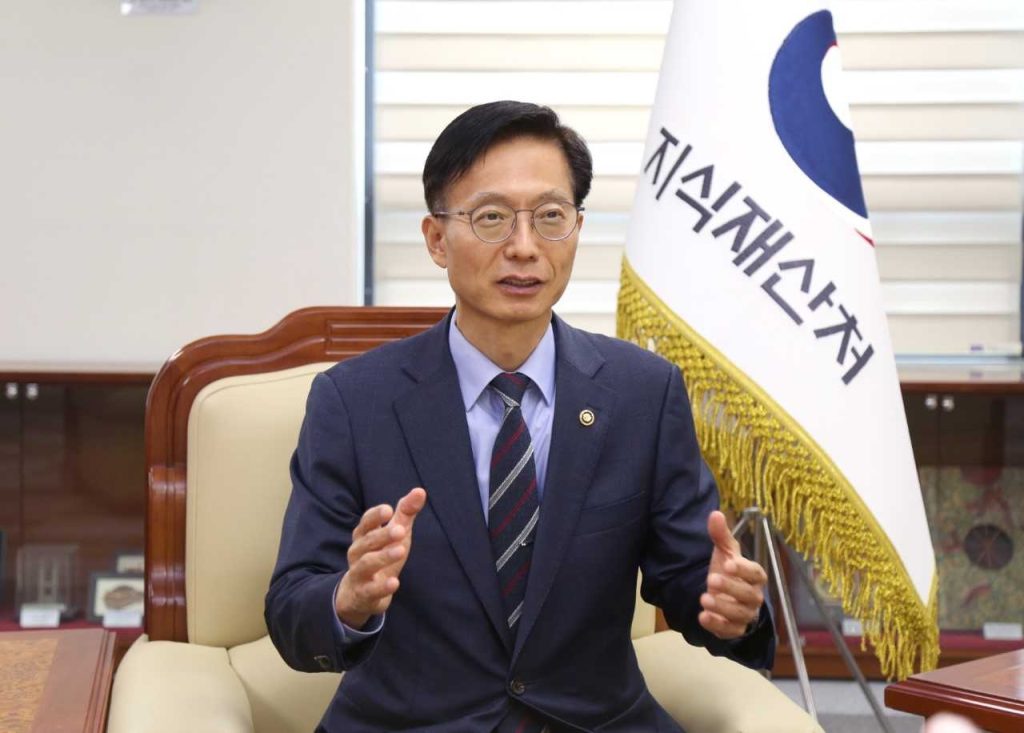
In a recent interview, Intellectual Property Minister Kim Yong-sun emphasized that the ministry’s upgrade reflects a pivotal change in the government’s perception of intellectual property. It’s no longer just a legal issue but a vital component of economic competitiveness.
“In knowledge-based economies, intangible assets constitute a significant portion of corporate value,” Kim stated, highlighting data showing intangible assets accounting for approximately 90% of the S&P 500’s value in 2020, a considerable increase from 17% in 1975.
“Strengthening intellectual property is, therefore, crucial for South Korea to maintain its leading position in the global economy,” he added.
The ministry is expanding its mandate beyond patent examination to encompass the entire IP lifecycle, focusing on protection, commercialization, and monetization.
Minister Kim described the ministry as the government’s primary authority on intellectual property, responsible for coordinating policies across various sectors and ensuring IP’s direct contribution to economic growth and innovation.
“Our goal is to transform ideas and knowledge into valuable national assets that enhance people’s lives and fuel innovation,” he explained.
This shift comes as South Korea confronts structural challenges such as slowing population growth and increased competition in cutting-edge technologies like AI, semiconductors, and biotechnology.
Streamlining IP Policy: From Fragmented to Centralized
A key function of the new ministry will be to serve as a central “control tower” for IP policy, unifying previously disparate government initiatives into a cohesive national strategy.
Kim believes this integrated approach is essential to unlock synergies between innovation, industry, and finance, particularly as IP becomes more closely linked to corporate valuation and national competitiveness.
Since assuming office five months ago, he has concentrated on restructuring the organization and reforming working practices to align with its broadened responsibilities.
One of the initial initiatives is the “Everyone’s Idea” project, designed to encourage public participation in innovation by assisting individuals in converting creative ideas into economic value.
Simultaneously, the ministry is working to enhance the efficiency of South Korea’s IP system. Patent examination waiting times have been reduced, and the government has initiated procedures to join the Patent Law Treaty, which would simplify filing processes and increase language flexibility for applicants.
Efforts to safeguard Korean IP abroad have also been strengthened, particularly in sectors like food, beauty, and fashion, where the global popularity of Korean brands has led to a surge in counterfeiting and infringement cases.
Five Pillars for Economic Growth and Security through Intellectual Property
Looking forward, Minister Kim outlined five key policy priorities: fostering startup growth, promoting regional development, expediting patent examination, ensuring fair dispute resolution, and strengthening economic security.
To support startups and early-stage companies, the ministry plans to offer comprehensive support covering the entire innovation cycle, from securing IP rights to commercialization and funding.
The ministry also aims to develop 100 regionally based “K-brands,” connecting IP to job creation and income generation in local economies, while establishing infrastructure such as regional IP support centers.
Improving the speed and quality of patent examination remains a priority. The ministry intends to increase the number of examiners and implement AI-powered systems to reduce patent review times to under 10 months by 2029.
To enhance fairness, the ministry is preparing to introduce a Korean-style discovery system to improve damage compensation in IP disputes, along with faster and more affordable dispute resolution mechanisms for startups and smaller companies.
Kim emphasized that IP is increasingly intertwined with economic security, especially as global competition intensifies in critical technologies.
The ministry plans to enhance investigative capacity to address technology leaks and expand enforcement powers to cover overseas cases involving core technologies.
Expanding South Korea’s Global IP Footprint
International collaboration will be a cornerstone of the ministry’s strategy, especially as Korean companies expand their operations abroad.
Recent agreements with Singapore and the Philippines aim to strengthen collaboration in areas such as AI-driven IP systems, combating counterfeit goods, and facilitating cross-border data sharing.
Minister Kim noted that South Korea is already a leading IP power, ranking fourth globally in the number of patent applications and holding top rankings relative to population and GDP.
However, he believes the next challenge is to convert that scale into tangible economic benefits.
“We must transition from being strong in numbers to being strong in value,” Kim stated.
The ministry aims to increase the proportion of overseas patent filings by Korean companies and ultimately achieve a surplus in the country’s IP trade balance.
“Intellectual property must be a central driver of South Korea’s next major advancement,” he concluded.
kwonhl


