
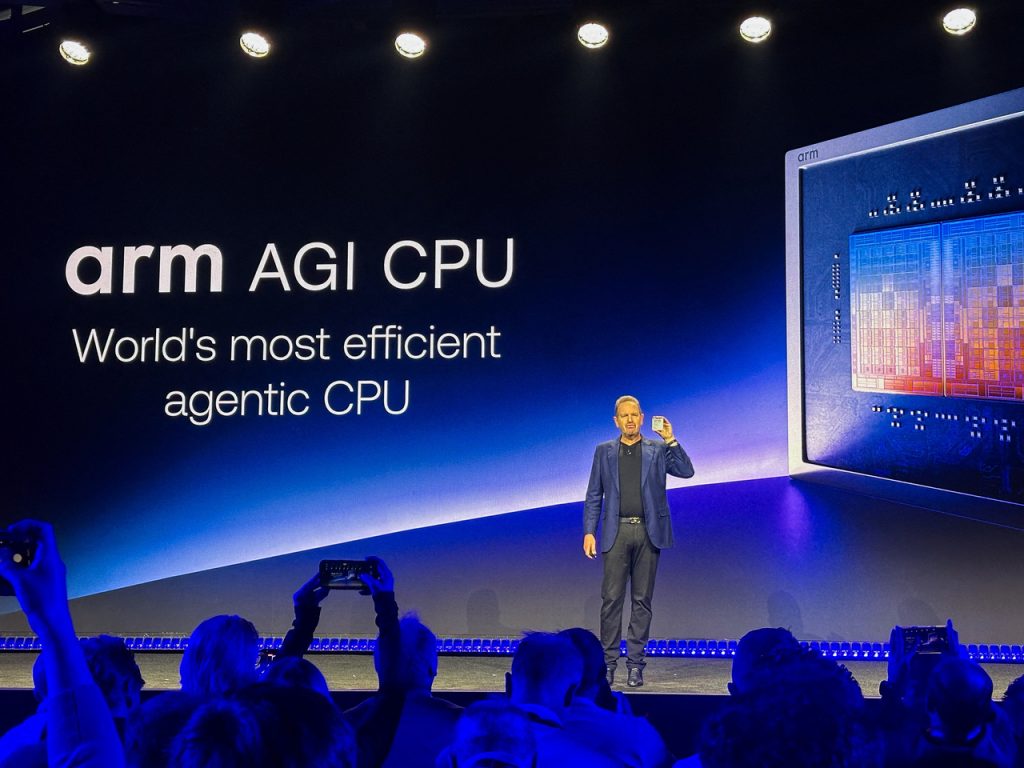
Arm Holdings, renowned for its semiconductor technology licensing, is venturing into chip sales, projecting an annual revenue of approximately $15 billion within five years from this new venture.
Meta Platforms is set to be the inaugural major customer for Arm’s custom silicon, dubbed the AGI CPU, revealed Tuesday at a San Francisco event. This powerhouse chip will feature up to 136 cores, indicating considerable processing power, and consume 300 watts of electricity, according to Arm. Taiwan Semiconductor Manufacturing Co. (TSMC) will handle the chip’s production.
This strategic move includes ambitious sales targets. The UK-based company anticipates that revenue from the new AGI CPU business will surpass its existing income from intellectual property licensing.
Arm projects total sales to reach around $25 billion within five years, a fivefold increase from current levels. The IP business is expected to continue its growth, reaching approximately $10 billion by that point, the company forecasts.
Earnings are projected to reach $9 per share during that timeframe. Analysts estimate earnings of $1.75 per share for the current fiscal year, excluding certain items.
Under the leadership of CEO Rene Haas, Arm has expanded its focus beyond smartphone technology, playing a more significant role in the data center market. This shift aims to capture more value from the often complex and costly chip development process.
This transition allows Arm to capitalize on higher-value purchases. While even the priciest smartphone chips cost tens of dollars, high-end data center semiconductors can fetch tens of thousands.
The new sales forecast boosted Arm shares by as much as 7.8 percent in late trading. The stock had already risen 23 percent year-to-date through the close.
Chief Financial Officer Jason Child acknowledged that while Arm’s current offerings – semiconductor designs and technology licenses – offer higher profit margins, selling physical chips will generate significantly more profit dollars overall.
On a hypothetical $1,000 chip, Arm earns approximately 5 percent in licensing revenue when customers use its instruction set, the basic code for chip-software communication. This represents pure profit. If a client utilizes Arm’s designs, the profit rises to about $100. However, if Arm manufactures the chip itself, it secures around $500 in gross profit dollars, he explained.
The decision to develop the new AGI CPU was driven by customer demand, according to Haas. The product, a central processing unit that serves as the “brains” of a computer, is designed to complement accelerator chips from companies like Nvidia. It streamlines inter-computer coordination, data preparation, and execution of elements that respond to AI queries, Arm stated.
“The product we’re building is not only compelling, but we actually have customers who are lined up to buy it,” Haas stated in an interview.
The company highlights that its AGI CPU offers superior power efficiency compared to traditional CPU designs from Intel and Advanced Micro Devices Inc. This translates to data center operators achieving greater computing power within the same footprint and electricity budget, Haas explained.
Arm’s increasing influence directly challenges the “x86 data center products” of Intel and AMD, according to Haas. Gaining market share from these traditional leaders in a rapidly expanding market will enable both Arm and its customers to thrive, he contends.
“The market is plenty big enough for multiple players,” Haas said.
Arm faces significant competition in the data center processor market. Numerous startups and established companies are striving to challenge Nvidia’s dominance through diverse approaches. Nvidia itself recently unveiled a new CPU lineup, targeting the same category that Arm is entering. Haas clarified that Arm’s chip is aimed at a different segment of the market compared to Nvidia’s latest addition.
Arm’s move into chip sales could also complicate its relationships with customers. Most major data center silicon buyers, including Meta, have their own in-house chip development programs. Almost all of them also license technology and designs from Arm.
Data center operators source chips from a variety of suppliers, including Meta, which recently finalized long-term agreements with Nvidia, AMD, and startup Cerebras Systems. The social networking giant intends to integrate the AGI CPUs with its existing chip infrastructure.
“We worked alongside Arm to develop the Arm AGI CPU to deploy an efficient compute platform that significantly improves our data center performance density,” Santosh Janardhan, head of infrastructure at Meta, said in a statement.
Other companies, including OpenAI, Cerebras, and SK Telecom, also plan to incorporate the AGI CPU into their infrastructure, Arm announced. Off-the-shelf systems utilizing the chip are currently available from vendors such as Quanta Computer and Super Micro Computer, with wider availability expected in the second half of this year. (Bloomberg)


