
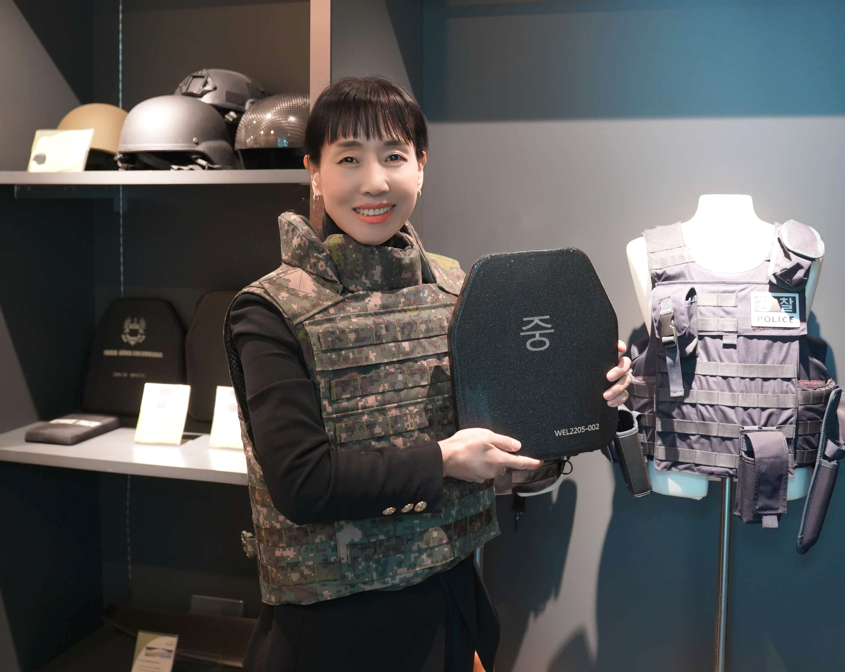
Execution-focused leadership, decades of materials R&D underpin defense push
For most of its 34-year history, Welcron was better known for something far removed from the battlefield: industrial cleaners and functional bedding.
The Korean microfiber specialist, however, is now positioning itself to be on the front lines as a world-class defense supplier.
At the center of that shift is CEO Shin Jung-jae, a hands-on executive who rose through the ranks not as a defense specialist, but as a merchandiser, salesperson and operations leader. Her approach to leadership — meticulous, system-driven and deeply rooted in execution — is swiftly shaping Welcron’s push into what she calls an “inevitable” industry.
“About 20 years ago, we began the research into how our industrial fibers could be used in the defense sector,” Shin said in a recent interview with The Korea Herald at the company’s headquarters in Seoul.
“The defense sector has affirmatively solidified itself as a next-generation growth engine for Welcron. If the focus was more on individual gear in the past, now the range of our defense business is rapidly expanding into platform protection, such as vehicles and vessels. In step with the increasing trend in global defense budgets, the defense business will become the most dynamic and heavily relied upon source of profit in our portfolio.”
Welcron logged 95.1 billion won ($62.8 million) in sales and 6.7 billion won in operating profit last year, up 13 percent and 70 percent, respectively, from 2024. Sales from its defense products reached 25 billion won, almost doubling on-year.
Shin pointed to how Welcron’s roots in ultrafine microfiber technology led to its development of its defense businesses.
“Old bulletproof vests used to weigh about 5 to 6 kilograms,” she said. “We found a way to make them lighter at about 3.4 kg, yet with advanced protection even as ammunition and firearms improved.”
The company’s defense ambitions grew larger with the development of ballistic plates for bulletproof vests.
Since 2018, Welcron has supplied around 300,000 ballistic plates to the Korean military. It has also exported its protective gear to destinations including Malaysia, the Philippines, Indonesia, Australia, Colombia, Ukraine and Taiwan.
Welcron’s hybrid protection technology combines ceramics and ultrahigh-molecular-weight polyethylene, to perform on par with NATO’s highest level of protection for occupants of logistics and light armored vehicles.
The company’s entry into the ballistic plate market opened up more applications, as they are essential to armored vehicles and naval vessels. Welcron’s ballistic plates have been used in the Tigon, the armored vehicle from Hanwha Aerospace that is exported to Saudi Arabia.
“Since everything that is strong and lightweight uses carbon fiber, the range of application for our R&D and technology in the defense sector has practically no boundaries,” Shin said. “As countries continue to upgrade their weapons systems, the demand for our protection products will keep growing.”
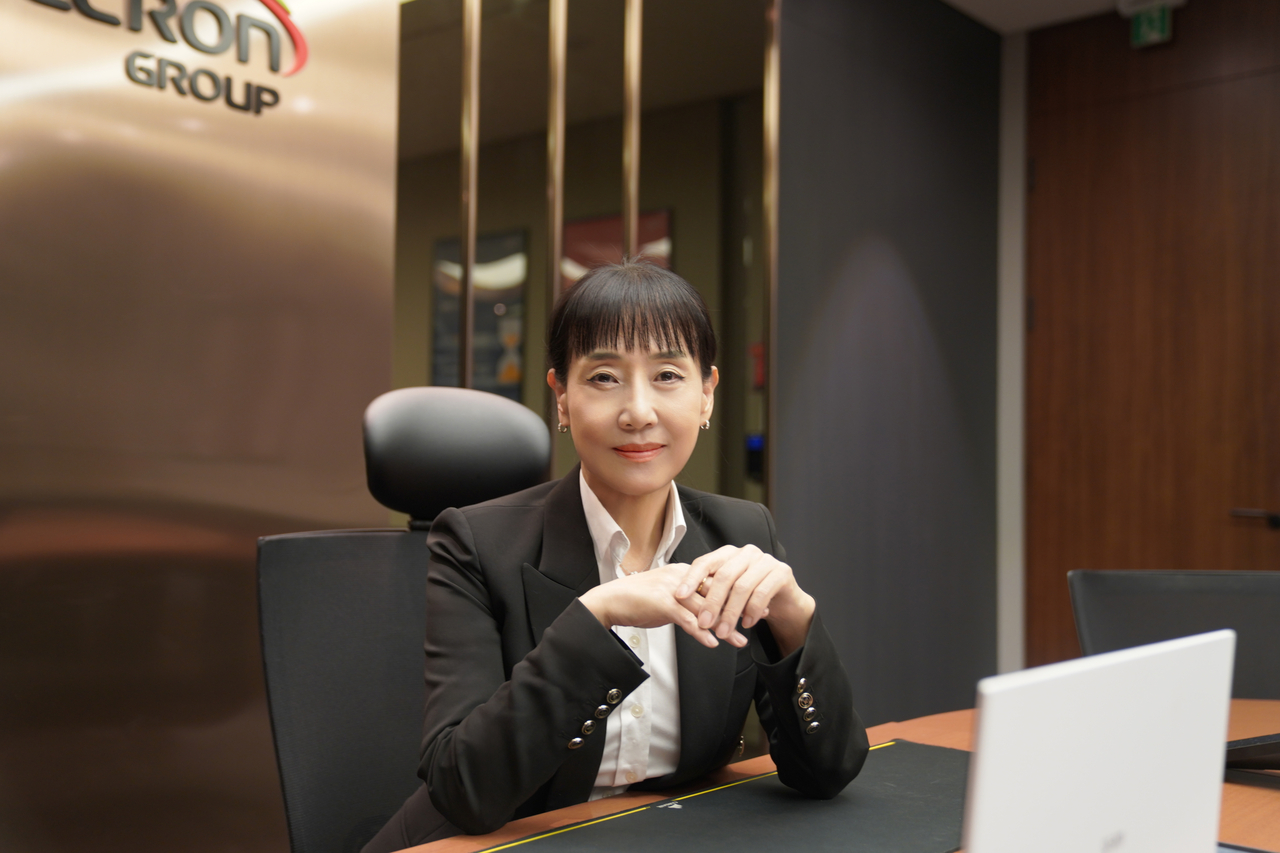
According to the CEO, Welcron is preparing to launch a new English website dedicated to introducing its defense products as the company aims to attract overseas clients.
The company also plans to participate in defense industry conventions to showcase the firm’s protection capabilities.
“Starting this year, Welcron will begin setting up exhibition booths at various defense shows such as DX Korea and Kadex,” she said. “As we are trying to expand our global business, we should also attend overseas defense conventions more actively.”
DX Korea and Kadex — the Korea Army International Defense Exhibition — are South Korea’s two largest biannual military expos and two of the biggest armed forces conventions in Asia, drawing thousands of military officials from across the world.
While Welcron’s expansion into the defense sector benefits from Korean defense companies’ rising profile on the global stage, Shin’s leadership philosophy that underscores systematic documentation and continuous learning has helped the company’s employees excel.
“I ask every employee, from entry-level staff to executives, to write daily work logs every day, from Monday to Friday,” she said with a smile. “Of course, they find it difficult at first. But over time, it becomes natural. This practice improves efficiency, reduces errors and builds each individual’s capabilities.”
The CEO said she also requires every employee to present his or her yearly business plan at the beginning of every year, noting that this imbues responsibility and specific goals for everyone.
“From the perspective of an employee, I think whether one can improve their own capabilities is more important than how much they are getting paid,” Shin asserted. “If they look at their supervisors and find them incapable or lacking competency, what are they going to learn? That’s why I challenge all of my employees to get better at what they do and expand their areas of expertise.”
Having joined Welcron in 2010, Shin has worked in various roles across product planning, retail operations, online sales and department store expansion. Her performance in each field led to greater responsibility, eventually leading to her appointment as CEO in 2017. Since taking charge of the company’s defense business only a few years ago, Shin discovered that 24 hours in a day is just not enough.
“I’m constantly studying,” she said. “Whether it may be learning industry trends or reviewing reports, I’m always doing something. … As a CEO, you don’t have to know too much more than an expert, but you need to be able to connect the dots and make decisions.”
hwkan


