
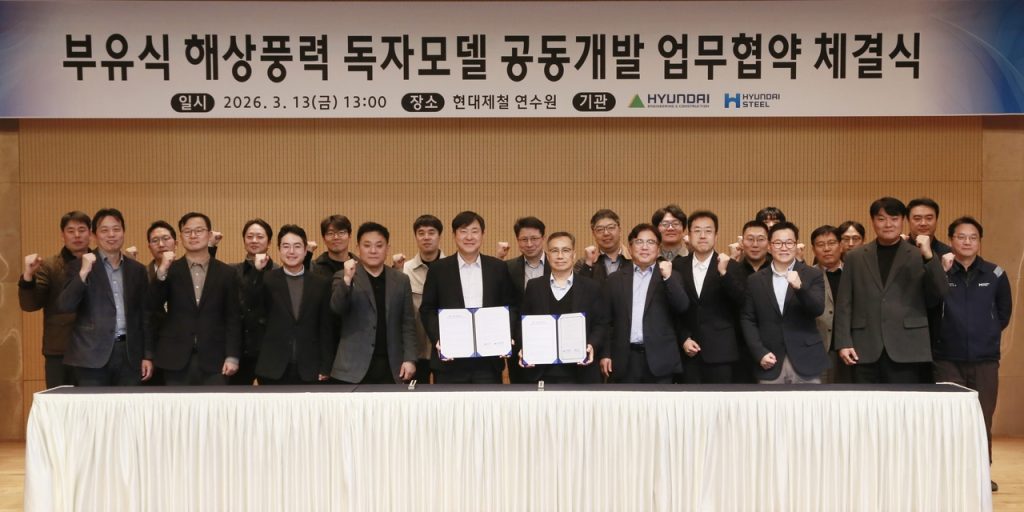
Hyundai Engineering & Construction (Hyundai E&C) and Hyundai Steel are partnering to develop innovative floating offshore wind technology, leveraging their respective expertise to gain a competitive advantage in the rapidly growing renewable energy sector.
Hyundai E&C announced on Sunday that the companies signed a joint research agreement on Friday at Hyundai Steel’s Dangjin steelworks in South Chungcheong Province. The agreement outlines a collaborative effort to co-develop a cutting-edge offshore wind floater and pursue international certification.
Unlike traditional fixed-bottom turbines, floating offshore wind platforms can be deployed in deeper waters, unlocking access to stronger and more consistent winds for increased energy production. Industry projections estimate the floating offshore wind market could reach 250 gigawatts by 2050, representing a market exceeding $1 trillion.
The partnership will focus on developing a hybrid floater design that combines the benefits of specialty steel and concrete. Hyundai E&C will lead the engineering and modular fabrication aspects of the project, while Hyundai Steel will concentrate on developing and validating specialized steel grades suitable for the harsh marine environment.
By optimizing the floater’s structure to minimize steel consumption and employing advanced modular construction techniques, the companies aim to reduce fabrication costs by 20 percent without compromising the platform’s structural integrity and durability.
Hyundai E&C also stated that they have jointly filed a patent for this groundbreaking technology.
The research and development process will involve conceptual and basic design phases to achieve an optimal floater design. Following this, the partners will seek approval in principle (AIP) from internationally recognized classification societies, such as Det Norske Veritas (DNV).
“The design of the floater is a key differentiator in the floating offshore wind sector,” stated a Hyundai E&C official. “Through this joint research initiative, we aim to develop proprietary technology and enhance our competitiveness in global offshore wind engineering, procurement, and construction (EPC).”


