
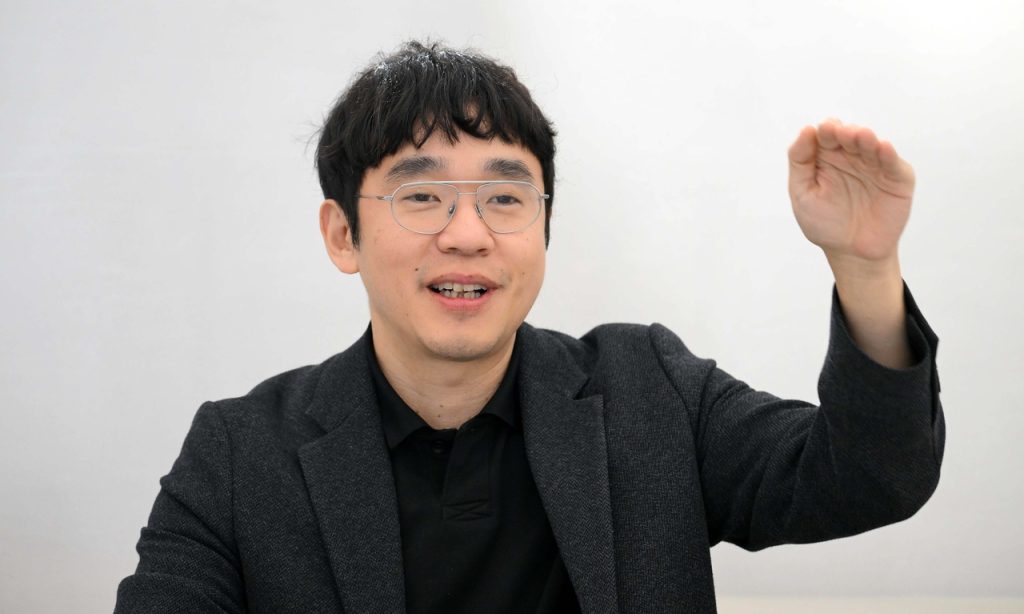
Shin Jin-woo: AI Ecosystem, Not Model Scores, Will Define Korea’s AI Future
While China rapidly advances in foundation models, South Korea is keeping pace in frontier model performance, according to Shin Jin-woo, ICT endowed chair professor at the Kim Jaechul Graduate School of AI at KAIST. However, Shin argues that model performance is not the only factor for success.
“The perceived technology gap is often an exaggeration,” Shin stated in a recent interview with The Korea Herald in Seoul. “The actual difference, considering the time it takes to understand and replicate published technologies, is closer to six months.”
Shin explained that the open-source nature of many Chinese AI models enables Korean developers to quickly analyze and adopt key advancements.
However, he emphasized a crucial distinction between matching benchmark results and establishing a leading AI ecosystem.
“China has already developed the technological capabilities to lead specific sectors of the AI industry,” he said. “This goes beyond simply achieving comparable performance metrics.”
Rapid Deployment as a Key Advantage
Shin pointed out that the gap in raw performance between US and Chinese AI models is smaller than many believe.
“US models might be more refined in certain applications,” he noted, “but Chinese models have reached similar levels of sophistication in many areas.”
China’s strength lies in the speed of industrial deployment.
“Even if the technology isn’t perfect, it’s deployed rapidly,” he explained. “The feedback from these real-world deployments is then incorporated into the next generation of models. This iterative cycle has become a significant advantage.”
This continuous loop – development, deployment, data gathering, and refinement – accelerates the iteration process, surpassing the progress achievable through purely lab-based competition.
Three Pillars: Talent, Data, and Compute
Shin believes China’s accelerated progress is built on three coordinated pillars: talent, data, and computing power.
“AI ultimately relies on people, data, and computational resources,” he said. “China has effectively mobilized its engineering talent, expanded access to data, and invested heavily in its computing infrastructure.”
While the US maintains a leading position in high-end AI hardware globally, China has strengthened its domestic semiconductor industry and is exploring alternative computing approaches.
“The coordinated integration of these three elements is what makes the real difference,” Shin emphasized.
Sovereign AI as Strategic Insurance
The concept of “sovereign AI” in Korea has gained traction as the government promotes a state-supported foundation model initiative.
During the second-stage review of the national AI project, concerns arose regarding the acceptable level of open-source integration for models intended to be domestically independent.
“It was a process of defining clear standards,” Shin explained. “We needed to establish a clear boundary between adopting open-source technology and achieving sovereign development.”
For Shin, sovereign AI is not about isolation; it’s about strategic risk management.
“If we become overly reliant on foreign platforms and access conditions change, numerous industries could be affected,” he said. “Developing domestic capabilities acts as a crucial safeguard.”
He added that the development of large-scale foundation models cannot be solely sustained by private companies.
“AI is capital-intensive and requires a long-term perspective,” Shin stated. “In Korea’s corporate environment, few companies can withstand years of losses without government support. Some level of state-driven momentum is necessary.”
Shin argues that Korea should neither abandon foundation model development nor focus solely on surpassing the US or China.
“Completely giving up on foundation models would be unrealistic,” he said. “However, focusing solely on outperforming global leaders in this area would also be impractical.”
Instead, he proposes a two-pronged strategy: maintain core foundation model capabilities while leveraging Korea’s strengths in manufacturing and electronics in areas like agent-based AI and physical AI, including robotics.
“AI is evolving beyond software and entering the physical world,” he said. “We may see significant commercialization in these areas in the coming years.”
Shin believes the next five years are crucial for Korea’s AI development.
“Korean AI talent is highly competitive,” he said. “But without a sufficiently large domestic industry, it becomes difficult to retain that talent.”
Top researchers are increasingly attracted to larger markets and greater investment opportunities overseas.
“Ultimately, talent follows industry,” Shin concluded. “Building that industry is the real challenge.”
yeeun


