
Upcoming Rubin rollout reinforces Samsung’s speed edge, SK’s volume dominance
Nvidia is reportedly considering a dual-track adoption strategy for high bandwidth memory (HBM) in its upcoming Vera Rubin AI accelerators. This move is expected to further solidify Samsung Electronics and SK hynix’s positions at the forefront of the global artificial intelligence memory market, according to industry sources on Thursday.
The proposed “dual-bin” structure would categorize HBM4 chips into two performance tiers. The premium Rubin systems would utilize memory operating at speeds of up to 11.7 gigabits per second (Gbps), while the lower-tier versions would employ chips running at approximately 10 Gbps.
This strategy reflects the booming demand for AI and the widening technological disparities among suppliers. It also positions the two South Korean memory giants, Samsung and SK Hynix, favorably in the highest-value segments.
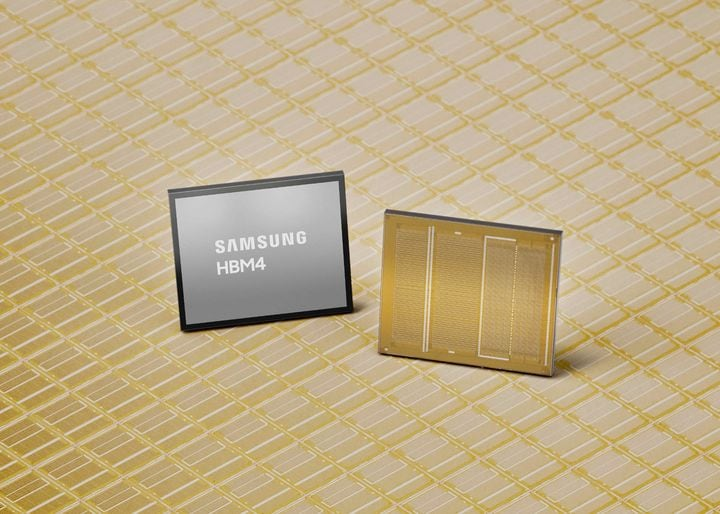
Samsung is anticipated to play a role in Nvidia’s top performance tier. Its HBM4, which has recently entered mass production, boasts speeds of up to 11.7 Gbps – a 46 percent increase compared to the 8 Gbps baseline set by the Joint Electron Device Engineering Council (JEDEC). Samsung is also the first to use sixth-generation 10-nanometer-class (1c) DRAM in HBM production, citing stable yields and the potential for speed expansion to 13 Gbps.
This development signifies a significant comeback for Samsung after trailing in the previous HBM cycle. By placing its 1c-based HBM4 in Nvidia’s premium tier, the company is reclaiming technological leadership in the competitive AI memory landscape.
SK hynix, the current HBM market leader and Nvidia’s primary supplier in previous generations, is projected to supply roughly two-thirds of the total HBM4 volume for Rubin. Its HBM4, based on fifth-generation 10-nm-class (1b) DRAM, exceeds JEDEC standards and is expected to be the foundation of Nvidia’s mainstream tier, alongside Micron.
Even with a dual-tier structure, SK hynix remains crucial to Nvidia’s volume strategy, highlighting its established dominance in the HBM ecosystem.
Pricing is expected to reflect the performance tiers. Samsung’s top-tier HBM4 is predicted to be priced around $700 per unit – approximately 20 to 30 percent higher than HBM3E. SK hynix’s HBM4 was quoted in the mid-$500 range last year. Nvidia is expected to adjust accelerator pricing to manage rising memory costs.
Market research firm TrendForce reported on February 13th that Nvidia is likely to source HBM4 from Samsung, SK hynix, and Micron, noting that no single supplier can meet the total demand for the Rubin platform. They project Samsung’s HBM market share to increase to 28 percent this year from 20 percent last year, narrowing the gap with SK hynix.
Industry analysts suggest that Nvidia’s approach underscores a broader shift in the AI chip market, where performance capabilities are increasingly prioritized over sheer mass production capacity.
“With increased competition in AI accelerators, memory performance requirements are becoming more critical than production yield,” said an industry insider.
Another industry source indicated that the market’s recent emphasis on large-scale production races may lessen, allowing technological competitiveness to play a more significant role in determining market influence.
Earnings momentum for both Samsung and SK hynix is expected to persist throughout the year, driven by rising memory prices. Global investment bank Morgan Stanley forecasts Samsung to report 245.7 trillion won ($189 billion) in operating profit this year, and SK hynix to reach 179.4 trillion won, representing year-over-year increases of 464 percent and 280 percent, respectively.


