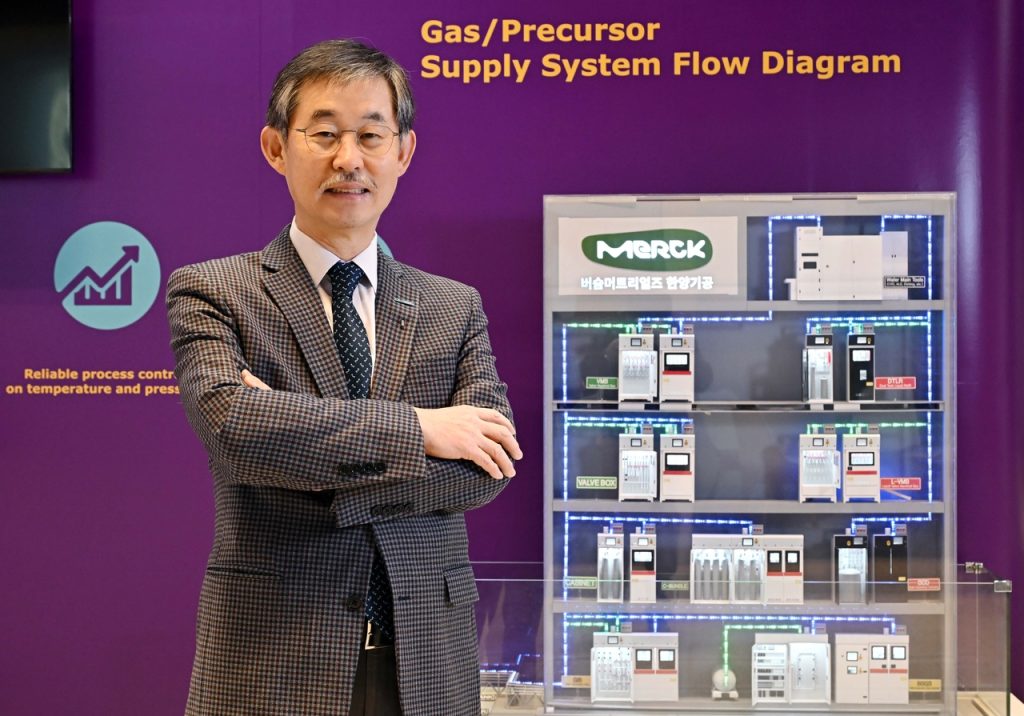
Executive highlights molybdenum push and Korea investment for 2nm era
Merck Korea’s leadership anticipates a structural growth phase for the semiconductor materials market, propelled by advancements in artificial intelligence alongside burgeoning sectors like quantum computing and robotics.
“AI growth and high-performance computing currently drive the chip industry,” stated Kim Woo-kyu, Managing Director of Merck Korea, in a recent interview with The Korea Herald on February 13th. “Looking ahead, quantum computing and robotics will necessitate substantial volumes of chips, encompassing both NAND and DRAM.”
The evolution of semiconductor manufacturing, transitioning from 14-nanometer nodes to cutting-edge 2-nanometer processes, introduces heightened production complexity. This demands more intricate process steps and tighter performance margins at atomic scales, thereby boosting the demand for advanced materials throughout the fabrication cycle, including patterning materials, deposition solutions, diffusion gases, and chemical-mechanical planarization (CMP) slurries.
“We foresee increasing demands for material enhancements,” Kim elaborated. “This extends beyond the introduction of new materials to elevating the performance of existing materials to unprecedented levels.”
Molybdenum push for next-generation chips
In light of these developments, Merck is expediting the commercialization of molybdenum-based materials tailored for advanced chips.
Molybdenum offers reduced electrical resistance compared to tungsten at the atomic level, facilitating faster signal transmission while minimizing power loss. This material is particularly well-suited for vertically stacked transistor architectures, where maintaining stable signal pathways across densely packed layers becomes increasingly vital.
Merck’s initial focus is on NAND flash memory. Following customer acquisition of manufacturing experience and validation of performance enhancements, the company anticipates the expansion of molybdenum adoption into logic and DRAM applications, according to Kim.
To bolster this initiative, Merck will manufacture molybdenum precursors at its forthcoming Eumseong plant, currently under construction. These materials will be distributed via the company’s ChemKeeper system, designed to optimize material utilization and reduce production costs.
The Eumseong line constitutes part of Merck’s 600 million euro investment in Korea, announced in 2021, aimed at expanding semiconductor materials capacity and reinforcing the local supply chain.
Merck maintains its second-largest concentration of manufacturing and R&D facilities in Korea, following the US, highlighting the nation’s strategic importance. As the home of memory chip leaders such as Samsung Electronics and SK hynix, Korea stands as a pivotal market for advanced materials.
Given Korea’s limited natural resources and significant reliance on imported inputs, geopolitical tensions have intensified supply chain vulnerabilities. In response, Merck has adopted a “for the region, in the region” strategy, establishing local production capabilities to mitigate exposure to cross-border disruptions.
“Forecasting geopolitical disruptions is challenging, with countries enacting unexpected trade restrictions,” Kim noted. “Our objective is to manage this risk through a local-to-local strategy, providing support to customers in close proximity.”
Industry projections now indicate that the global semiconductor market — encompassing chips, equipment, materials, and services — could reach $1 trillion as early as this year, surpassing earlier estimates for 2028.
Addressing concerns regarding rising material costs and supply chain constraints linked to geopolitical tensions and tariff measures under the previous administration, Kim asserted that Merck has secured multiple supply sources to ensure business continuity despite escalating cost burdens.
As chip architectures grow more intricate and process nodes continue to shrink, Kim anticipates heightened demand for high-performance materials.
“In advanced nodes, materials are no longer mere secondary components,” he concluded. “They are evolving into decisive factors in determining chip performance and efficiency.”