
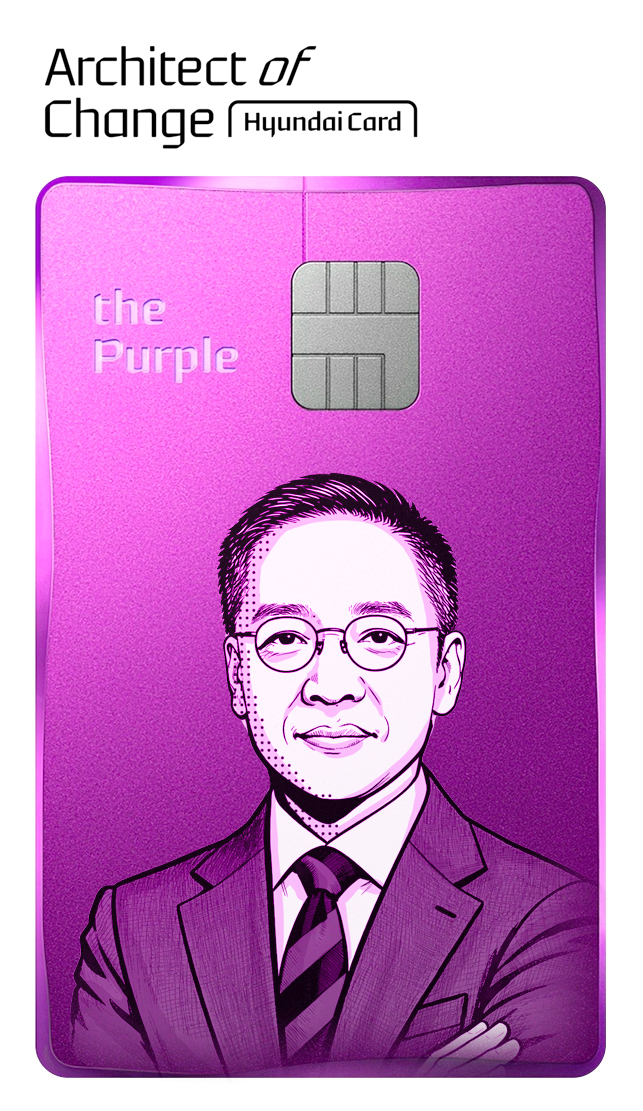
Vice Chair Chung Tae-young’s redesign turns brand power into financial strength
For years, Hyundai Card held a reputation as a creative force, its brand recognition surpassing its actual earnings. However, recent performance indicates a significant shift, with financial success now mirroring its brand cachet. Sustained profit growth has propelled Hyundai Card into the top three industry players, a testament to Vice Chair Chung Tae-young’s strategic overhaul of the business from the ground up.
In the past year, Hyundai Card reported a net profit of 350 billion won ($243 million), a year-on-year increase of over 10 percent, marking its fourth consecutive year of growth. This achievement elevated the company to third place in terms of net profit, surpassing KB Kookmin Card for the first time.
Operating profit soared to 440 billion won, extending its growth streak and rising roughly 40 percent from 2022.
In a market challenged by declining fee income and margin compression, Hyundai’s robust performance stands out. Among major card issuers in the nation, Hyundai Card was the sole entity to register earnings growth. Market leader Samsung Card experienced a 3 percent decline, while second-ranked Shinhan Card saw profits fall by 17 percent, continuing a multiyear downward trend.
This growth extended beyond just headline earnings. Credit sales volume, a vital indicator of core competitiveness, increased by 6.2 percent year-on-year to 176.5 trillion won, maintaining its leading position in the industry for 15 consecutive months through December 2024. Membership grew by 1.6 million over the last three years, despite a highly saturated market. Overseas credit sales led the industry for the third year running, and the delinquency rate remained stable.
In his New Year’s address, Chung characterized the past year as the culmination of a “build-up” phase. “It was a year in which Hyundai Card and Hyundai Commercial delivered significant achievements across all areas, including growth and earnings,” he stated, emphasizing that the two financial units had “newly designed and reshaped the foundation, form and size” of their businesses.
Hyundai Commercial, the lending arm of Hyundai Motor Group, also under Chung’s leadership, followed a similar growth trajectory. Net profit increased by 17 percent to 226 billion won in 2025, driven by asset and earnings expansion. Previously focused on industrial finance, the company has diversified into corporate and investment finance under a “Balanced Growth” strategy, mitigating concentration risk and creating diverse revenue streams.
Chung’s strategy at Hyundai Card has involved streamlining product offerings under the “Architect of Change” framework, refining market segmentation through data analytics, and strengthening proprietary technological capabilities. In an evolving card industry, he has emphasized differentiation through design, data-driven insights, and disciplined portfolio management.
Partnership-driven growth has reinforced this approach. Hyundai Card has expanded its private label credit card portfolio with major corporate partners, embedding itself within retail ecosystems and enhancing customer data integration. The early adoption of Apple Pay in Korea strengthened its digital presence and attracted a younger customer base.
The company has developed Universe, a proprietary analytics platform that leverages transaction data to optimize pricing and customer targeting. Behavioral insights are applied to shape product architecture and marketing strategies, aiming to deliver tailored, long-term customer value. Domestically, Hyundai Card established a 17-partner data alliance to provide analytics-based consulting and promote cross-industry collaboration. Internationally, the platform was exported to Japan’s Sumitomo Mitsui Card, marking the first overseas software export by a Korean financial firm.
“We’ve delivered steady quantitative and qualitative growth over the past three years by sharpening products around customers’ lifestyles, supporting balanced expansion across the business,” said a Hyundai Card official. “We will continue advancing the business to sustain profit growth while expanding our data science capabilities globally, where we have a clear competitive edge.”
This year, Chung indicated a shift in focus from redesign to refinement. Having constructed the framework of the business in recent years, the next phase will determine the sustainability of profitability amid tighter margins and external market volatility.
“In 2026, sustaining growth and responding wisely to unexpected external variables will be the key challenge,” Chung said. “From here on, we must move to a stage of advancement that builds greater precision on top of simplicity.”
Chung is also working to extend Hyundai’s financial reach beyond traditional card and captive finance models. Hyundai Alternative launched last May with full capital backing from the group. By the end of the year, the asset manager had secured approximately 380 billion won in commitments, demonstrating rapid initial growth.
jwc


