
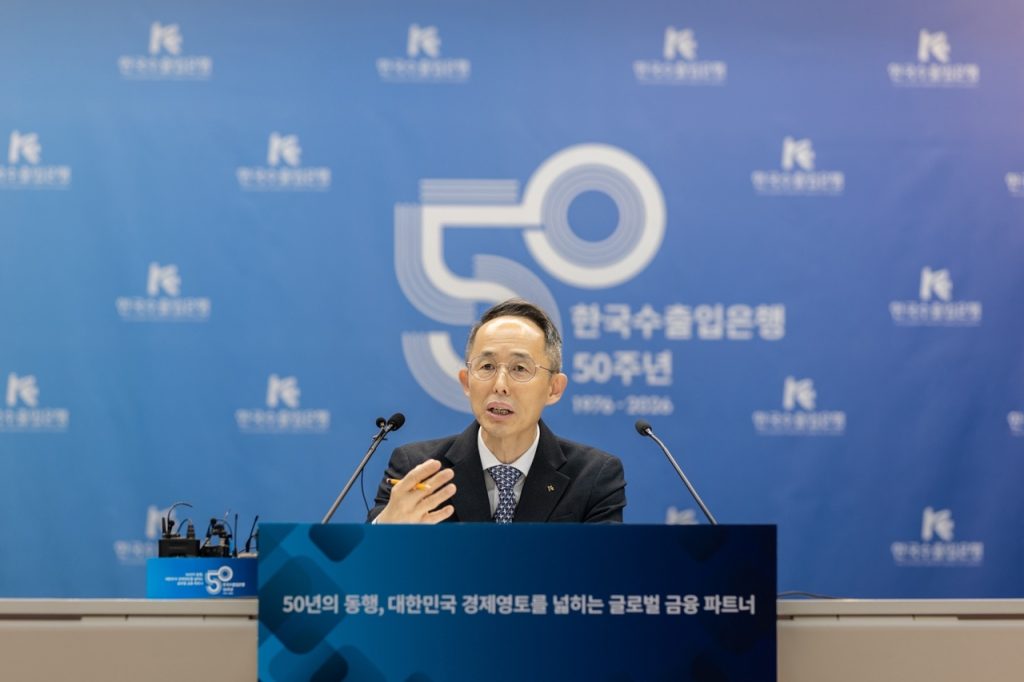
CEO Hwang Ki-yeon highlights market diversification, shared growth
The Export-Import Bank of Korea (Eximbank) provided a record 87 trillion won in financing last year, supporting South Korea’s landmark achievement of surpassing $700 billion in exports amidst ongoing trade and geopolitical uncertainties, according to CEO Hwang Ki-yeon on Wednesday.
“In the face of rapidly evolving trade dynamics and heightened technological competition, we have proactively implemented programs designed to address disruptions and bolster the competitiveness of strategic industries,” stated Hwang during his inaugural press conference since assuming office in November. He emphasized that the bank has “served as a reliable safeguard for exporters.”
Notably, 38 trillion won of the total lending was allocated to small- and medium-sized enterprises (SMEs), marking the seventh consecutive year of record support in this sector, he added.
Looking toward the future, CEO Hwang outlined Eximbank’s 2026 agenda, which will prioritize “innovative and balanced growth,” leveraging finance as a tool to combat sluggish economic growth and address widening economic inequalities.
As a core component of this strategy, the policy lender will introduce a five-year, 150 trillion won export finance package aimed at assisting companies in navigating challenging trade conditions.
“We will move beyond short-term crisis management to support a qualitative transformation of our exports, ensuring that growth is distributed more equitably across regions and industries,” he explained.
A key focus will be alleviating financial burdens on smaller exporters, particularly those located outside of the Seoul metropolitan area. In addition to offering preferential interest rates and collaborative programs with regional financial institutions, Eximbank plans to allocate 110 trillion won to SME financing over the next three years and establish a dedicated 1.3 trillion won fund specifically for regional businesses.
“Productive finance is integral to our core mission,” Hwang asserted. “Unlike commercial banks, our focus is not on household or property loans. We have consistently supported exporters through economic cycles, and we will continue to provide patient capital until emerging industries are firmly established.”
In alignment with the government’s strategic focus on sectors such as artificial intelligence (AI), semiconductors, and energy, Eximbank will allocate 22 trillion won over five years to AI-related initiatives and 50 trillion won to the semiconductor, battery, and biotechnology industries. An additional 100 trillion won will be directed towards large-scale strategic projects in defense, nuclear energy, and infrastructure, with a strong emphasis on diversifying export markets beyond Europe and the Middle East to encompass Asia and Latin America.
“In an era characterized by heightened uncertainty, market diversification is no longer optional but essential,” Hwang stressed, highlighting increasing competition between nations. “We are assisting companies in expanding into the Global South and emerging markets in Europe, providing both financial assistance and regulatory guidance.”
The state-run bank also intends to expand its direct investment activities and create venture-focused funds, following recent amendments to the legislation governing the institution. Eximbank is enhancing its investment capabilities and recruiting specialized professionals to facilitate this transition.
Hwang, approaching his 100th day in office, shared that his strategy has been shaped by visits to companies throughout the country and meetings with legislators, regulators, and staff.
“The answers are always found in the field,” he remarked. “At a time when industries are undergoing restructuring and smaller companies are facing critical decisions, they need someone who is willing to persevere alongside them.”
Commemorating its 50th anniversary, Hwang emphasized that Eximbank “will not retract the umbrella when it rains, and at times, stand in the rain with companies,” reaffirming its commitment to supporting exporters in an increasingly fragmented global economy.
jwc


