Merck is set to commence production of molybdenum, a next-generation semiconductor material, in South Korea this year. This move aims to supply local chip manufacturers as they transition from conventional metal wiring in advanced chip designs.
Molybdenum is emerging as a promising alternative to tungsten and copper in the microscopic interconnects that link transistors within semiconductors. As wiring dimensions shrink to 2-nanometer nodes and beyond, traditional materials are encountering physical limitations that hinder performance and energy efficiency.
“Customer deliveries are being prepared for this year,” stated Kim Woo-kyu, Managing Director of Merck Korea, during a press briefing held on Tuesday, ahead of Semicon Korea 2026, the nation’s premier semiconductor trade show.
While Merck refrained from disclosing specific client names, the company is a known supplier to Samsung Electronics and SK hynix. Industry sources anticipate that both companies will integrate molybdenum into their upcoming memory and logic chips.
At the atomic level, molybdenum exhibits lower electrical resistance compared to tungsten, enabling faster signal transmission with reduced power loss. Its initial application is primarily expected in 3D NAND flash memory, where vertically stacked transistors demand stable signal pathways across densely packed layers.
“Today, NAND is where the volume is largest,” Kim explained. “But logic is also a possibility, and after that, DRAM.”
Merck’s Eumseong plant, located in North Chungcheong Province, will be responsible for producing molybdenum precursors. These specialized compounds are essential for depositing ultra-thin films using chemical vapor deposition (CVD) and atomic layer deposition (ALD) techniques.
Unlike some conventional materials that can be delivered in gaseous form, molybdenum is solid at room temperature. To ensure optimal chip production, it must be maintained at a consistent temperature of 175 degrees Celsius throughout transport and delivery, preventing flow disruptions or contamination.
“This is not just about the molecule itself,” emphasized Katherine Dei Cas, Executive Vice President and Global Head of Delivery Systems and Specialty Gases at Merck Electronics. “It’s about how you deliver it, consistently and without failure, inside a fab.”
Merck combines the material with its proprietary ChemKeeper delivery system, engineered to maintain constant heat and pressure while achieving over 99 percent material utilization. According to the company, this reduces downtime and lowers the total cost of ownership for chipmakers.
The facility forms part of Merck’s 600 million euro ($714 million) Korea investment plan, announced in 2021, to expand semiconductor materials capacity and localize supply. While not all funds have been allocated, Kim affirmed that the molybdenum line is a critical component of this strategy.
Merck also manufactures molybdenum precursors in Pennsylvania, with the Eumseong site strategically positioned as its Asia supply hub.
“Our goal is to have regional production near customers while ensuring business continuity across global sites,” Dei Cas explained. “That balance is essential in today’s supply chain environment.”
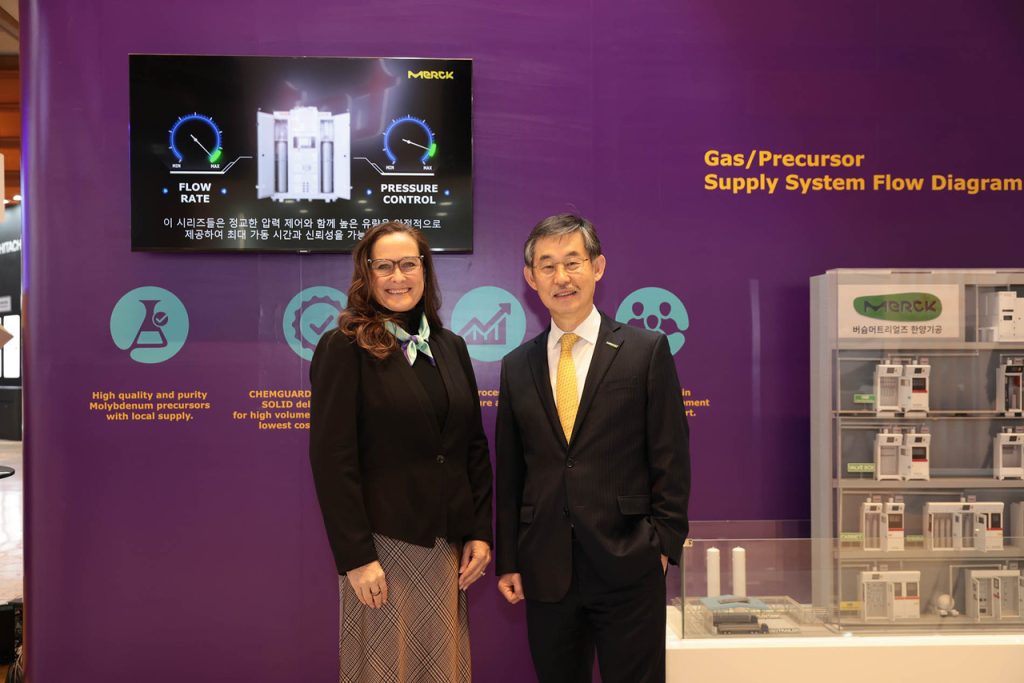
Merck is showcasing its molybdenum solution this week at Semicon Korea 2026 in Seoul.
mjh