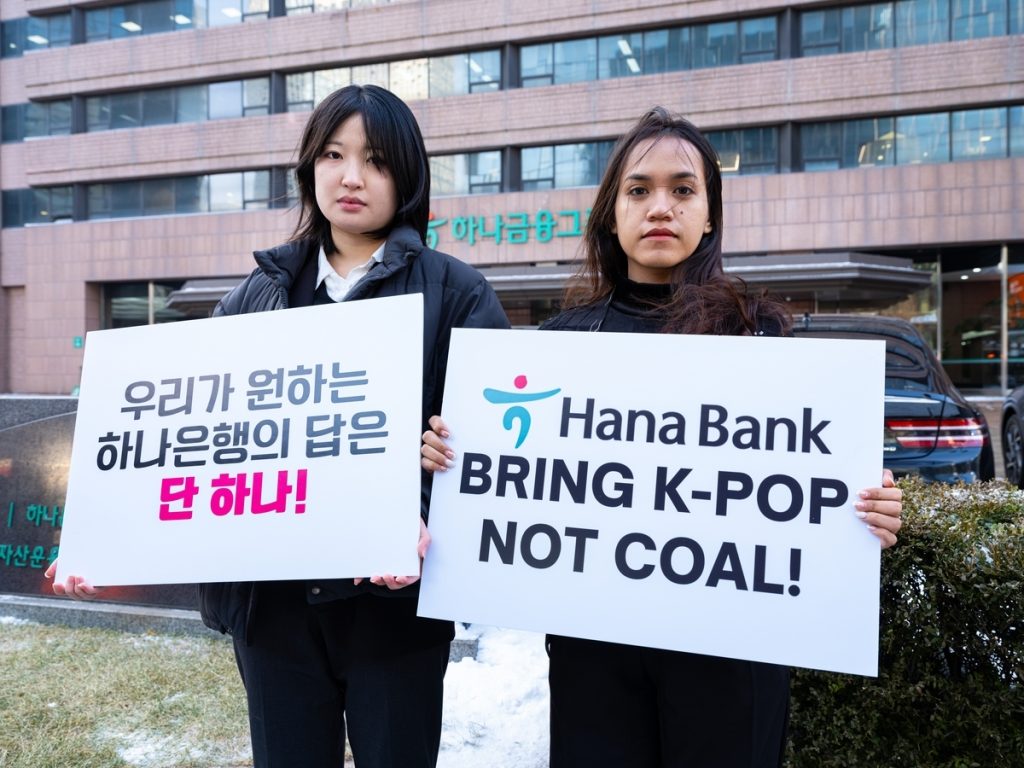
K-pop Fans Pressure Hana Bank to End Loans Tied to Coal-Fired Power in Indonesia
Indonesian K-pop fans are calling out a major South Korean bank over its financing of coal-linked industrial projects, highlighting the growing influence of fan communities as political and social forces.
Kpop4planet, a global climate advocacy platform powered by K-pop fans, is protesting Hana Bank’s overseas lending to Indonesia’s leading nickel producer, Harita Group. The organization asserts that Harita Group’s reliance on coal-fired power plants damages the environment, contradicting Hana Bank’s stated climate commitments and the positive image it cultivates through endorsements from popular K-pop stars.
Hana Bank, a prominent Korean financial institution used by many Indonesians, leverages the popularity of K-pop idols like G-Dragon and Ive’s Ahn Yu-jin to enhance its brand appeal among young users.
Representing a collective of over 280,000 followers across various social media platforms, Kpop4Planet and 12 Indonesian K-pop fan clubs have been actively running the “Hana, Bring K-pop, Not Coal” campaign since December.
Their central argument revolves around Hana Bank’s continued financial support for Harita Group’s operations on Obi Island, Indonesia, where newly constructed coal-fired power plants supply energy to the rapidly expanding nickel-processing industry.
Obi Island has undergone a rapid transformation into a significant industrial center as global demand for nickel skyrockets, driven primarily by the burgeoning electric vehicle (EV) and battery manufacturing sectors. This nickel-processing boom is heavily reliant on coal-fired power stations.
According to reports from Indonesian media and the Dutch watchdog Recourse, Hana Bank’s Indonesian subsidiary facilitated a syndicated loan amounting to $530 million in 2022 for an affiliate of the Harita Group.
These funds were allocated towards debt repayment and the construction of a new nickel smelter on Obi Island. Global Energy Monitor estimates that the existing coal plants powering these facilities already generate over 1,630 megawatts, with Harita Group planning to expand capacity to exceed 4 gigawatts.
Harita’s annual emissions currently contribute approximately 1% of Indonesia’s total emissions and are projected to nearly double by 2028.
Campaigners argue that this practice directly contradicts Hana Financial Group’s public commitment, announced in 2021, to phase out coal financing.
“The once-vibrant Obi Island now faces severe environmental devastation,” the fan groups stated in their open letter addressed to Hana Bank. “The carbon emissions and pollution stemming from the coal expansion, facilitated by Hana Bank’s financing, will disproportionately affect future generations.”
In response to the growing criticism, Hana Bank clarified to The Korea Herald that it has refrained from providing project financing for any new coal-related ventures since declaring its coal-exit policy in 2021.
The bank emphasized that its involvement in the Indonesian nickel smelter project was limited to being a minor participant in a larger syndicated loan, rather than acting as the arranger.
Hana Bank confirmed that its Indonesian subsidiary participated in a $530 million syndicated loan extended to a Harita Group affiliate in 2022, alongside DBS and UOB. However, it stated that its contribution was only $15 million and has since been fully repaid.
The bank further disclosed its participation in a $500 million refinancing round in 2024 with a $30 million commitment, of which approximately $25.5 million remains outstanding.
Hana Bank also argued that completely avoiding lending to companies that indirectly use electricity generated from coal-fired power plants is “realistically difficult,” acknowledging that this challenge is shared by many financial institutions operating in emerging markets.
Kpop4Planet campaigner Nurul Sharifah highlighted the sensitive nature of coal-fired industrial plants in regions like North Maluku, where many communities still lack reliable electricity access.
“In areas such as South Halmahera, where Obi Island is located, many residents still struggle to access electricity. Therefore, self-sustaining coal plants that do not benefit the community are a major point of contention,” she stated.
Sharifah, who traveled to Seoul to personally deliver the fans’ concerns to Hana Bank, described herself as a longtime fan of Exo’s D.O. and expressed feeling “betrayed” upon learning that a Korean bank was supporting a coal-dependent project overseas.
“We are passionate about K-pop and deeply concerned about the future our idols will inherit,” Sharifah added.
K-pop Activism
Established in 2021, Kpop4planet describes itself as a platform where K-pop fans advocate for climate justice in solidarity with communities often marginalized from environmental discussions, including young people, Indigenous groups, women, the Global South, and LGBTQ+ communities.
Scholars recognize K-pop fans as one of the most highly organized online collectives globally, renowned for their exceptional digital coordination skills.
K-pop fan communities maintain extensive communication networks across social media platforms, operate volunteer-run teams, and have a proven track record of successfully coordinating mass donations, fundraising initiatives, and impactful campaigns.
“While fandoms traditionally center around artists, they have evolved into communities with strong internal values surrounding justice, inclusion, and collective action,” explained culture critic Ha Jae-geun.
In Indonesia, where K-pop enjoys a massive youth following, fans have previously mobilized for various social causes, ranging from disaster relief efforts to promoting political transparency.
“The campaign against Hana Bank underscores how global fandoms now expect corporations endorsed by K-pop stars to demonstrate social and climate responsibility, rather than simply leveraging idol images for marketing purposes,” Ha added.
“The issue is not just environmental; it’s also about relationships. There’s a strong feeling that corporate behavior should align with the values associated with the artists they admire,” Ha said.
The Indonesian fan groups have vowed to continue their campaign until Hana Bank makes a clear commitment to ending all coal-related financing. “We will not rest until Hana Bank provides a definitive response and ceases funding for industries that rely on coal-fired power,” the group stated.
“K-pop fans are known for their unwavering solidarity and persistence.”
jychoi