By Shim Sun-ah
Busan, South Korea, is currently hosting the landmark 48th session of the UNESCO World Heritage Committee, marking a significant first for the nation since joining the UNESCO World Heritage Convention in 1988. The 10-day meeting, held at the Busan Exhibition and Convention Center, has drawn approximately 3,000 participants from 196 member states, international organizations, and nongovernmental entities, all converging to discuss the future of global heritage.
The prestigious opening ceremony saw the attendance of key international figures, including UNESCO Director-General Khaled El-Enany, Assistant Director-General for Culture Nayef Al-Fayez, and Lazare Eloundou Assomo, director of the World Heritage Center. South Korean President Lee Jae Myung delivered a powerful congratulatory address, underscoring that world heritage transcends its historical significance to serve as a unifying symbol for humanity, fostering peace and international cooperation across borders.

President Lee emphasized the profound impact of jointly preserving and remembering world heritage, stating, “The world can foster mutual respect for each other’s history and strengthen trust and solidarity within the global community.” He further highlighted South Korea’s growing influence as a cultural powerhouse, affirming the nation’s commitment to collaborating with the international community and UNESCO to build a more peaceful and prosperous future.
UNESCO Director-General El-Enany acknowledged South Korea’s impressive 17 sites on the World Heritage List, recognizing them as a vibrant reflection of the diversity of Korean history. Expressing gratitude to the South Korean government and the city of Busan, he conveyed the committee’s mission over the coming days: to “revitalize the world through the living power of culture.”
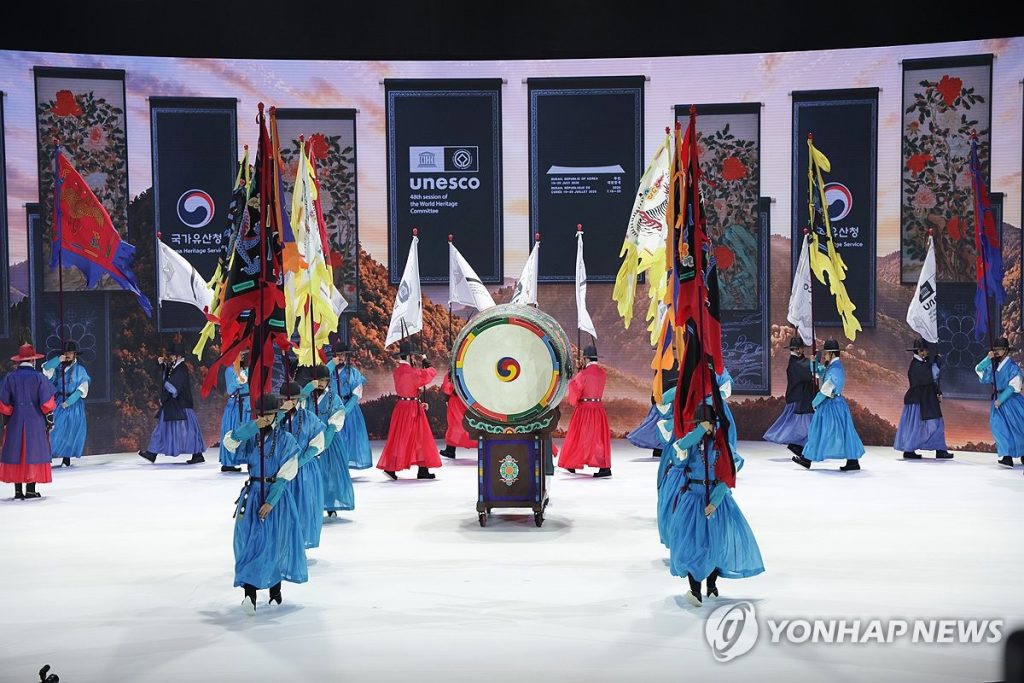
The opening ceremony itself was a spectacular showcase of Korean culture, featuring a series of performances that spanned historical traditions to modern interpretations. Highlights included a reenactment of a traditional gate-opening ceremony by royal guards of Gyeongbok Palace, alongside contemporary renditions of classic Korean dances such as “ilmu,” “taepyeongmu,” and the communal “ganggangsullae” circle dance.


Adding a contemporary touch, K-pop sensation G-Dragon, serving as an honorary ambassador for the session, delivered a poignant speech emphasizing art’s crucial role in safeguarding global heritage. He eloquently stated, “Protecting heritage is not only about preserving the past but about building peace for the future,” highlighting art’s power to inspire collective action and drive global change. Dressed in a striking white suit, he expressed his readiness to actively contribute to international endeavors to protect World Heritage sites threatened by ongoing conflicts and climate change.

As UNESCO’s primary decision-making authority for cultural and natural heritage, the committee will dedicate its plenary sessions from July 20-29 to review 33 proposals. These include 30 new nominations and three requests for extensions or modifications to existing World Heritage listings. Customary practice dictates that the host country presides over the meeting, with Lee Byong-hyun, a former South Korean ambassador to UNESCO, chairing the 48th session.
Among the key proposals is a recommended extension for South Korea’s “Getbol, Korean Tidal Flats” site, which aims to add four new coastal wetlands to the property originally inscribed in 2021. The International Union for Conservation of Nature (IUCN), the committee’s advisory body on natural heritage, has recommended approval, a decision typically endorsed by the committee.

Further discussions will focus on a draft decision concerning Japan’s adherence to follow-up measures for the Sado mine World Heritage site. The draft suggests Japan implement additional steps to accurately reflect the mine’s “whole history,” particularly regarding the wartime mobilization of Korean laborers. During Japan’s 1910-45 colonial rule of the Korean Peninsula, over 1,500 Koreans were compelled to work at the mine, which transitioned from gold production to supplying the Japanese imperial army during World War II. Despite Japan’s 2024 promise to thoroughly convey the history of forced conscription in line with UNESCO recommendations, the draft decision indicates Tokyo’s efforts remain insufficient. This draft is expected to be adopted during the 48th session unless member states raise objections; however, its enforceability within UNESCO’s framework and Japan’s compliance level remain to be fully seen.

A notable point of interest is the potential adoption of a “Busan declaration,” which proposes “collaboration” as an additional strategic objective. This would join the committee’s existing five “C” priorities for effective World Heritage Convention implementation: credibility, conservation, capacity-building, communication, and communities. According to Seoul officials, this proposed addition reflects a growing consensus within UNESCO to strengthen international cooperation to address the increasingly complex challenges facing global heritage sites, including the pressing issue of climate change.