
CXMT Unveils Ambitious DRAM Expansion Plans Amidst Persistent Technology Gaps and Domestic Market Reliance
China’s ChangXin Memory Technologies (CXMT) is making a significant move into the global DRAM market with a massive $8.5 billion initial public offering (IPO). This strategic financial maneuver aims to challenge the established dominance of industry giants Samsung Electronics, SK hynix, and Micron Technology in the competitive memory chip sector.
Scheduled for a landmark listing on Shanghai’s STAR Market on July 27, CXMT’s IPO represents the largest flotation by a Chinese chipmaker to date. This offering serves as CXMT’s global debut, positioning the company as China’s leading and the world’s fourth-largest DRAM manufacturer by capacity, even while acknowledging a comparatively smaller global market share against the top three established leaders.
Priced competitively at 8.66 yuan ($1.30) per share, the CXMT IPO is projected to raise an impressive 57.9 billion yuan, with potential for up to 66.6 billion yuan if a 15 percent overallotment option is exercised. This substantial capital infusion values ChangXin Memory Technologies at approximately $85.2 billion.
This significant capital raise, which nearly doubles the 29.5 billion yuan allocated for projects in its prospectus, is earmarked to finance rapid DRAM capacity expansion. It will also fuel CXMT’s strategic push into higher-value memory products and intensify efforts to narrow the crucial technology gap with its global semiconductor rivals.
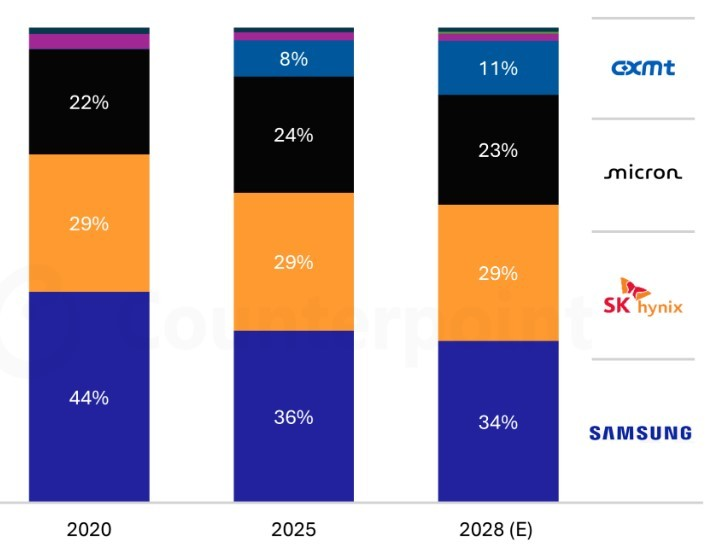
Industry analysts assert that CXMT must achieve a 15 percent share of global DRAM bit shipments to firmly establish itself among top-tier memory suppliers. This market share is deemed critical for sustaining necessary investments in advanced, next-generation DRAM technology.
This rapidly growing company currently commands approximately 9 percent of the market and is projected by Counterpoint Research to expand its share to 11 percent by 2028, signaling strong growth in the competitive DRAM sector.
Hwang Min-seong, a research director at Counterpoint, emphasizes that the 15 percent market share represents a “critical threshold CXMT must cross.” He references Taiwan’s DRAM manufacturers as a cautionary historical example: after their combined market presence dipped below this level in 2008, they faced significant challenges in financing advanced fabrication plants (fabs) and ultimately scaled back to approximately 3 percent, becoming niche suppliers.
In terms of revenue, CXMT has similarly demonstrated rapid advancement in the global DRAM sector. Its market share surged from 4.1 percent in Q1 2025 to 7.6 percent just one year later, as reported by TrendForce. For the latest quarter, Samsung Electronics maintained its lead at 38 percent, followed by SK hynix at 29 percent, and Micron at 22 percent, highlighting the competitive landscape.
The significant capital raised through the IPO will fuel a broad expansion strategy designed to sustain this impressive growth trajectory. CXMT’s ambitious plans include substantial investments in its advanced fifth-generation G5 DRAM process, 12-layer HBM3 development, and the establishment of new production facilities. Concurrently, the company aims to enhance yields for its more advanced server DDR5 and mobile LPDDR5X chips, alongside the ongoing development of next-generation DDR6 memory.
CXMT’s monthly wafer capacity is projected to significantly increase from approximately 320,000 to 420,000 by 2027. This expansion will be facilitated by new fabrication plants in key locations like Shanghai and Beijing, in addition to a substantial manufacturing cluster in Hefei. The company’s long-term vision is to double its DRAM production capacity by 2030 and triple it by 2035, while strategically pivoting towards higher-value memory products, with LPDDR5 and DDR5 anticipated to comprise about 75 percent of its total output.
Navigating CXMT’s Future: Key Risks and Opportunities in the Global Memory Market
The ongoing global memory shortage has undeniably created highly favorable market conditions for CXMT’s strategic expansion. As global DRAM prices continue to rise, CXMT has successfully capitalized on this trend, emerging as a major supplier of essential commodity DRAM chips like DDR4 and LPDDR4. These are segments that industry leaders have progressively deprioritized to concentrate on more lucrative, higher-margin memory solutions such as High-Bandwidth Memory (HBMs).
Competitive pricing presents another significant advantage for CXMT. Its DRAM chips are estimated to be 5 to 10 percent more affordable than those offered by Samsung, SK hynix, and Micron, making them potentially highly attractive to a broader range of buyers, especially as global memory supplies become constrained. Notably, Apple, one of the world’s largest consumers of memory, is reportedly navigating regulatory complexities with Washington while exploring the integration of CXMT chips into its devices designated for sale exclusively within the Chinese market.
Despite these opportunities, CXMT still faces considerable hurdles in directly challenging the established and entrenched “Big Three” dominant players in the global DRAM industry.
A primary concern is CXMT’s technology gap, which is broadly estimated at two to three years behind the market leaders. While CXMT commenced mass production of advanced LPDDR5 and DDR5 memory chips only late last year, these products have been long-established offerings from the three leading manufacturers. Furthermore, CXMT’s production yields for these advanced nodes are currently considered unstable.
This technology disparity is even more pronounced in the critical segment of high-bandwidth memory (HBM), a key AI chip component that significantly drives profitability for Samsung, SK hynix, and Micron. While these market leaders have already introduced sixth-generation HBM4 and are progressing with sampling for HBM4E, CXMT is still in the earlier development stages for fourth-generation HBM3 and anticipates mass production of HBM3E only by next year.
CXMT exhibits a heavy reliance on domestic Chinese sales, with overseas sales contributing a mere 2.79 percent to its total revenue. The company’s largest and most significant customers — including major players like Alibaba Cloud, ByteDance, Xiaomi, and Honor — are overwhelmingly Chinese, with the top five accounts generating approximately two-thirds of CXMT’s core business revenue.
The notable surge in CXMT’s server DRAM sales, which climbed sharply from 8.39 percent of revenue in 2024 to 26.51 percent last year, appears predominantly driven by China’s aggressive domestic AI infrastructure localization initiatives rather than widespread global market adoption.
Furthermore, restricted access to cutting-edge advanced lithography equipment presents another significant long-term obstacle for CXMT’s global ambitions. In response, CXMT is actively accelerating the development of innovative alternative technologies, such as vertical channel transistors and advanced wafer-on-wafer bonding.
“Ironically, the very restrictions imposed on CXMT could inadvertently foster an unprecedented opportunity for the company to leapfrog established incumbents,” commented Neil Shah, vice president at Counterpoint Research. He elaborated that established suppliers often exhibit slower adoption rates for new architectures due to their focus on maximizing returns from existing, costly equipment investments.
“By strategically navigating the constraints of export controls, CXMT has the potential to transform these challenges into a powerful catalyst for rapidly narrowing the technology gap and potentially disrupting its global rivals,” Shah concluded.


