
South Korea’s Cash-Based Leveraged ETFs: Debating Market Volatility Amplification Versus Hong Kong’s Swap Model
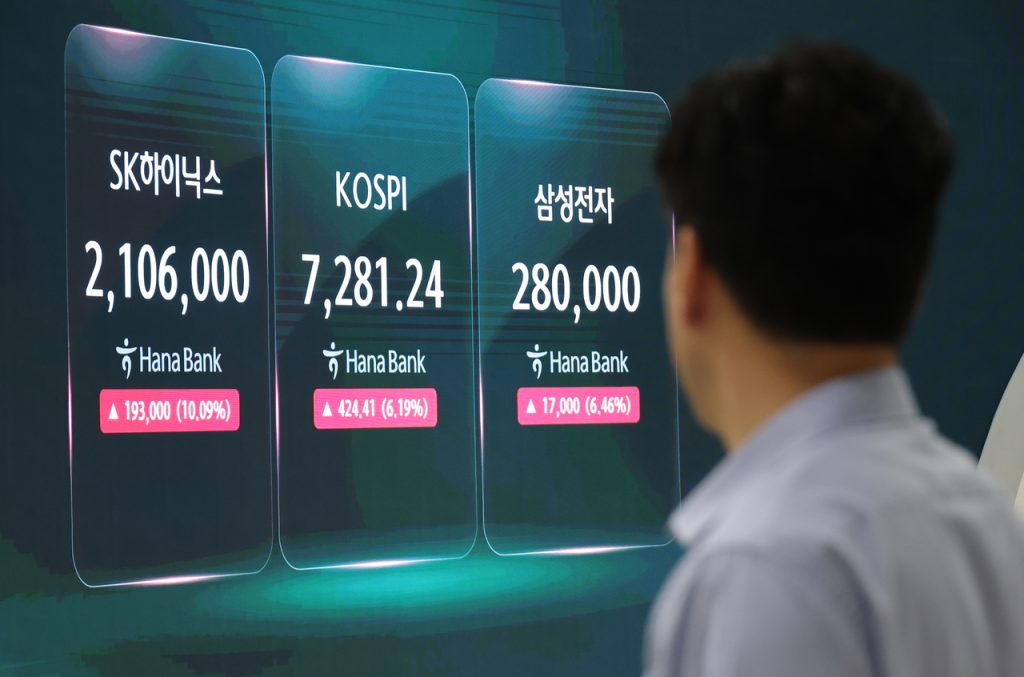
A significant surge in trading volume for South Korea’s single-stock leveraged exchange-traded funds (ETFs), particularly those tracking semiconductor giants Samsung Electronics and SK hynix, is sparking growing concerns. Market analysts are questioning whether these high-volume products are merely reflecting market movements or actively contributing to amplified price swings in the nation’s two largest chip stocks – and by extension, the broader Kospi index.
Remarkably, on certain trading days, the turnover for leveraged ETFs linked to SK hynix has escalated to as much as 65 percent of the trading volume in its underlying stock. This unusually elevated ratio, according to experts, can substantially magnify short-term market volatility due to the funds’ inherent daily rebalancing requirements.
These concerns extend beyond just the two prominent chipmakers.
Given that Samsung Electronics and SK hynix command a substantial portion of the Kospi’s overall market capitalization and daily trading activity, the intense buying and selling pressure generated by leveraged ETFs can easily reverberate across the wider South Korean equity market during periods of heightened volatility.
Some market participants suggest that these unique supply-and-demand dynamics played a role in Samsung Electronics’ recent share price underperformance, even in the face of stronger-than-expected earnings reports. This phenomenon might also explain the expanding valuation gap observed between SK hynix’s shares listed in Seoul and its recently introduced US American Depositary Receipts (ADRs).
On a recent Monday, which saw a market-wide circuit breaker temporarily halt Kospi trading, the cumulative turnover in SK hynix leveraged ETFs since their inception represented 29 percent of the underlying stock’s trading volume. More recently, the daily turnover ratio surged to 65 percent.
Similarly, Samsung Electronics’ leveraged ETFs have registered a cumulative turnover ratio of 19.6 percent, with daily turnover frequently exceeding 27 percent of its underlying shares.
In stark contrast, the Direxion Daily TSLA Bull 2X Shares, a comparable product, typically accounts for only 5 to 8 percent of the daily trading volume in Tesla shares.
“Single-stock leveraged ETFs are acting as a significant catalyst within South Korea’s supply-and-demand landscape, directly influencing market dynamics,” observed Kim Seok-hwan, a respected analyst at Mirae Asset Securities.
Understanding How Leveraged ETFs Amplify Market Volatility
Unlike traditional exchange-traded funds, leveraged ETFs are mandated to rebalance their portfolios at the close of every trading day to consistently maintain their specified target return. This daily rebalancing mechanism is crucial for their operation.
To reliably deliver, for instance, twice the daily return of their underlying stock, these funds strategically increase their market exposure by purchasing additional shares or futures contracts after price gains. Conversely, they actively reduce exposure by selling assets following price declines. This constant adjustment process is fundamental to their design.
This particular mechanism, widely recognized in financial markets as “short gamma,” generally does not predetermine the long-term direction of a stock’s price movement. Instead, analysts concur that it can significantly amplify existing price swings by introducing additional buying pressure during upward rallies and intensifying selling pressure during market downturns, thus exacerbating short-term volatility.
In South Korea, these critical rebalancing trades are typically executed directly within the cash and futures markets throughout the trading session or immediately prior to the market close. As the trading activity in these leveraged ETFs expands, the resultant buy and sell orders become progressively larger, thereby increasing their direct influence on the supply and demand dynamics of the underlying shares.
Analysts further emphasize that the actual market impact depends less on the total asset under management (AUM) of an ETF and more on the daily trading volume generated through investor subscriptions, redemptions, and, most importantly, the mandatory rebalancing activities.
Why the Structural Difference with Hong Kong Markets?
South Korea initially introduced single-stock leveraged ETFs with the strategic aim of repatriating trading demand that had previously gravitated towards Hong Kong-listed products tracking Samsung Electronics and SK hynix. The objective was to offer a domestic alternative and boost local market liquidity.
However, the domestic products utilize a distinct structural approach. The Korea Exchange (KRX) permits these ETFs to gain market exposure primarily through direct cash equities and futures contracts. In contrast, Hong Kong-listed leveraged products often leverage total return swaps (TRS) and various options for their exposure management.
The decision to implement cash- and futures-based structures in Korea was primarily driven by the goal of lowering investment costs for local investors, thereby enhancing the competitive edge of Korean products against their Hong Kong-listed counterparts. Yet, this very structure is now under intense scrutiny because it necessitates daily rebalancing of exposure by asset managers to maintain the targeted leverage, potentially adding direct buying and selling pressure onto the underlying shares in the spot market.
Trading volumes in both markets remain exceptionally substantial. According to data from Hong Kong Exchanges and Clearing (HKEX), Hong Kong-based CSOP Asset Management’s leveraged ETFs, tracking SK hynix and Samsung Electronics, recorded a cumulative turnover of HK$344.9 billion (approximately $44 billion USD) and HK$40.9 billion, respectively, during the seven weeks following Korea’s launch of its domestic products on May 27. On a single Tuesday alone, the SK hynix and Samsung Electronics products traded at HK$26.5 billion and HK$3.45 billion.
Over the exact same period, Korea-listed leveraged ETFs reported a cumulative turnover of 231 trillion won (approximately $159 billion USD) for SK hynix and 113 trillion won for Samsung Electronics. Daily turnover figures for a recent Tuesday reached 9.2 trillion won and 2.8 trillion won, respectively.
Certain market participants contend that these fundamental structural differences help clarify why Hong Kong-listed products, despite their immense trading volumes, have demonstrated a more limited visible impact on the Kospi index.
“The product structure itself constitutes one of the primary reasons for this noticeable difference,” commented a senior official within the ETF industry. “The KRX exclusively permits cash- or futures-based structures, whereas Hong Kong-listed leveraged ETFs have the flexibility to utilize total return swaps for their hedging strategies.”
“Since a TRS agreement does not mandate the ETF itself to directly trade the underlying shares on a daily basis, the rebalancing pressure exerted on the cash market is significantly reduced. When combined with the inherent time difference between the Hong Kong and Korean markets, these products are generally less likely to exert a meaningful direct impact on Korea’s cash market during its regular trading hours.”
CSOP, recognized as the world’s largest operator of leveraged ETFs linked to Samsung Electronics and SK hynix, predominantly relies on extensive swap agreements with major global investment banks such as Goldman Sachs and Morgan Stanley. These prominent banks effectively manage the intricate hedge exposure, with a significant portion of the portfolio adjustment processes occurring after the Korean market has officially closed.
“Given both the time difference and the specific structure of our fund, its impact on intraday trading within South Korea’s market remains quite limited,” stated a CSOP official.
Regulators: TRS Is Not a Free Pass for Market Impact
Korean financial regulators and domestic asset managers, however, caution against overstating these structural differences, asserting that the distinction should not be exaggerated. Although the ETF itself may not directly engage in trading the underlying shares, the essential task of hedging the exposure still falls to someone.
“TRS merely signifies that the asset manager delegates the crucial hedging responsibility to a securities firm, rather than executing the trades directly,” an industry official clarified.
“Regardless of the specific product structure employed, ultimately, some entity must trade the underlying shares or futures contracts to consistently deliver the promised daily return, such as twice the underlying asset’s performance.”
The official further explained that while the time difference might distribute trading activities across varying hours and potentially mitigate immediate market impact, it fundamentally does not eliminate the necessity for these critical hedging trades themselves.
Officials from the Financial Services Commission (FSC) largely share this perspective.
“It is difficult to definitively conclude that TRS-based products have absolutely no market impact solely based on their structural design,” an FSC official stated.
“Since hedging trades are an inherent and ultimate component of the swap process, we intend to gather further expert opinions from various research institutions and active industry participants to gain a comprehensive understanding.”
The official also emphasized that regulating only Korean domestic products would not comprehensively address the issue, especially as an increasing number of overseas-listed leveraged ETFs tied to Korean stocks continue to enter the global market.
Anticipation of More Overseas Products and Market Evolution
The ongoing debate surrounding the market impact of leveraged ETFs is expected to gain further intensity, particularly following SK hynix’s recent successful US ADR listing. This development opens new avenues for derivative products.
Prominent US ETF issuers, including Leverage Shares, GraniteShares, and ProShares, are actively preparing to launch new leveraged ETFs specifically linked to the SK hynix ADR. This influx of new products could potentially extend the realm of price discovery for SK hynix beyond traditional Korean trading hours, impacting global markets.
Analysts consistently maintain that the long-term trajectory of SK hynix shares will continue to be primarily dictated by global semiconductor demand trends and the company’s fundamental corporate earnings performance.
Nevertheless, the short-term market impact is likely to be significantly influenced by factors such as investor inflows into these products, the daily rebalancing volumes generated, and the sophisticated hedging activities undertaken by swap counterparties.
Industry officials also issued a word of caution, advising against solely attributing recent market volatility to leveraged ETFs alone.
“The perspective that single-stock leveraged ETFs are the exclusive or primary cause of recent market volatility tends to oversimplify a complex causal relationship,” an industry official noted.
“The fundamental drivers of this volatility are rooted in the inherently high volatility of the semiconductor sector itself, coupled with the concentrated domestic investment capital predominantly flowing into these key semiconductor stocks.”
The official concluded by suggesting that the more effective, longer-term solution does not lie merely in restricting leveraged ETFs. Instead, it involves actively broadening investment opportunities across the South Korean market, moving beyond a concentrated focus on a handful of dominant semiconductor stocks.
ch0221


