Gwangju Semiconductor Cluster: Fast-Track Potential Meets Major Hurdles at Former Military Base
South Korea is poised to establish a major **semiconductor cluster in Gwangju**, strategically utilizing a vast state-owned former military air base. This ambitious project aims to significantly accelerate **chip production infrastructure development** compared to conventional sites.
However, realizing this speed advantage hinges on critical next steps: the successful **relocation of the active military air base** and progress in negotiations with Muan, South Jeolla Province, identified as the preliminary relocation site for this **Honam semiconductor hub**.
This week, the government officially designated the 8.26 million-square-meter site as a cornerstone for the **Honam semiconductor cluster**. This strategic move will facilitate the construction of four new fabrication plants (fabs) by industry giants **Samsung Electronics and SK hynix**, marking a significant expansion of **South Korea’s chip manufacturing capabilities** beyond the capital region.
The site’s inherent advantages are clear. Its extensive area is ideal for accommodating the planned **semiconductor fabrication facilities**, and its flat, airport-grade terrain promises to streamline initial site preparation, as noted by presidential chief of staff Kang Hoon-sik. Furthermore, its predominantly state-owned nature is expected to mitigate potential delays often associated with land acquisition, compensation issues, and fragmented ownership in major industrial projects.
This accelerated timeline is crucial for **global chipmakers** striving to meet escalating demand for **AI memory solutions**. Typically, substantial **fab construction projects** face multi-year development cycles, encompassing permitting, power and water infrastructure, equipment installation, and testing. For instance, SK hynix’s Yongin cluster required six years from its 2019 announcement to break ground.
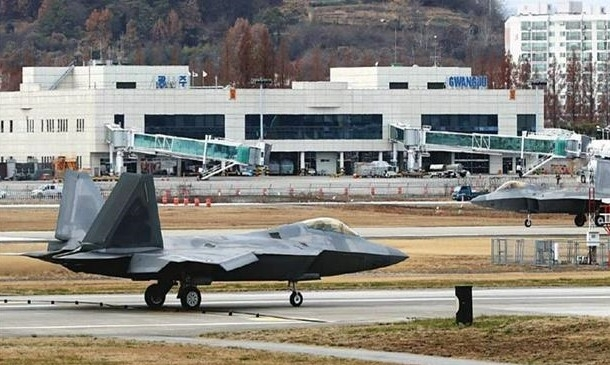
However, the proposed **Gwangju semiconductor site** is not yet industrially operational. It currently houses the Air Force’s 1st Fighter Wing and falls under both military facility protection and flight safety zone designations. Consequently, full-scale **semiconductor fab construction** can only commence once military operations are relocated and all associated restrictions are lifted.
The Defense Ministry has identified Mangun-myeon, Muan, as the preliminary **air base relocation site**. However, the definitive decision is pending designation procedures, comprehensive support plans, and a local referendum. While the government targets confirming the relocation site within the current year, negotiations with Muan are anticipated to be complex.
Muan’s demands include the prior transfer of Gwangju’s civilian airport to Muan International Airport, advancement in Gwangju-South Jeolla administrative integration, approximately 1 trillion won in government funding, and broader national incentives. Industry stakeholders express apprehension that unresolved issues could foster local opposition, potentially delaying the crucial **military base relocation**.
The relocation framework is designed around a ‘donation-for-transfer’ model, where the local government constructs a new military airport and transfers it to the state, receiving the existing **Gwangju military airport site** for redevelopment in return.
Gwangju City argues that this model is inadequate for a project of such magnitude, estimating a new airport cost of roughly 10 trillion won. Under the existing framework, they project the entire relocation and **site redevelopment for the semiconductor cluster** could exceed a decade. The city advocates for revisions to the special law governing military airport relocation, seeking enhanced central government funding and a streamlined process.
Reports indicate the government is exploring measures to accelerate the **Gwangju cluster project**, including easing military facility restrictions and evaluating temporary relocation options for the 1st Fighter Wing.
Beyond relocation, the site presents additional **infrastructure and regulatory challenges**. Its proximity to the Yeongsan River necessitates stringent environmental reviews concerning industrial water treatment. Furthermore, its location near Sangmu-gu and Gwangju Songjeong Station may require significant road infrastructure expansion, contingent on thorough traffic impact assessments for the **new chip manufacturing hub**.
**Reliable power supply** represents another formidable undertaking. Powering all four projected **semiconductor fabs** will demand approximately 6.3 gigawatts of electricity, making the construction of additional 345-kilovolt substations and transmission lines indispensable. Such substantial grid expansion is time-intensive and requires considerable local consensus.
A regional industry official commented, “The **Gwangju military airport site** was chosen as the optimal location for its potential speed, strategic position, and infrastructure advantages. However, the ultimate success of this **semiconductor manufacturing cluster** will largely be determined by the swift resolution of crucial outstanding issues, including **power grid expansion**, **airport relocation**, and comprehensive environmental and traffic impact assessments.”