
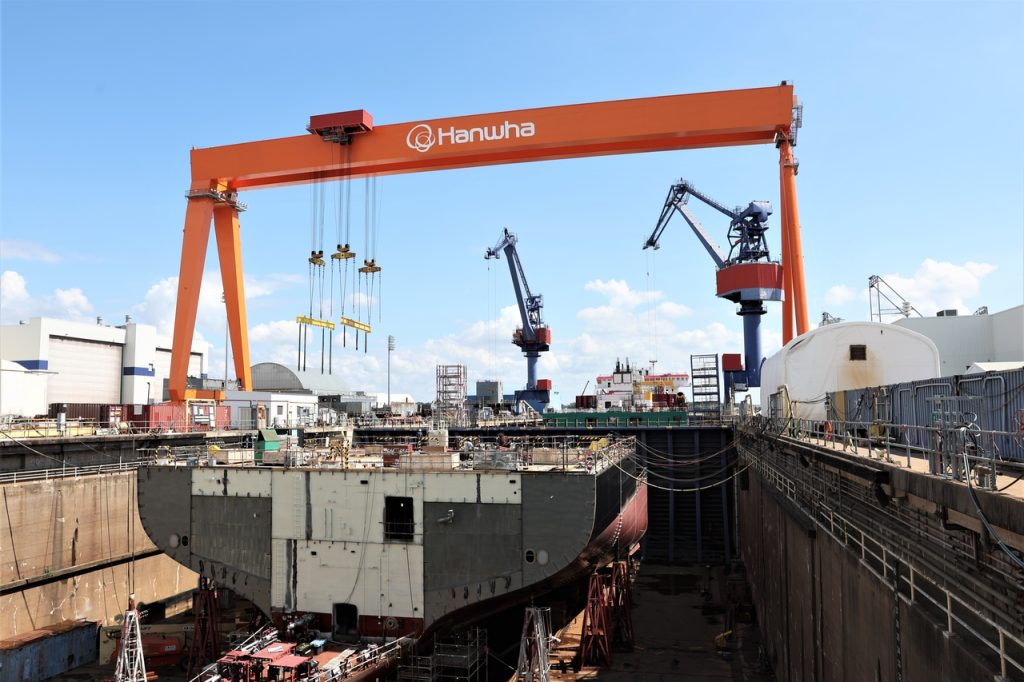
US Deepens Naval Cooperation with South Korea: First Formal Outreach to Shipbuilders Since MASGA
The United States has formally engaged with leading **South Korean shipbuilders**, signaling its intent to significantly deepen **naval shipbuilding cooperation** with Seoul under the “Make American Shipbuilding Great Again” (MASGA) initiative. This outreach aims to evaluate the **Korean shipbuilders’** advanced capabilities in **naval vessel design and construction**, a crucial step towards bolstering US maritime power.
**Defense industry sources** reveal that the Pentagon and the **US Navy** recently issued **Requests for Information (RFIs)** to prominent **Korean shipbuilders**, **HD Hyundai Heavy Industries** and **Hanwha Ocean**, specifically concerning **combat vessels**. Both companies promptly responded last month, detailing their expertise in **destroyer design and construction**, highlighting their robust capabilities.
In a related development, **HD Hyundai Heavy Industries**, **Hanwha Ocean**, and **Samsung Heavy Industries** collectively submitted responses to a distinct RFI focused on **medium-sized oilers**, further demonstrating the breadth of **South Korea’s shipbuilding prowess**.
These comprehensive RFI submissions from the three **South Korean shipbuilding giants** — HD Hyundai, Hanwha Ocean, and Samsung Heavy Industries — encompassed detailed information on their extensive **shipyard capabilities**. This included their impressive **construction records**, highly skilled **design personnel and engineering expertise**, and their considerable **annual shipbuilding capacity**, providing the US with a thorough assessment.
While **Hanwha Ocean** officially confirmed its participation in the RFI process, **HD Hyundai Heavy Industries** and **Samsung Heavy Industries** opted not to comment on their submissions.
An **RFI** serves as a critical preliminary step in the **US government’s procurement process**, preceding a formal tender. It enables the **United States** to meticulously evaluate various aspects of potential **shipbuilders**, including their **technical capabilities**, competitive **pricing**, project **feasibility**, and proposed **delivery timelines** for **US naval vessels**.
Although the **RFI stage** is non-binding and distinct from a formal tender, **defense industry officials** view this outreach as a significant step forward. It marks the inaugural instance of the **US government** engaging **Korean shipyards** via an RFI since the establishment of the **Korea-US shipbuilding partnership** under the “Make American Shipbuilding Great Again” (MASGA) initiative, which commenced in August of last year.
**Industry experts** suggest that the RFI responses likely also incorporated comprehensive details regarding the **South Korean shipbuilders’ ongoing cooperation projects within the United States**, further underscoring their commitment to the partnership.
These existing collaborations are substantial. **Hanwha Ocean** notably acquired **Philly Shipyard in Pennsylvania** for $100 million in December 2024, and is currently navigating licensing procedures to enable **combat ship construction in the US**. Meanwhile, **HD Hyundai** has forged a strategic partnership with **Huntington Ingalls Industries**, America’s largest **military shipbuilder**, to collaboratively develop the **US Navy’s next-generation fleet auxiliary ships**. Similarly, **Samsung Heavy Industries** has allied with **General Dynamics NASSCO** for both **US Navy shipbuilding** and various **commercial maritime projects**, demonstrating a broad spectrum of **US-Korea shipbuilding ventures**.
The timing of this **RFI process** is particularly noteworthy, following recent discussions initiated by **US President Donald Trump** concerning the possibility of **South Korea building US warships**. During their meeting on the sidelines of the G7 summit last month, President Lee Jae Myung reportedly confirmed that President Trump inquired about **South Korea’s capability to rapidly construct 10 US naval vessels**, highlighting the urgency and strategic importance of such cooperation.
As part of the broader **MASGA initiative**, Seoul committed last year to a significant **$150 billion investment** aimed at revitalizing the **US shipbuilding industry**. This commitment forms a key component of South Korea’s extensive **$350 billion investment package** directed towards the United States.
Despite growing cooperation, significant **regulatory hurdles** persist. The **Byrnes-Tollefson Amendment** currently imposes stringent restrictions on the **construction of US naval vessels at foreign shipyards**, effectively limiting the building of **US Navy ships** to within the United States.
**Industry observers** speculate that this recent **RFI** may represent an initial effort by the **United States** to explore potential avenues for easing or circumventing these existing restrictions, paving the way for expanded international collaboration in **naval shipbuilding**.
The **US Navy** is under increasing pressure to rapidly **expand and modernize its fleet**, particularly in response to China’s formidable and accelerating **naval expansion**. Last year, the **US Navy** unveiled ambitious plans to grow its fleet from 295 vessels at the close of 2024 to 381 by 2054, a strategic imperative to significantly **strengthen its maritime power** and maintain global naval superiority.
Achieving this ambitious target necessitates the acquisition of approximately **364 new naval vessels** over the next three decades, translating to an average of about **12 ships annually**. Such an undertaking would demand an estimated **annual shipbuilding budget of $40.1 billion** through 2054, culminating in a projected total expenditure nearing **$1 trillion**, underscoring the immense scale of this **naval modernization effort**.
sahn


