KASA Administrator Reveals Concrete Artemis Talks, South Korea Aims to Boost Domestic Launch Capabilities
SACHEON, South Gyeongsang Province — The Korea AeroSpace Administration (KASA) is actively pursuing a significant role for South Korea in future lunar infrastructure initiatives with NASA, while simultaneously striving to lessen its dependence on international launch providers amid increasing global competition for rocket slots.
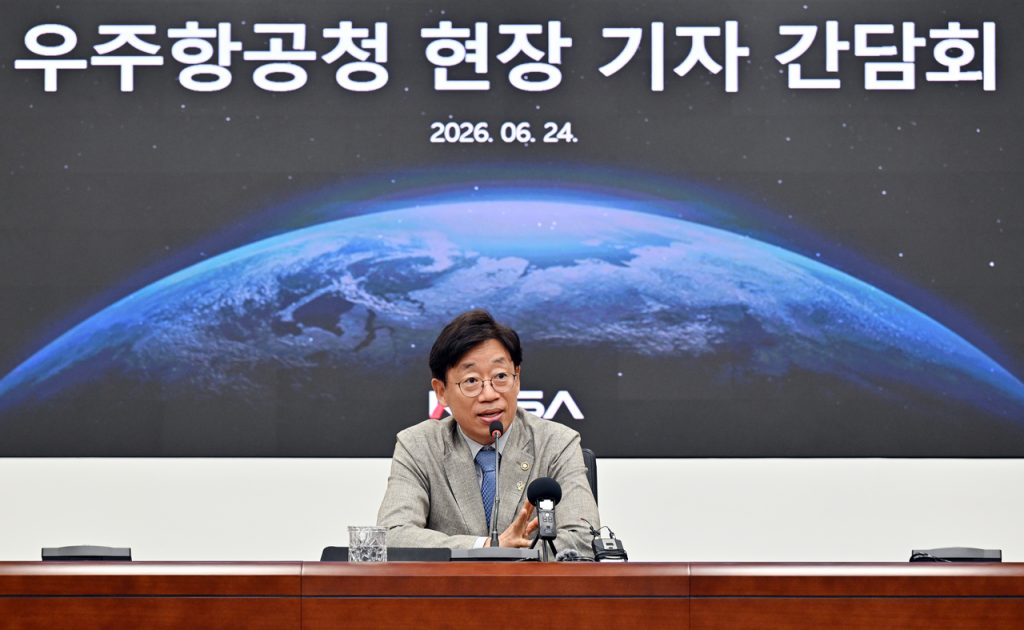
Oh Tae-seog, Administrator of KASA, announced on Wednesday that discussions with the U.S. space agency, NASA, are progressing into more specific and tangible areas as the Artemis program advances its plans for a sustained human presence on the Moon.
“Our collaboration with NASA builds upon prior extensive discussions,” Oh stated during a press briefing at KASA’s headquarters in Sacheon, South Gyeongsang Province. “Critical aspects such as communications, mobility systems, and related technologies are paramount for NASA’s forthcoming lunar base development.”
NASA’s ambitious Artemis program is designed to establish a long-term human presence on the Moon, with a permanent lunar outpost envisioned by the 2030s. Administrator Oh emphasized that South Korea is uniquely positioned to contribute by integrating its robust manufacturing and advanced industrial sectors—including automotive, battery, semiconductor, telecommunications, and robotics—with future space infrastructure demands.
“By aligning Korea’s formidable industrial competitiveness with the evolving needs of space exploration, we can offer distinctive contributions that others may not be able to provide,” he affirmed.
Oh elaborated that a future lunar base would necessitate many fundamental systems found on Earth, but engineered to endure significantly harsher environmental conditions.
“For human habitation, shelter will be indispensable. Reliable power generation will be essential. Life-support mechanisms and robust communication networks will also be critical,” Oh explained, adding that advanced robotics and unmanned autonomous systems would play a vital role, as humans would not be able to “perform construction tasks on the Moon in the same manner as workers on Earth.”
KASA is set to host a pivotal KASA-NASA Artemis workshop in Korea from July 29 to 31. Approximately ten high-ranking NASA officials, including key personnel involved in lunar base construction and operations, are expected to attend. The two agencies are slated to deliberate on potential Korean participation in vital lunar communications, power generation, and mobility systems, areas that have been under joint consultation for the past year.
Administrator Oh indicated that these discussions have evolved beyond general cooperation into precise areas ripe for inclusion in NASA’s programs, though he refrained from disclosing specific details as inter-governmental negotiations are still ongoing.
Furthermore, Korea is preparing to deploy its lunar space environment monitor, LUSEM, on an Artemis-related mission scheduled for later this year. This crucial payload is anticipated to launch aboard Intuitive Machines’ IM-3 lunar lander, propelled by SpaceX’s Falcon 9 rocket.
These intensive NASA talks coincide with KASA’s critical efforts to secure dependable access to launch vehicles, a challenge starkly highlighted by repeated delays affecting Arirang 6, Korea’s multipurpose satellite also known as KOMPSAT-6.
The 370 billion-won ($255 million) satellite, fully assembled in 2022, was initially slated for a Russian launch that same year. Seoul subsequently shifted its plans to Arianespace in 2023 after Russia’s invasion of Ukraine disrupted the original schedule. Its most recent launch timetable, initially set for the second half of this year via Arianespace’s Vega C rocket, has now been postponed to the second quarter of 2027 due to unforeseen delays involving a foreign co-passenger satellite.
“Canceling the existing contract would necessitate immediately securing an alternative launch provider, which is simply not feasible given current global market conditions,” Oh stated. “Following a comprehensive review of various strategic options, rescheduling the launch to the second quarter of 2027 emerged as the most viable choice.”
He underscored that this delay reflects a wider, systemic constraint in global launch availability. “I have been informed that even securing a launch slot with SpaceX is exceptionally challenging, and it is exceedingly difficult to obtain one within a three-year timeframe,” Oh revealed.
To fortify its domestic space access capabilities, KASA launched a public call on Monday for candidate sites for a second national space center. The agency aims to select the final location in October. This new state-of-the-art facility is projected to support next-generation launch infrastructure, including advanced reusable launch vehicles, by the mid-2030s.
The administration is also actively working to establish a more consistent and frequent launch cadence for Nuri, South Korea’s indigenous rocket. “Achieving commercial launch services cannot be realized with merely one launch per year,” Oh asserted. “We are committed to transitioning towards a robust launch service model.”
yeeun